
Running an HVAC business with Odoo
How do I invoice job time and materials in Odoo?
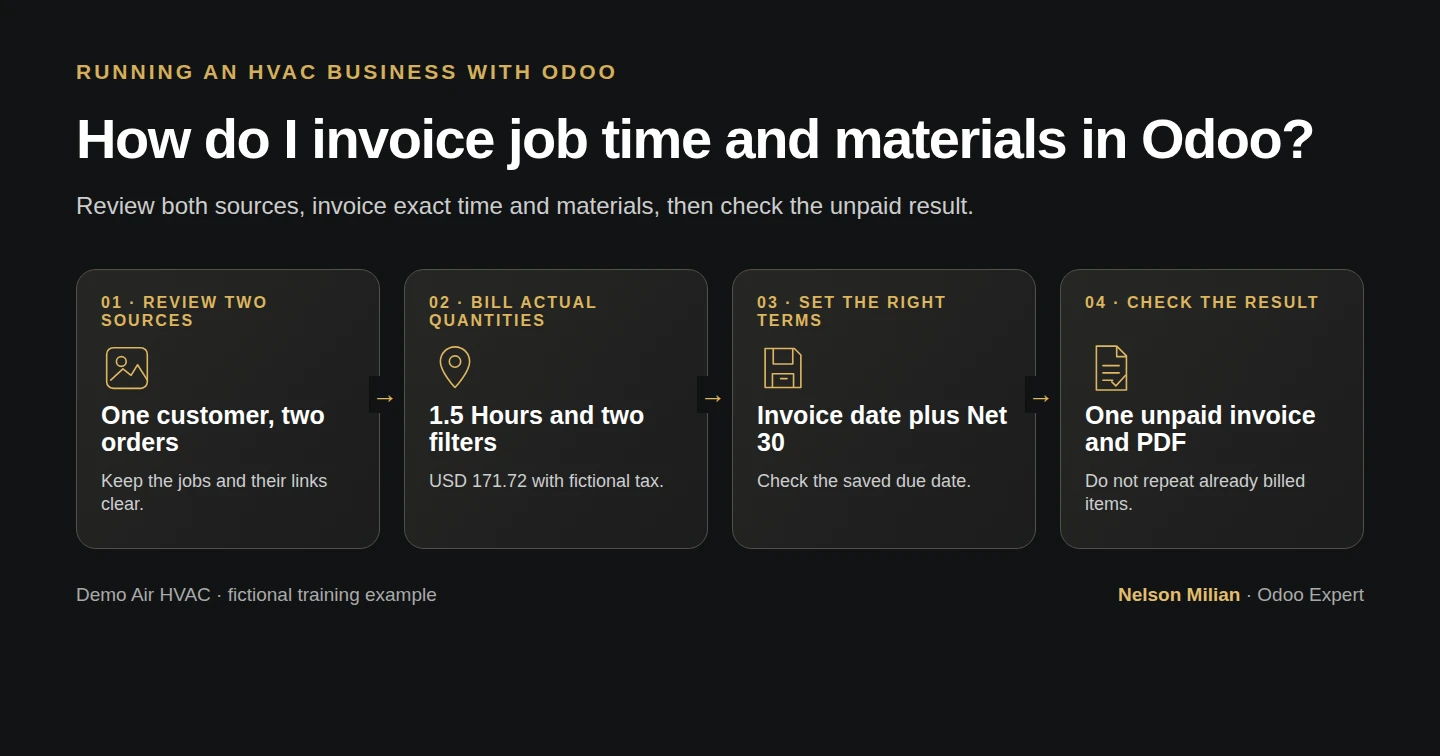
Create one Odoo invoice from reviewed technician time and delivered materials, verify its order links, Net 30 due date, posted balance and duplicate stop.
Alex wants one customer invoice that agrees with the time and materials records. This example completes the existing reviewed parts delivery, combines its amended order with the separate hourly order and verifies one posted invoice for $171.72. The invoice retains the exact source lines; it does not bill the unused half-hour of the estimate.
Alex Rivera and Demo Air HVAC are fictional training examples. Prices, dates, quantities and business situations in this guide are illustrative.
Before you begin
Tested in stock Odoo 20.0-20260926 Community as the demo owner administrator, with official modules and standard configuration. Complete the review in the reviewed job closeout, US invoicing setup, the the agreed order amendment and the saved payment term. Reuse the existing parts backorder. S00007 now orders two filters at $21 each; S00008 has one eligible 1.5-hour entry at $80 per Hour. Both use Demo Property H08, Billing Office H08, Service Site H08, the same company and USD. This lesson deliberately combines two reviewed orders for one customer; it does not assume Project automatically links their materials. The fictional invoice uses the saved Demo Net 30 H06 term. All prices, 6% demo tax, agreement and delivery/work records are synthetic. Select the actual commercial terms and tax treatment for your business.
Step-by-step workflow
Complete the reviewed delivery, combine the two eligible orders, check the exact time and materials, and post one unpaid invoice. The native PDF and refused duplicate attempt are checked; payment and sending the invoice remain separate.
Step 1. Complete the existing reviewed parts backorder
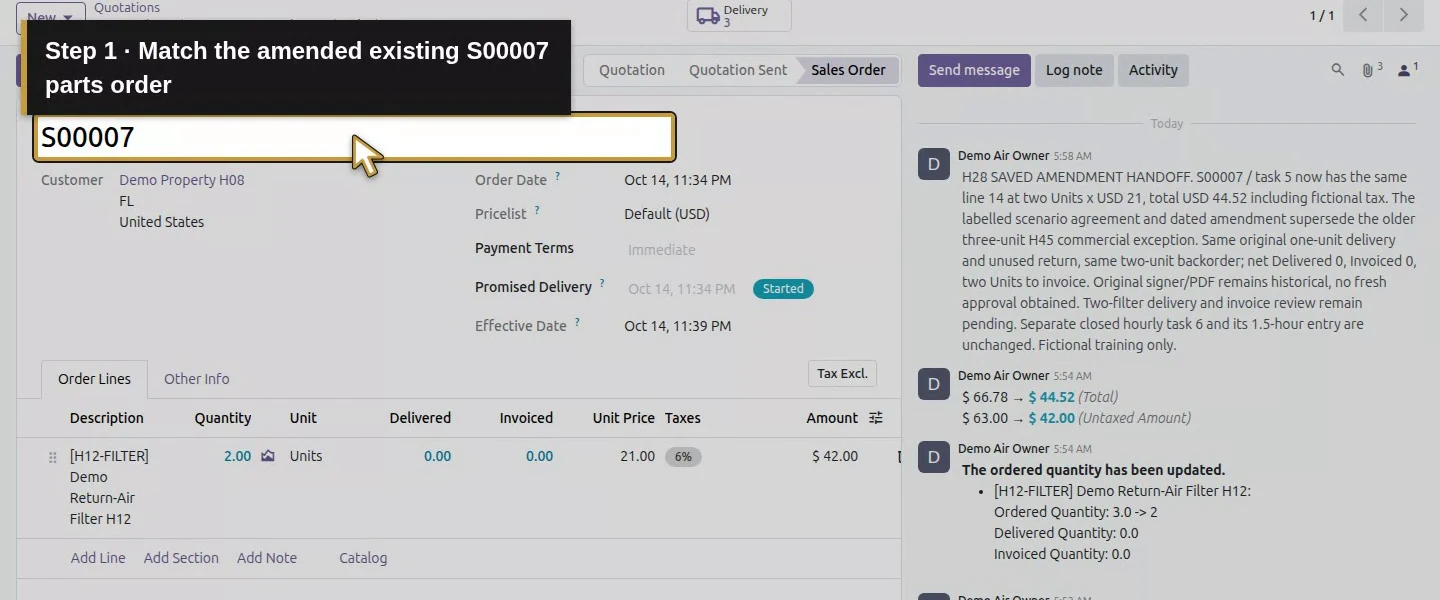
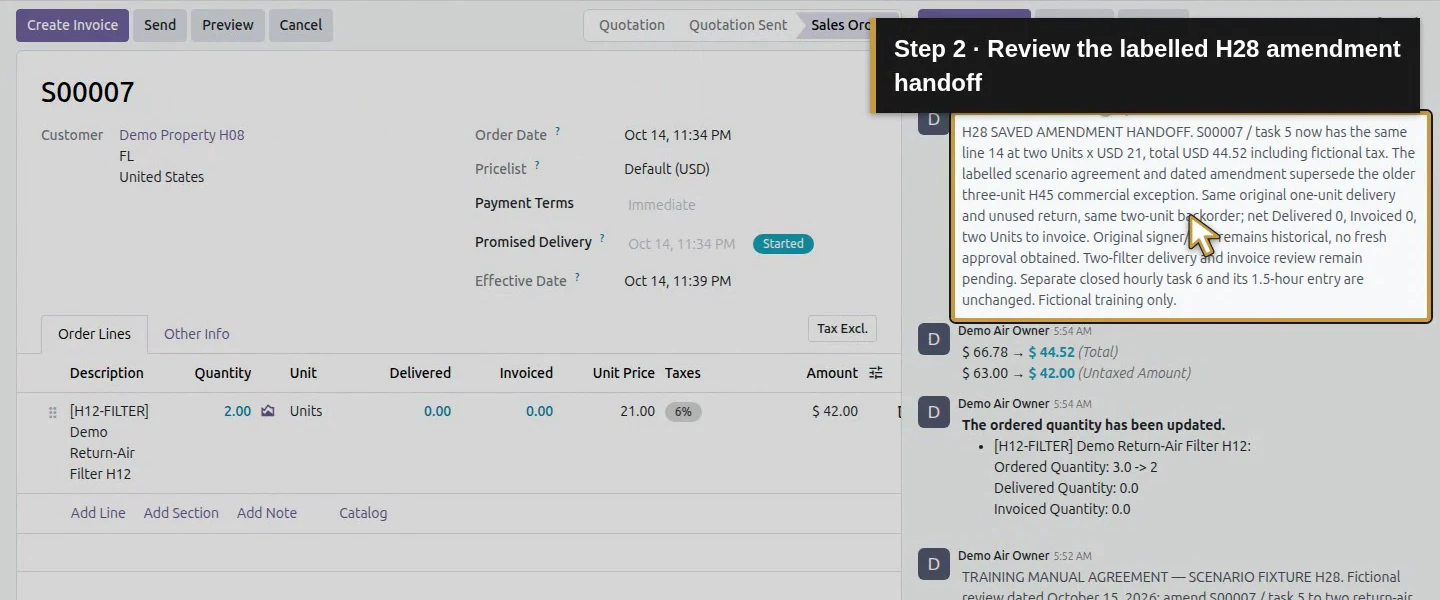
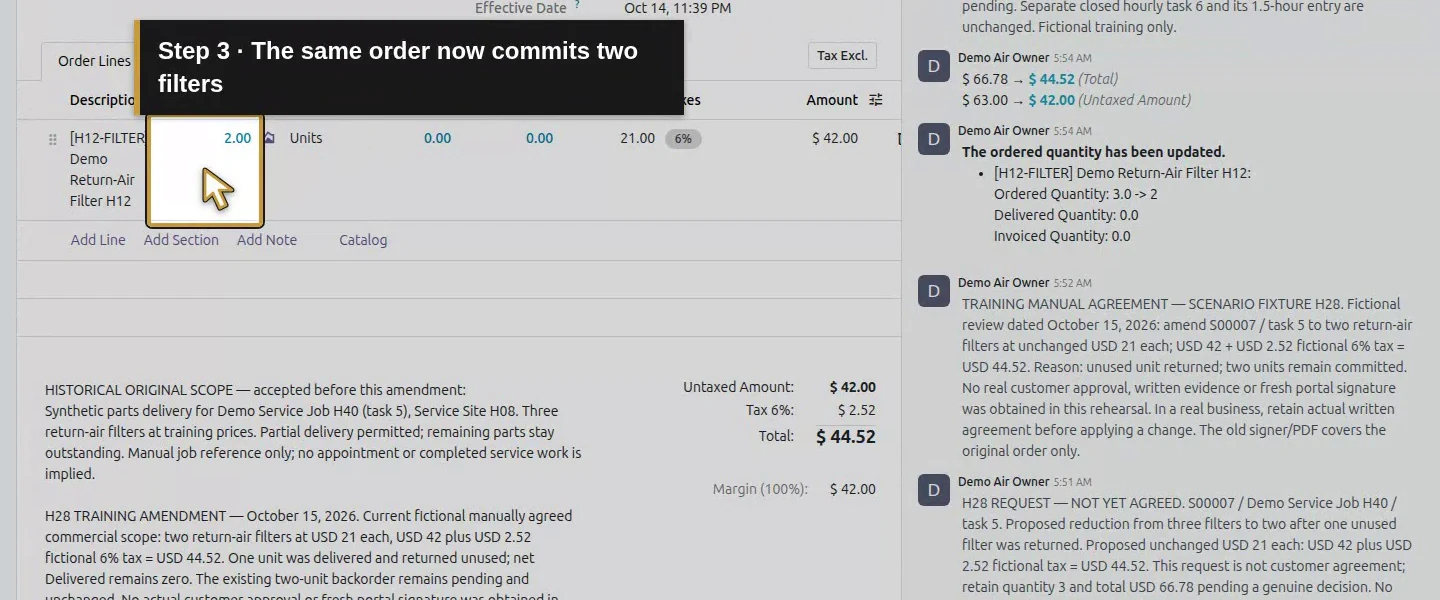
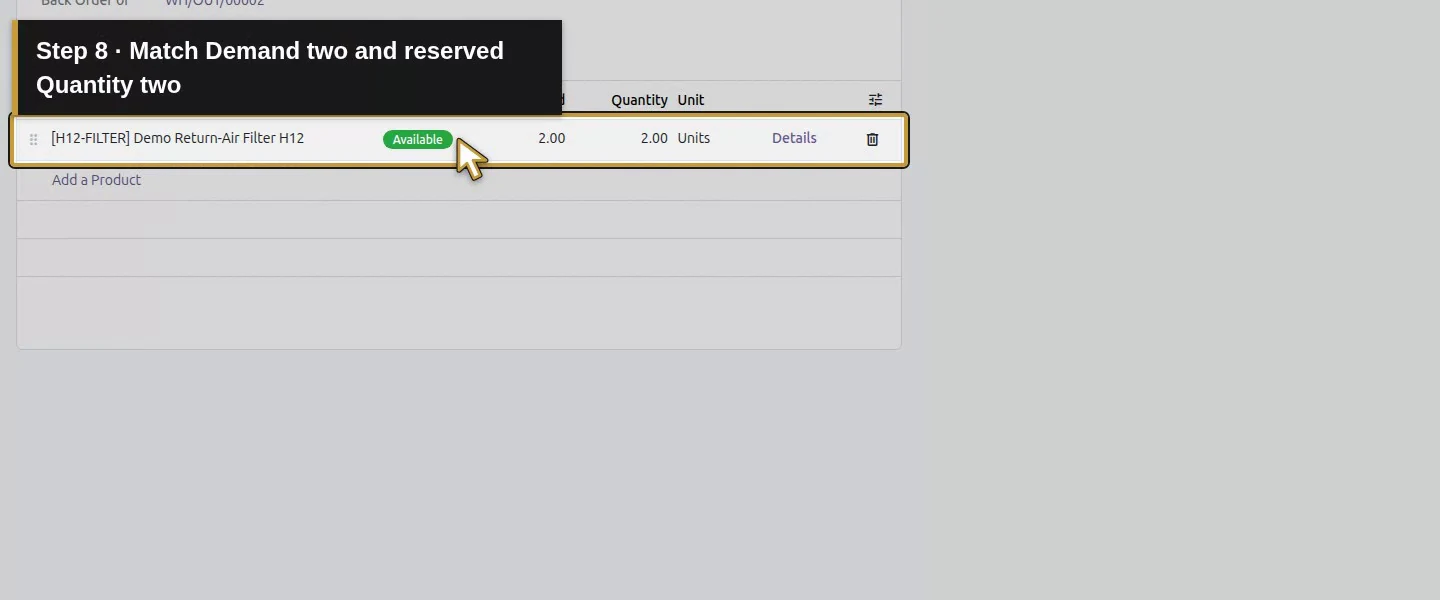
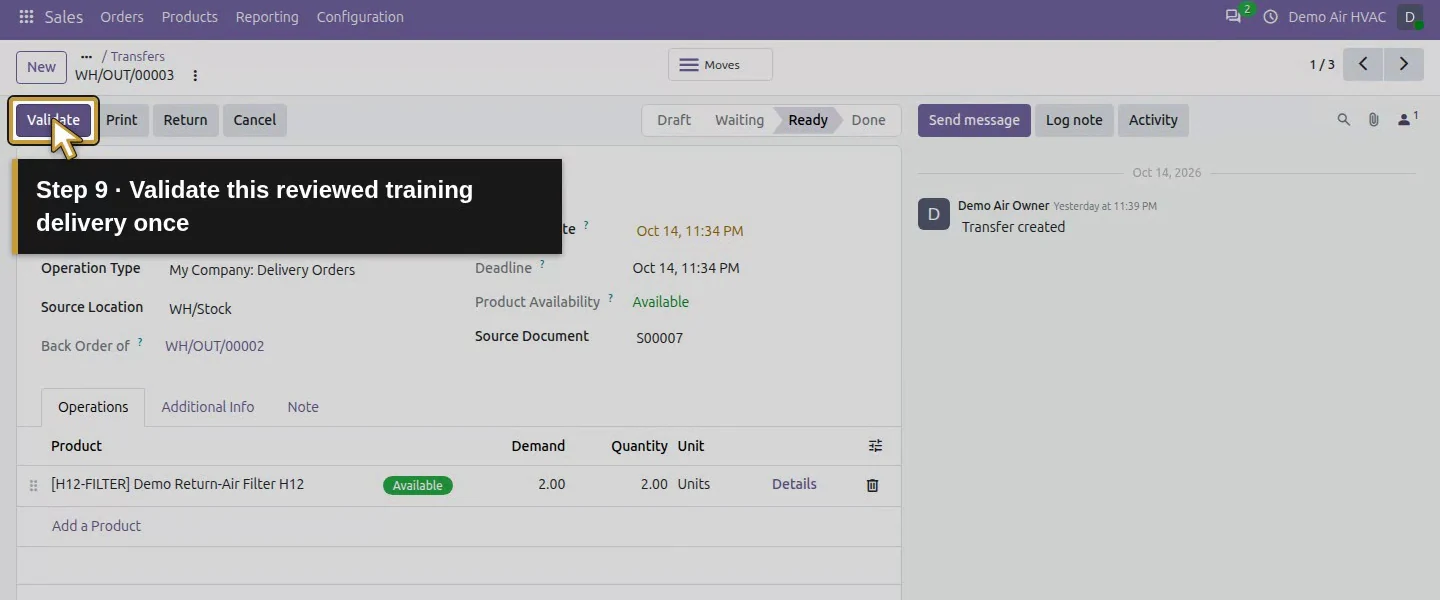
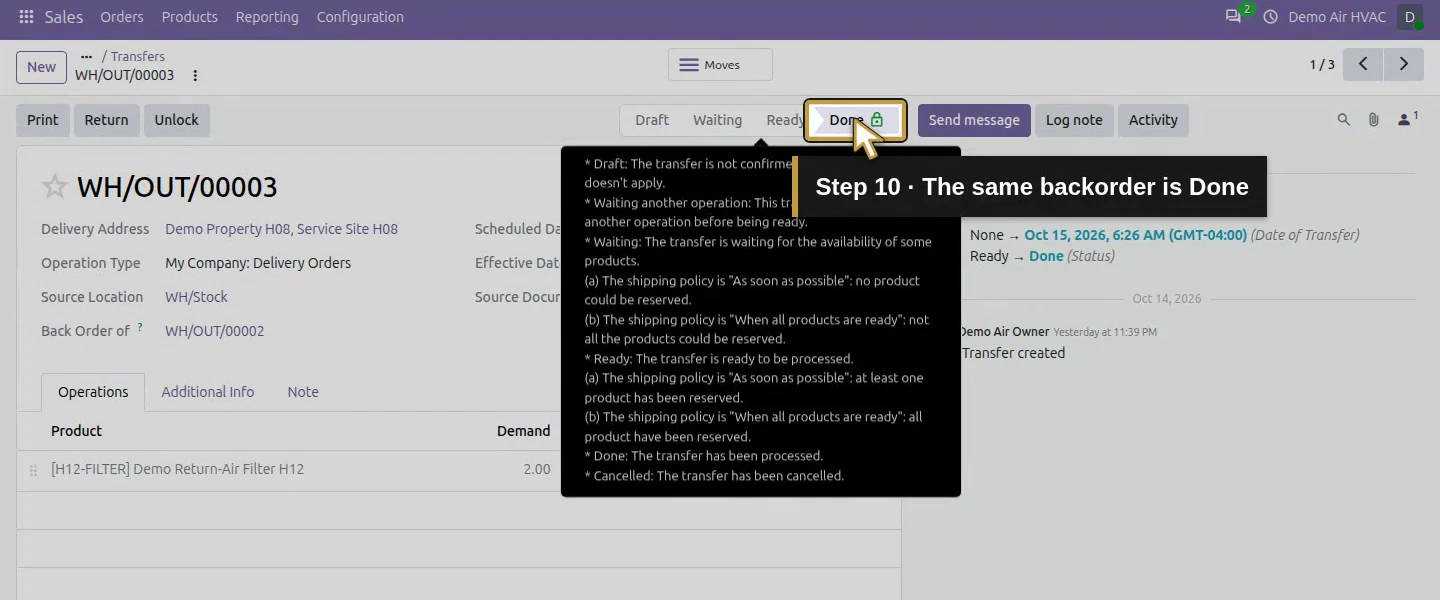
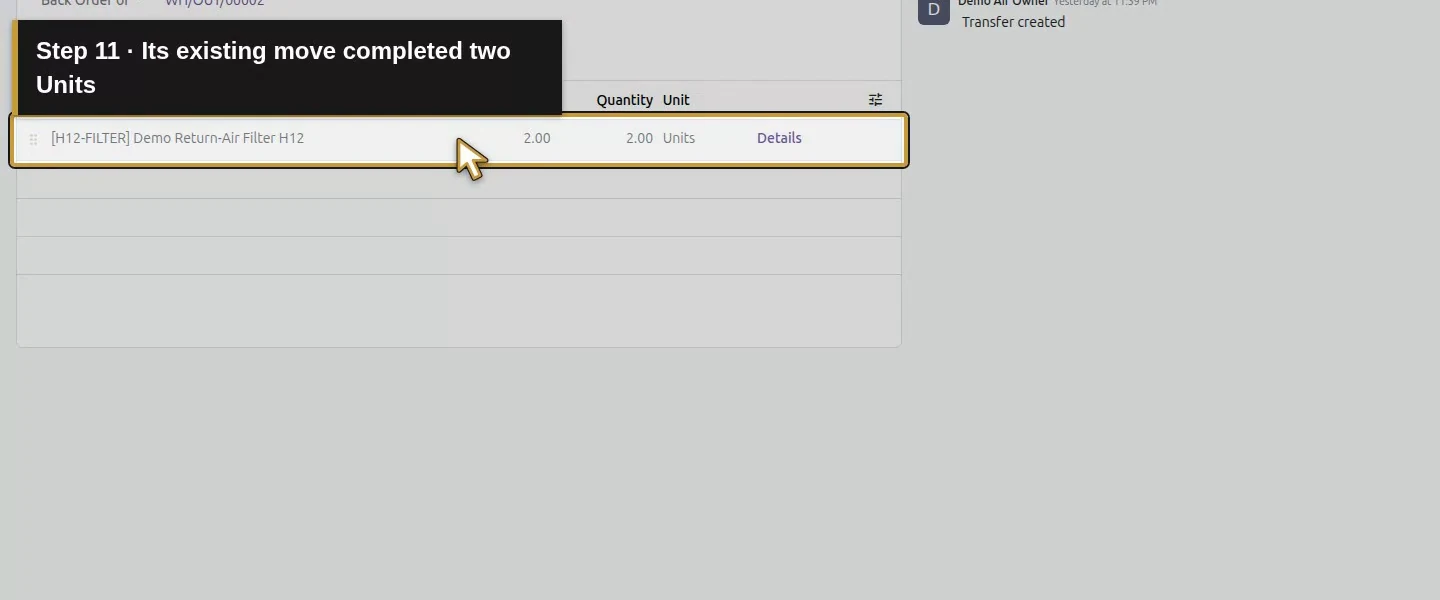
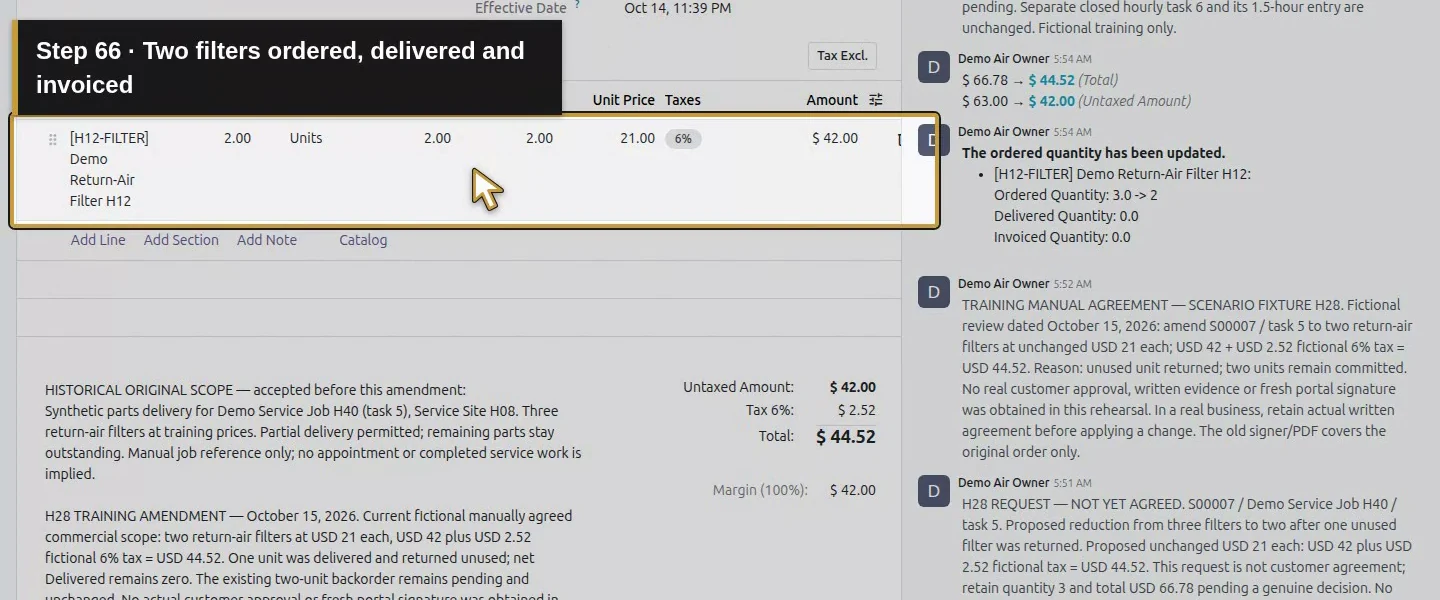
Open WH/OUT/00003 from S00007’s Delivery list. Check the amended order, service-site address, WH/Stock source and Demand: 2.00 / Quantity: 2.00 filters. After the office’s delivery review, click Validate once and wait for Done. This advances the existing backorder; no replacement transfer is created. Original one out, one returned and this two-unit completion leave S00007 net Delivered 2.00. Warehouse stock becomes zero and the van retains two unreserved filters.
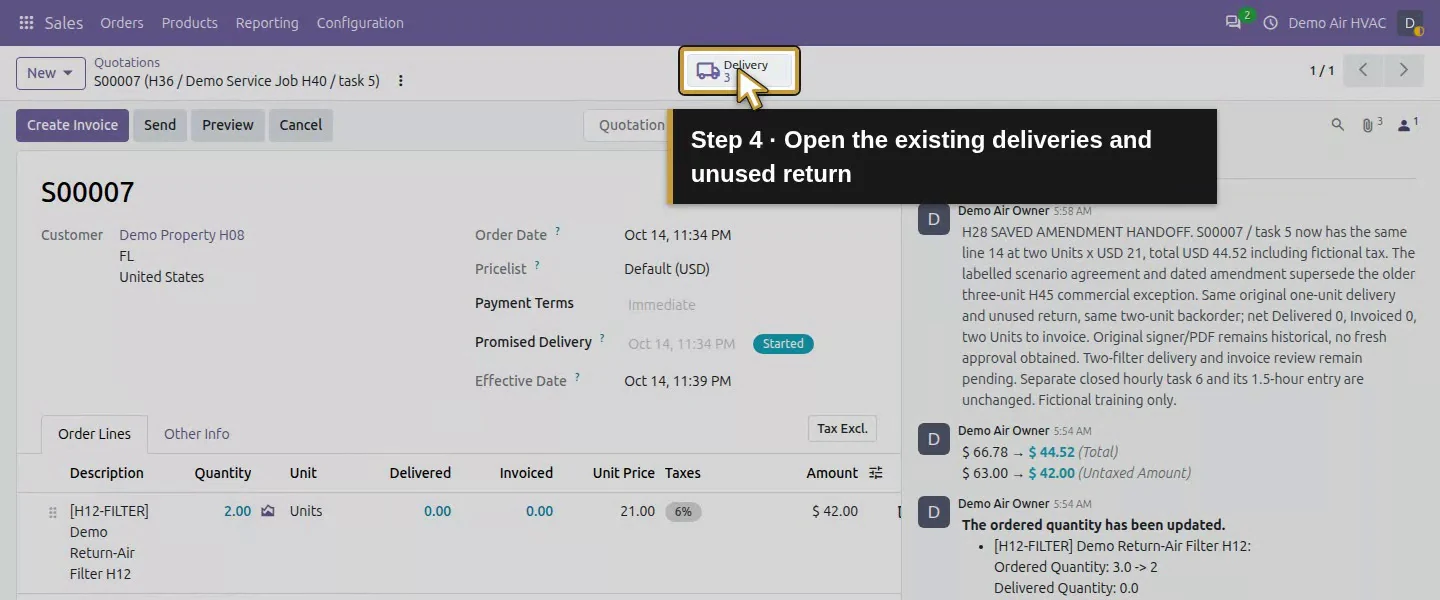
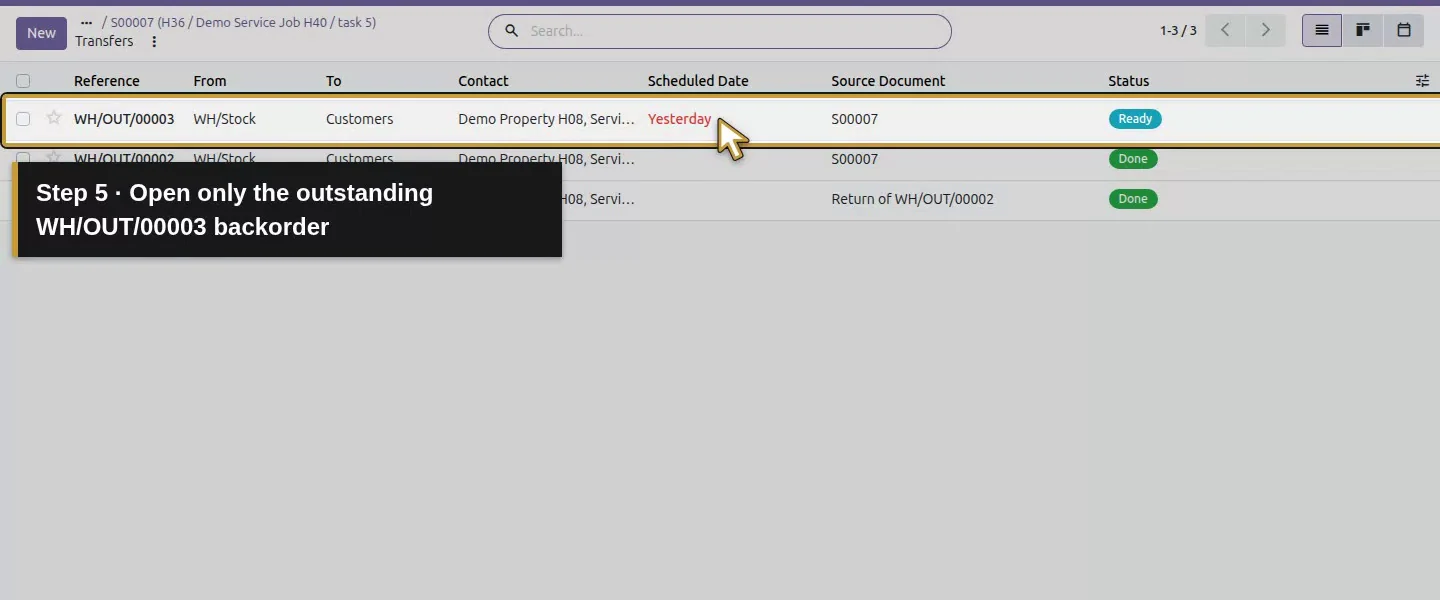
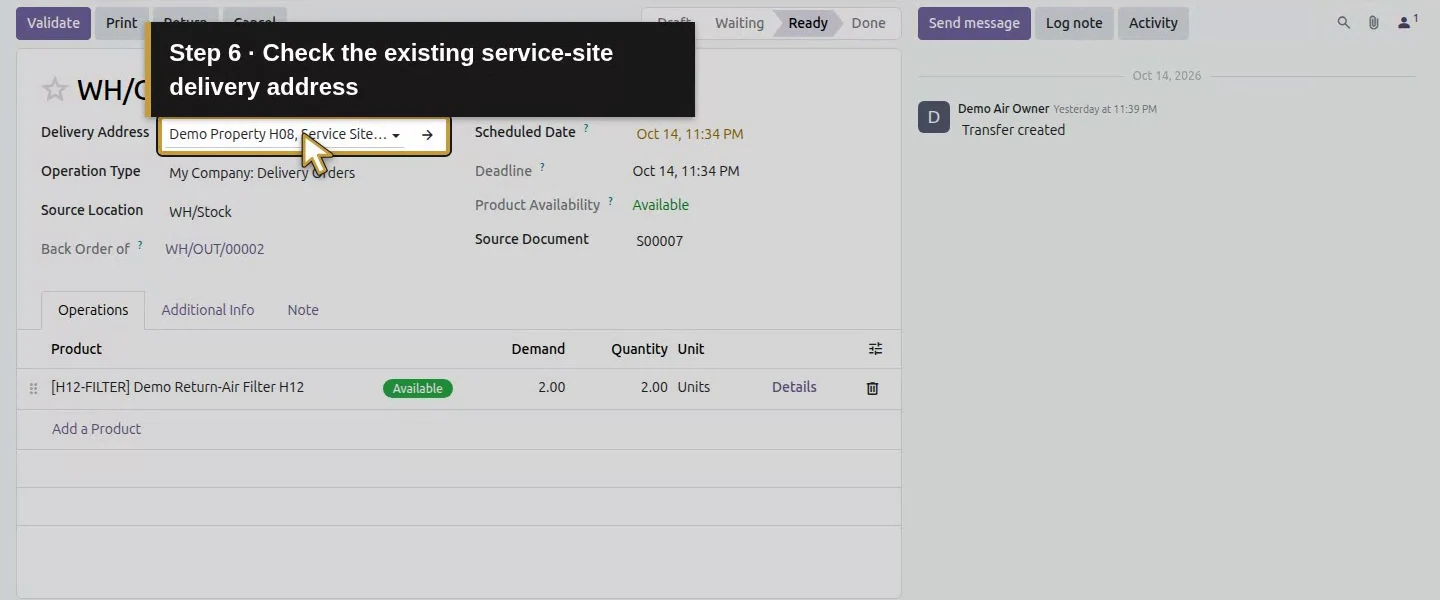
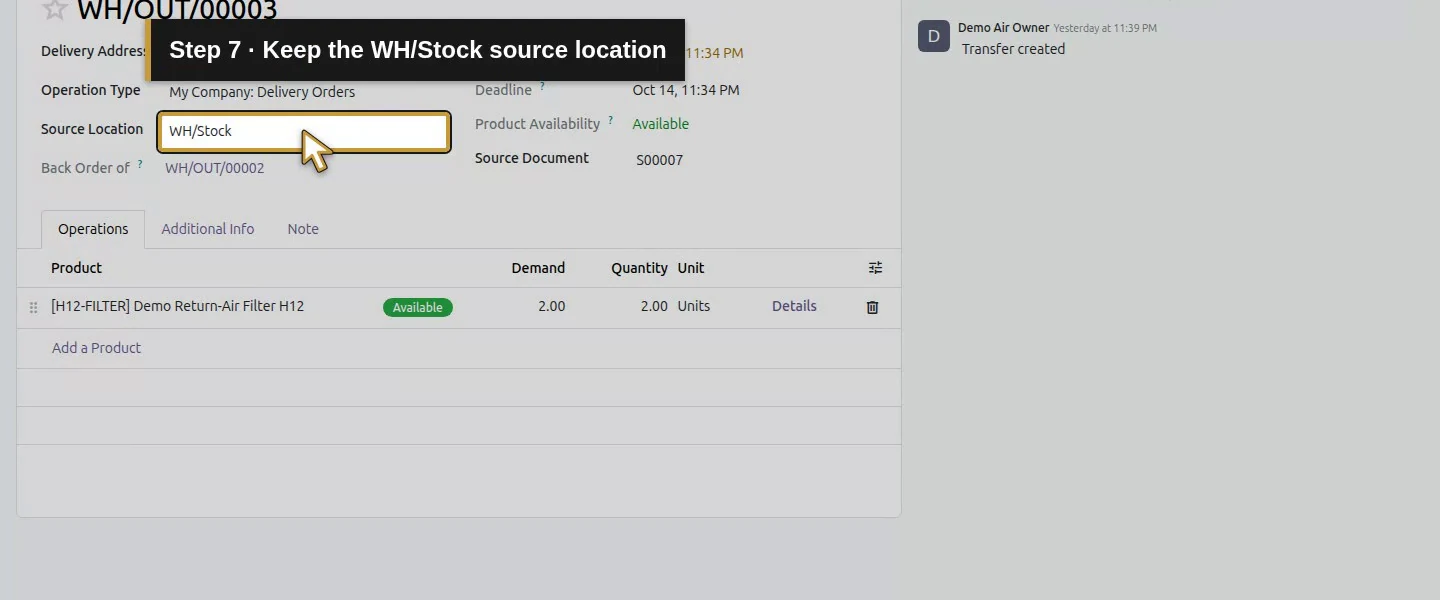
Step 2. Review the two billing sources separately
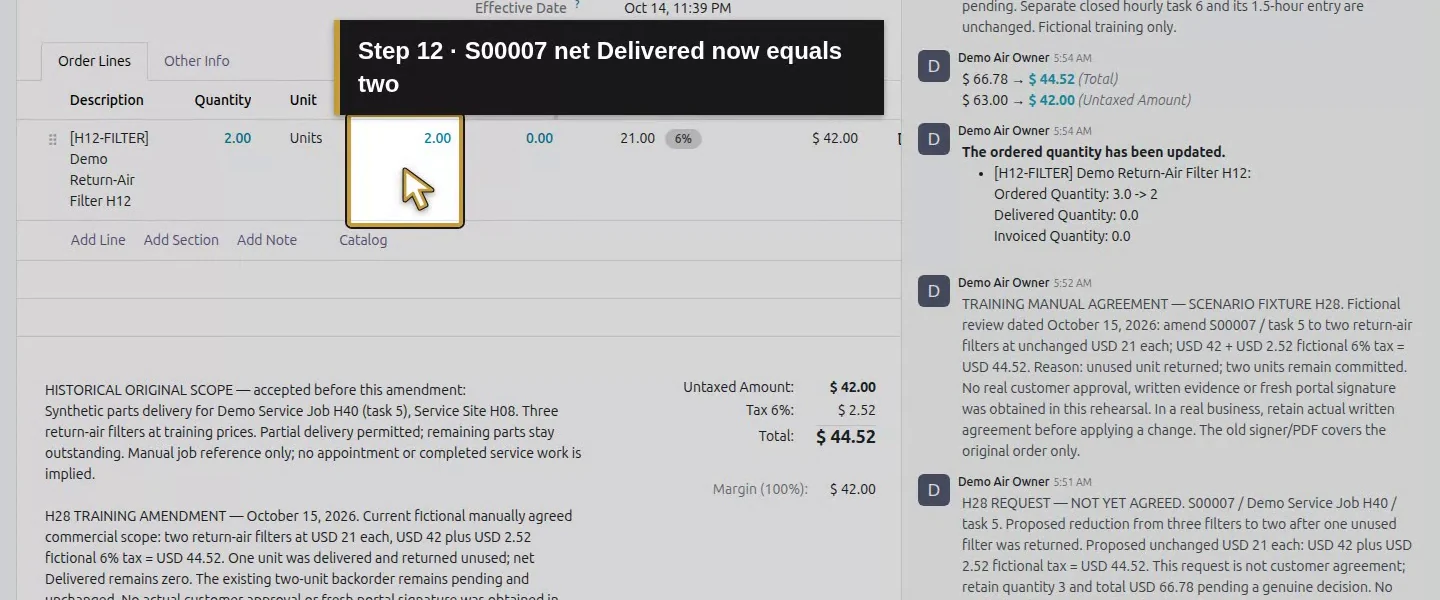
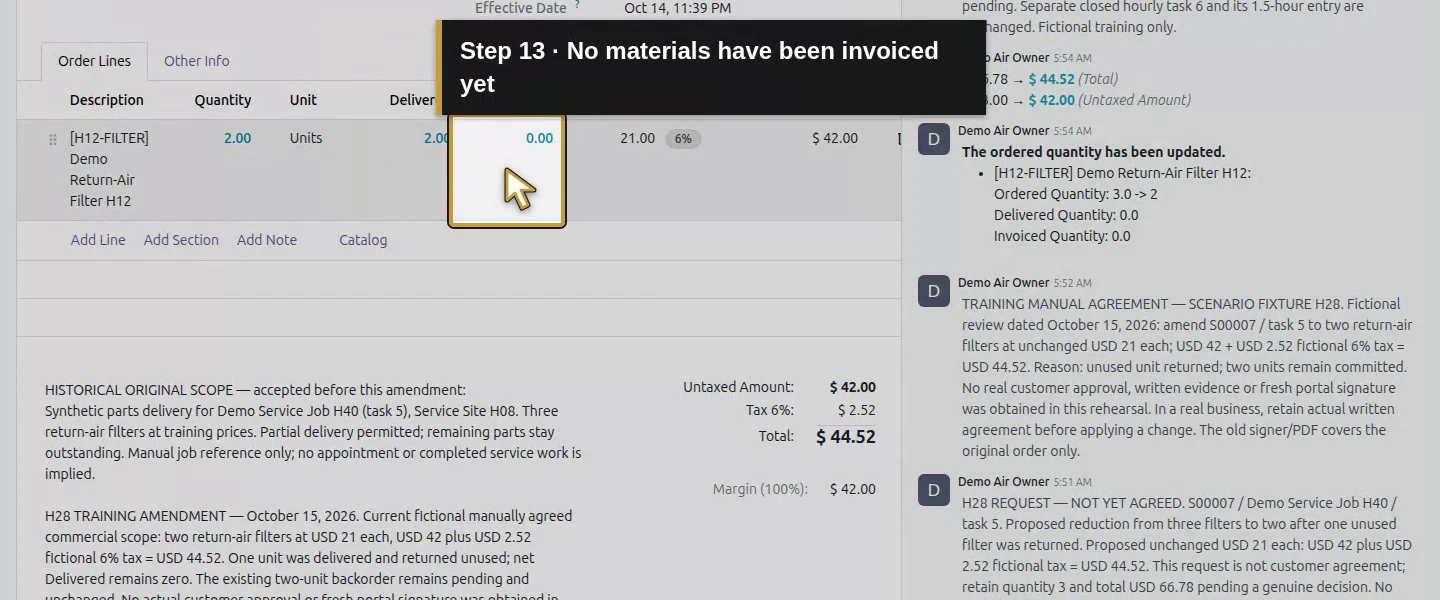
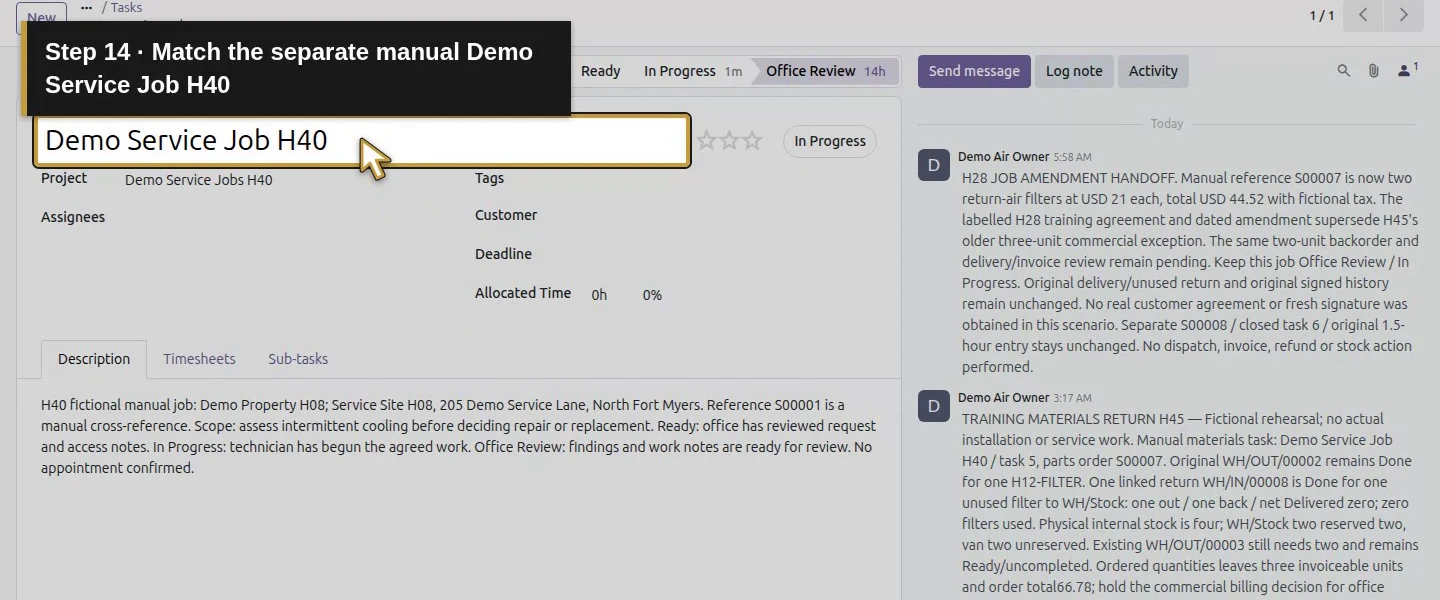
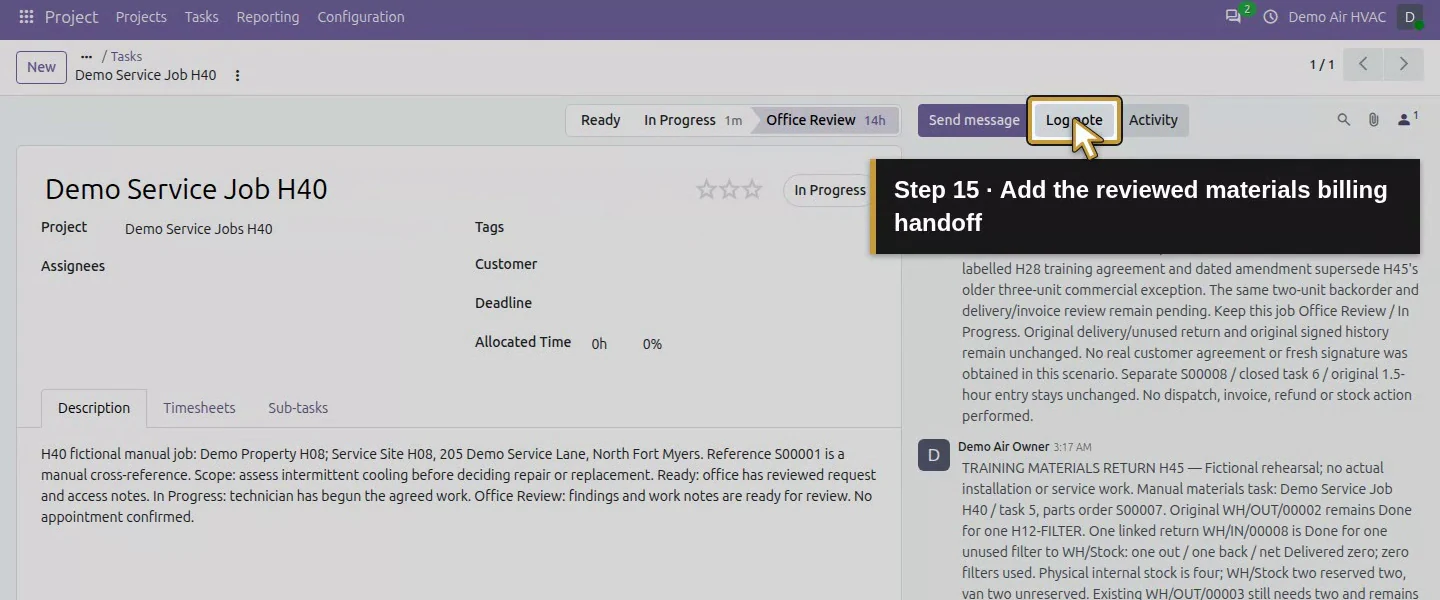
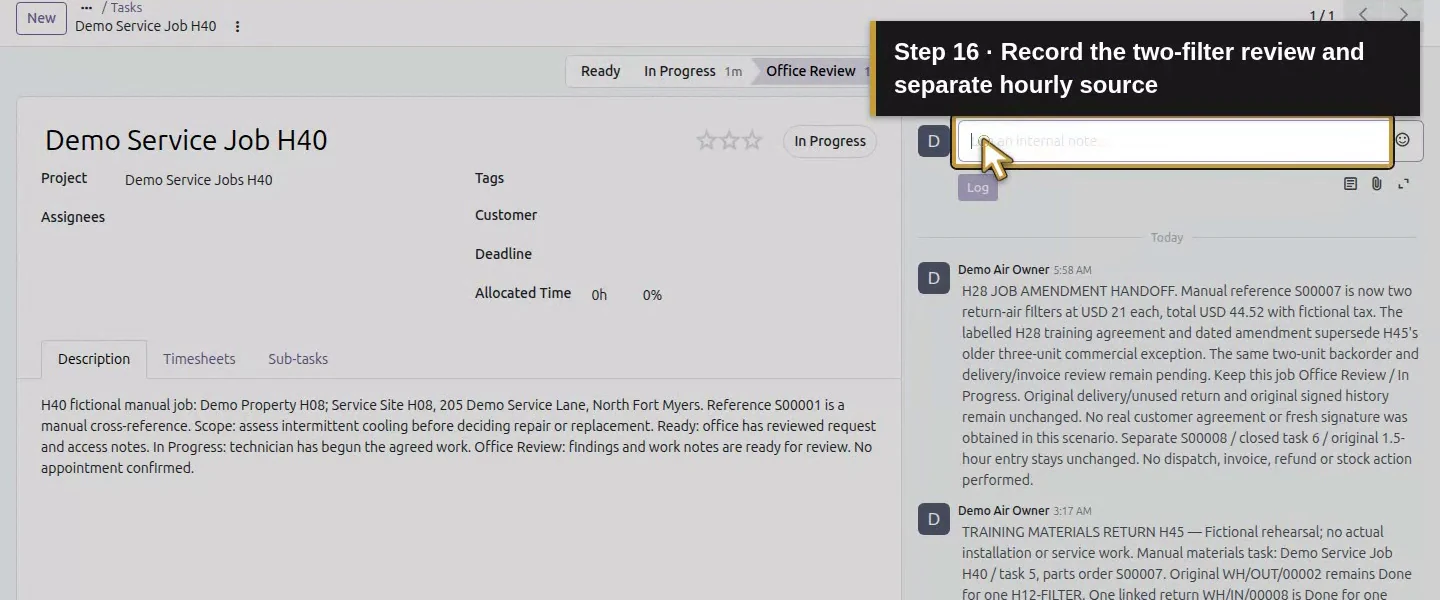
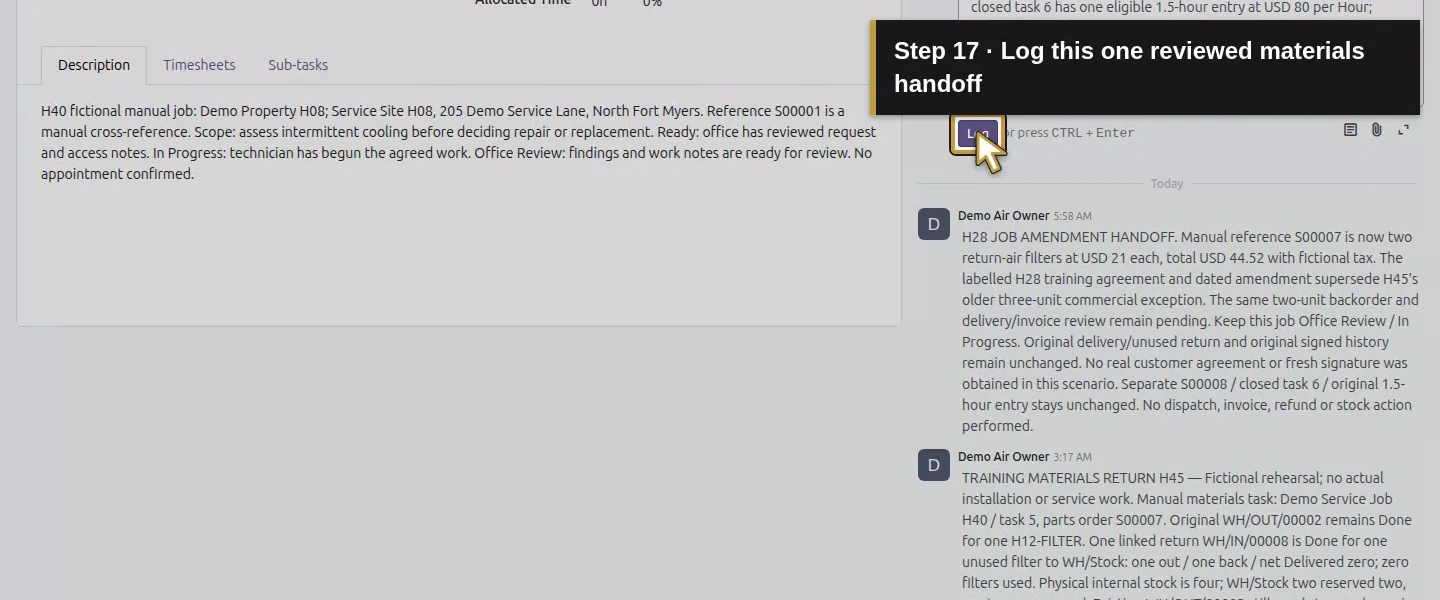
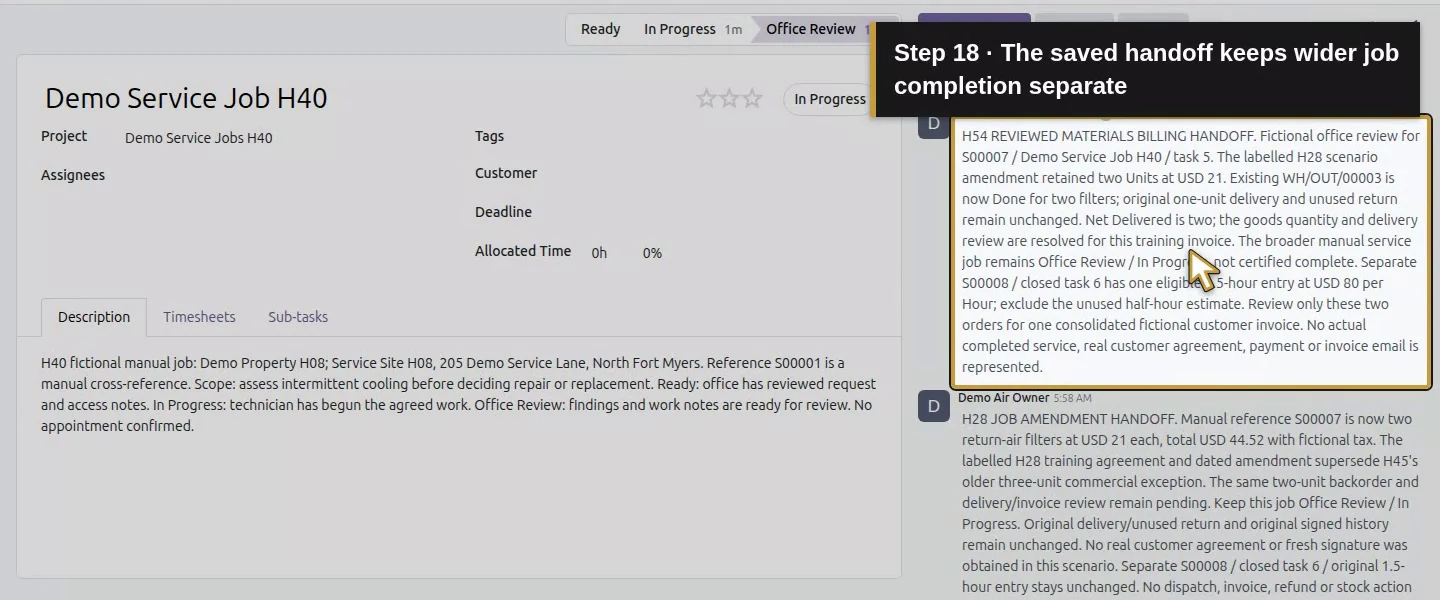
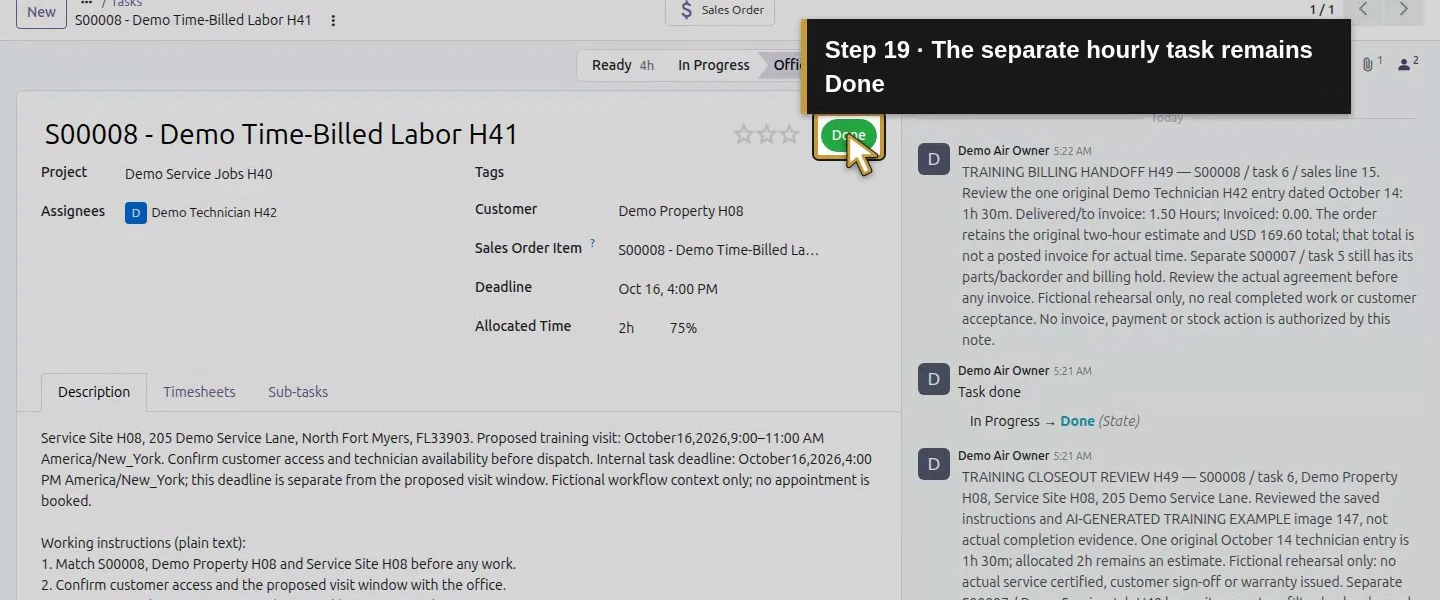
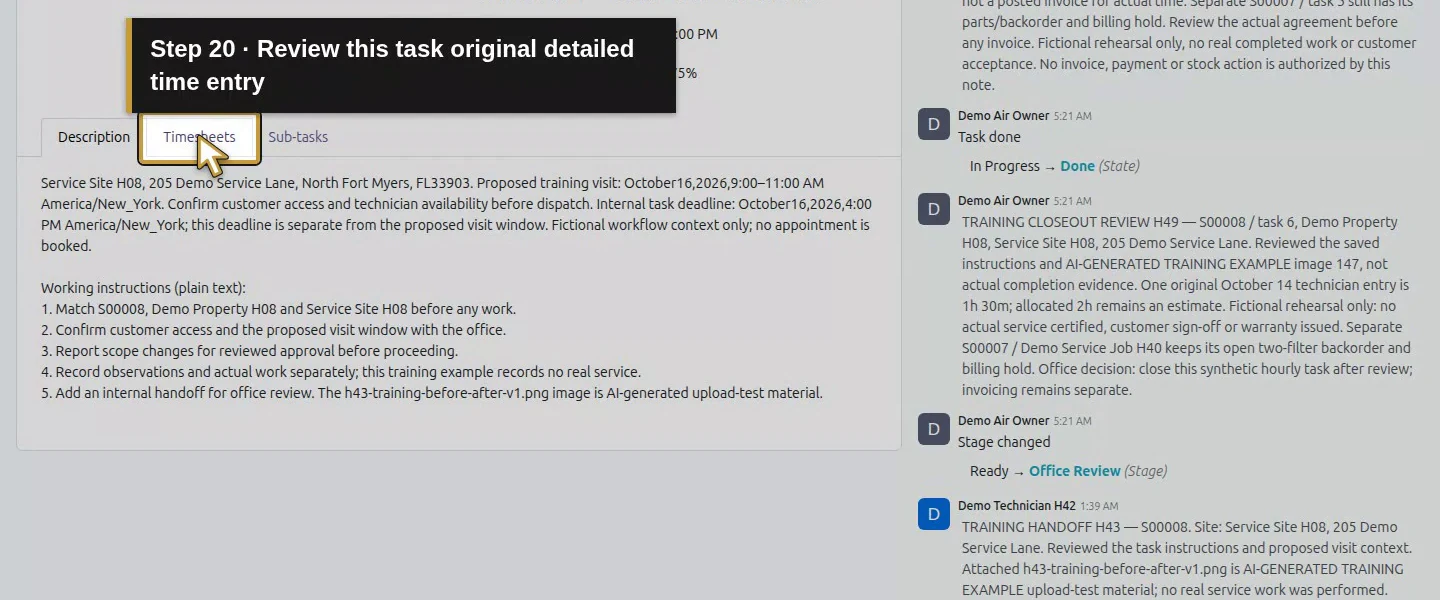
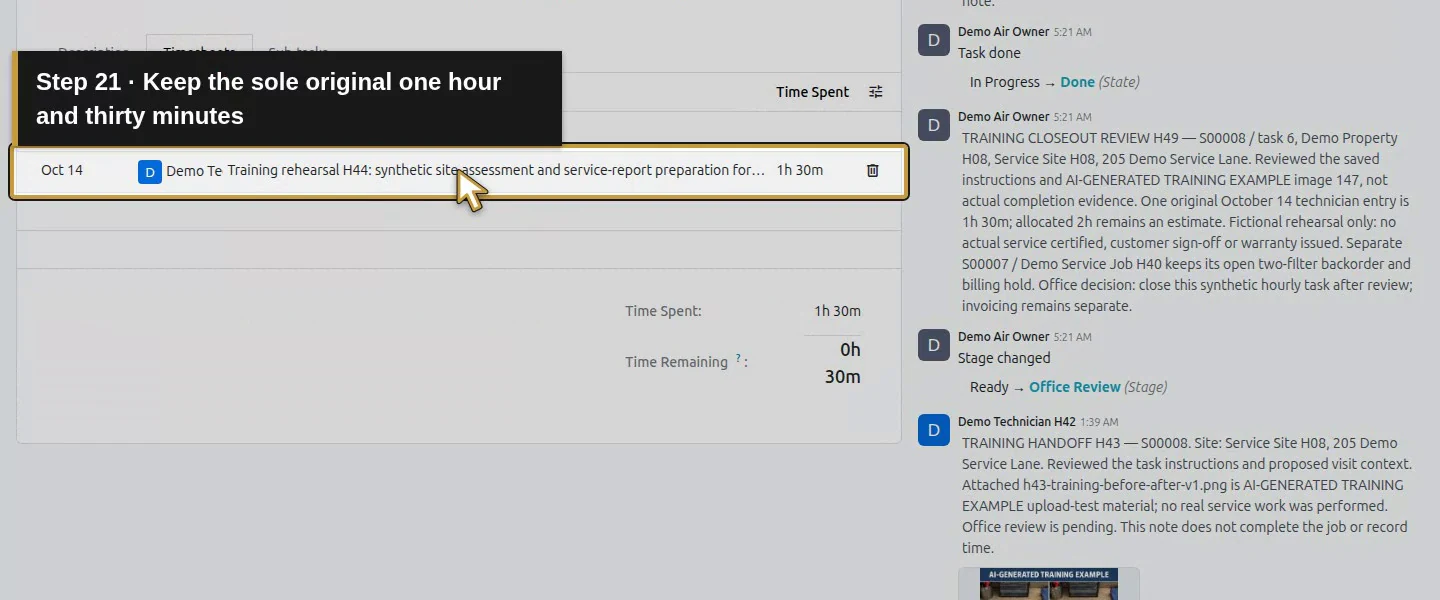
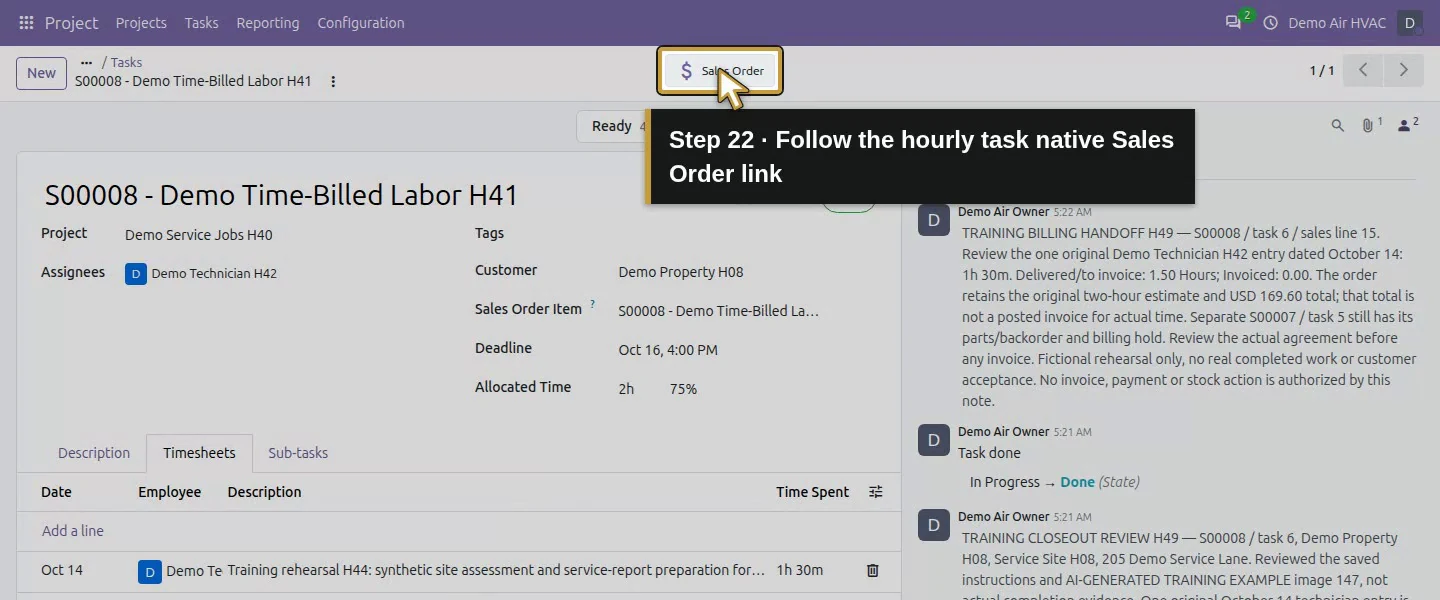
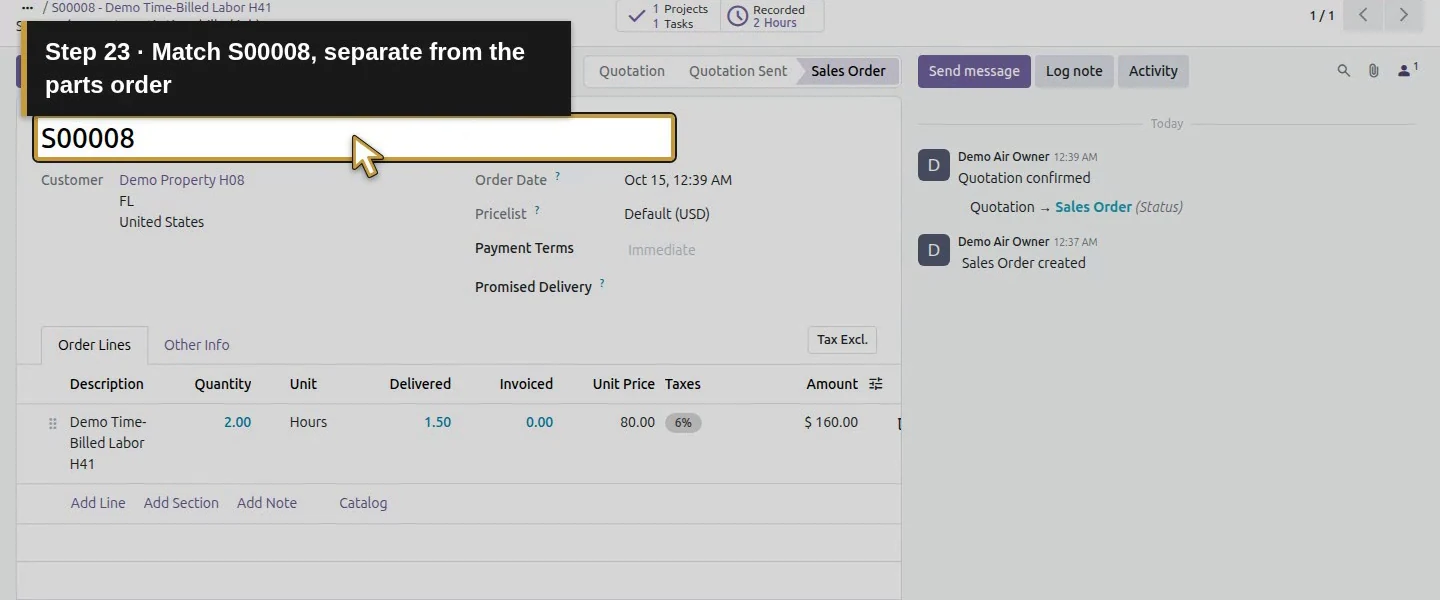
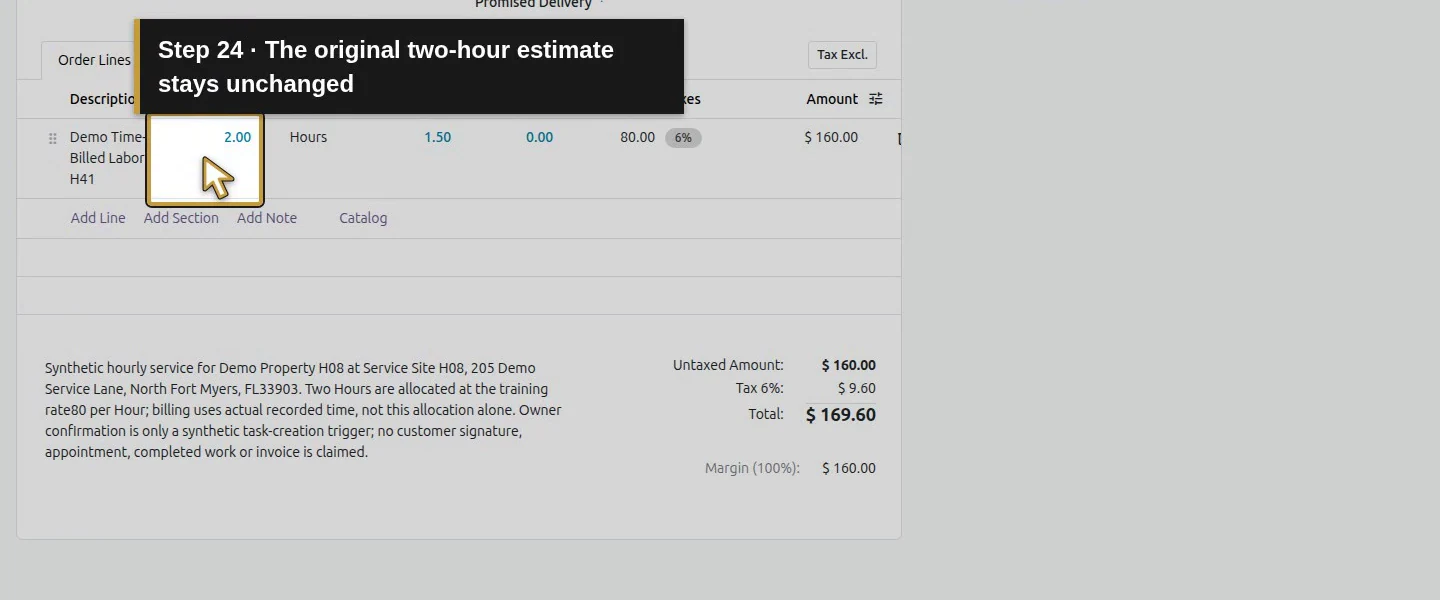
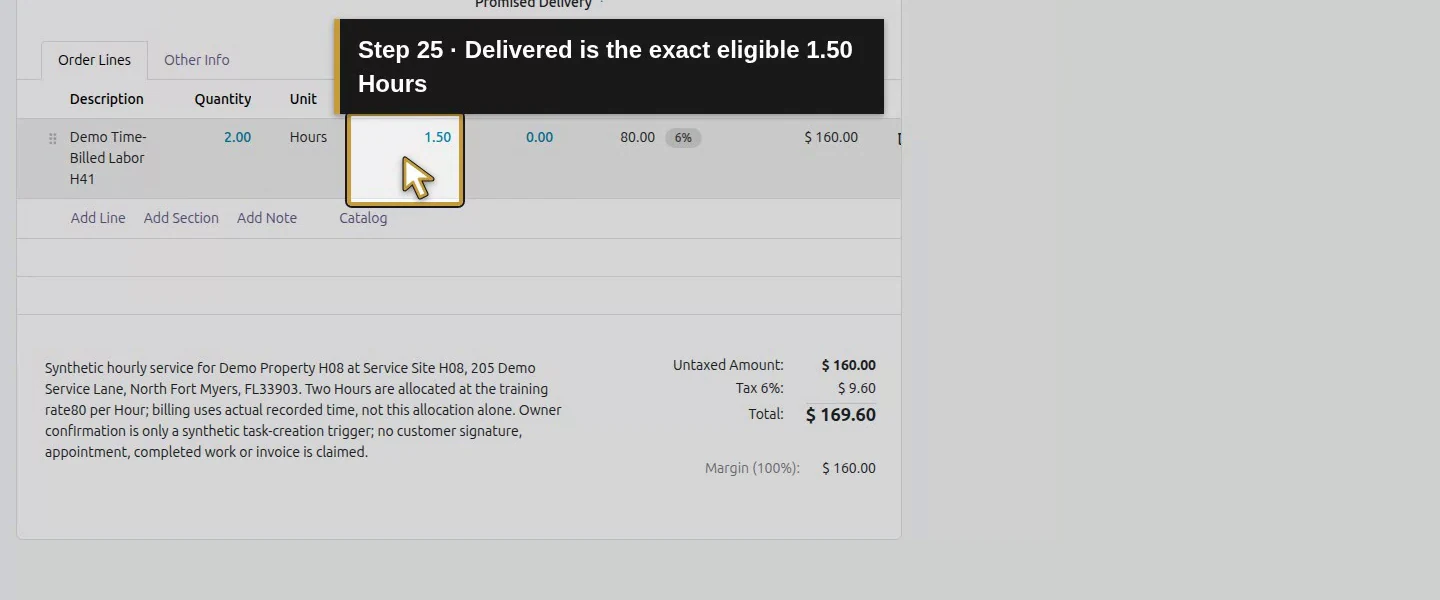
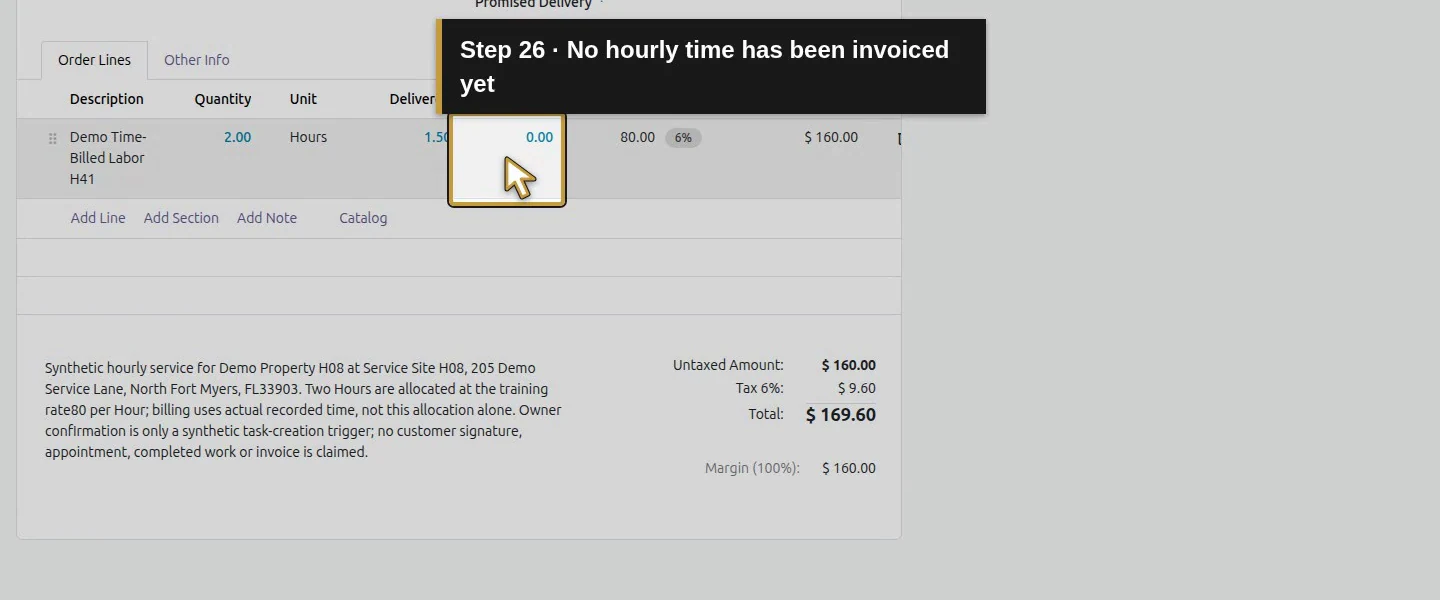
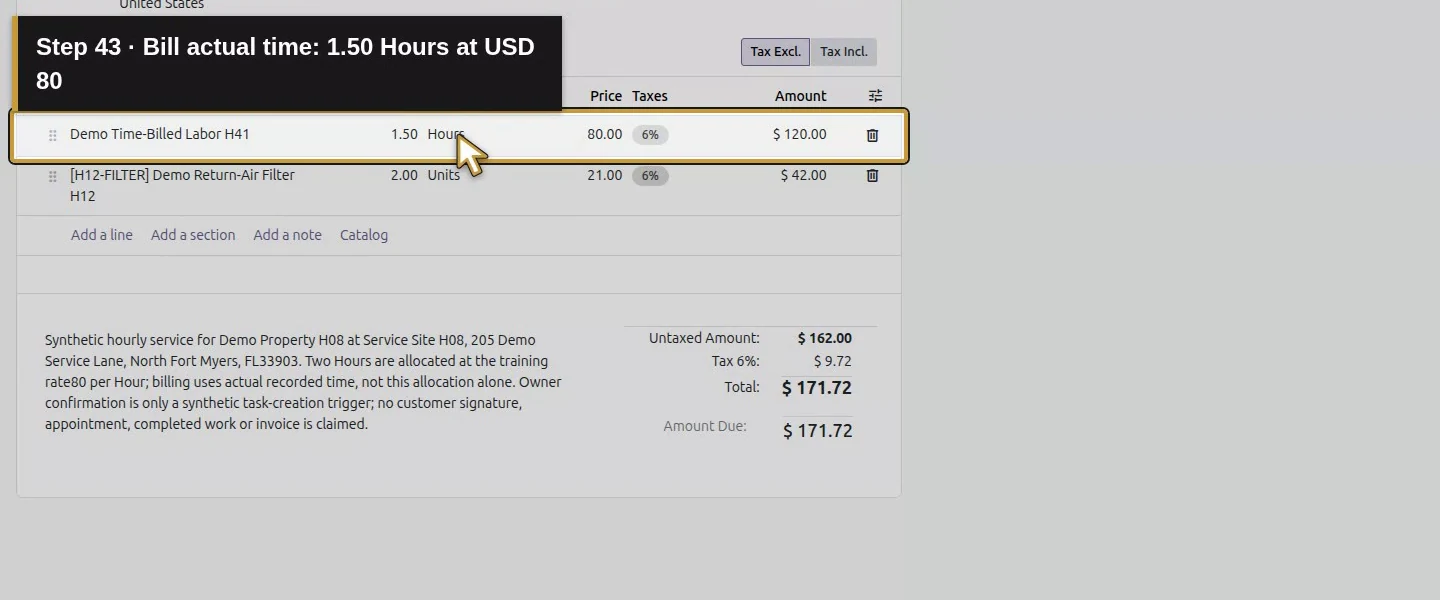
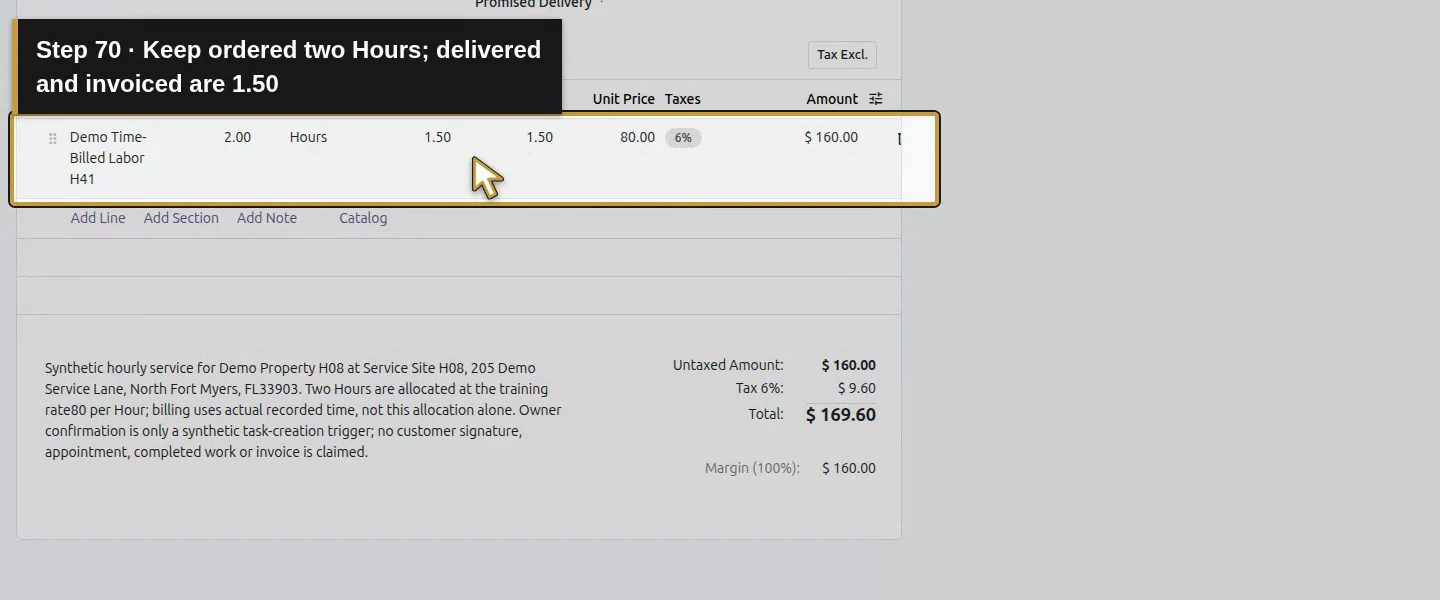
On the parts job, record the resolved quantity/delivery review with Log note → Log. Keep its wider service-completion decision separate. On the hourly task, verify the sole dated employee entry of 1h 30m, the correct sales link and H49 handoff. S00008’s line has 1.50 to invoice despite its original 2.00 Hours estimate. S00007 has 2.00 filters to invoice under Ordered quantities. Exclude S00001 and every unrelated quotation or order.
Step 3. Select only the two reviewed sales orders
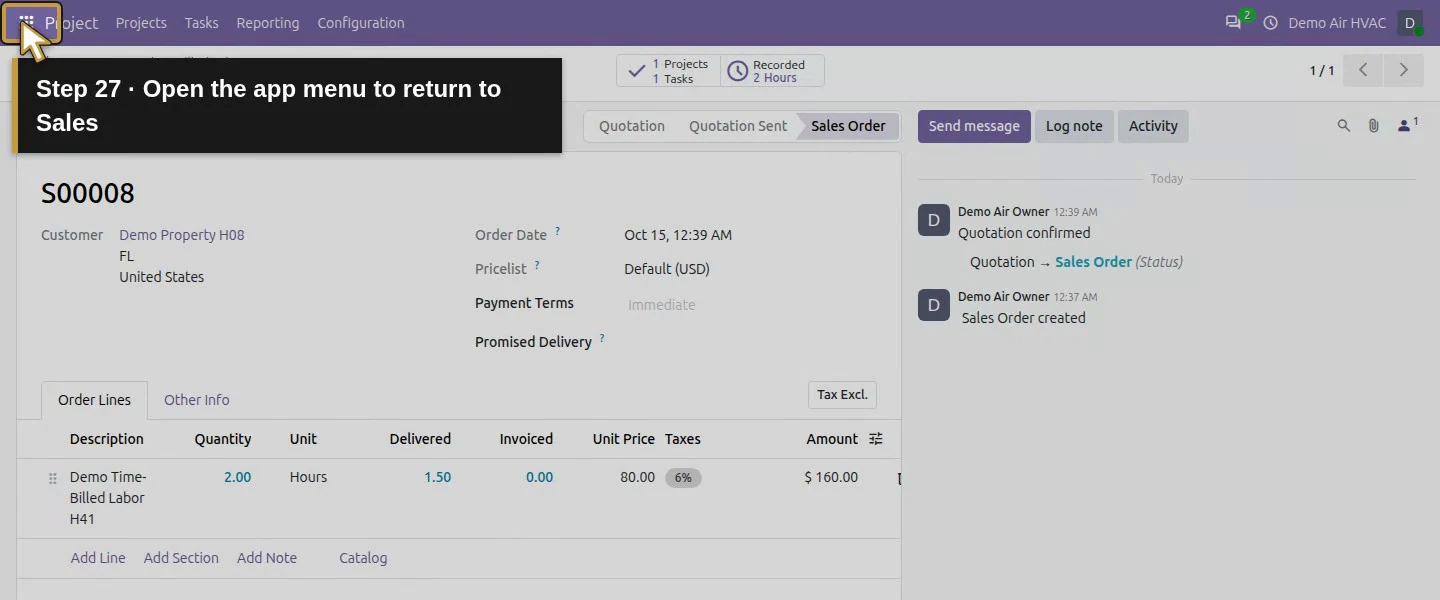
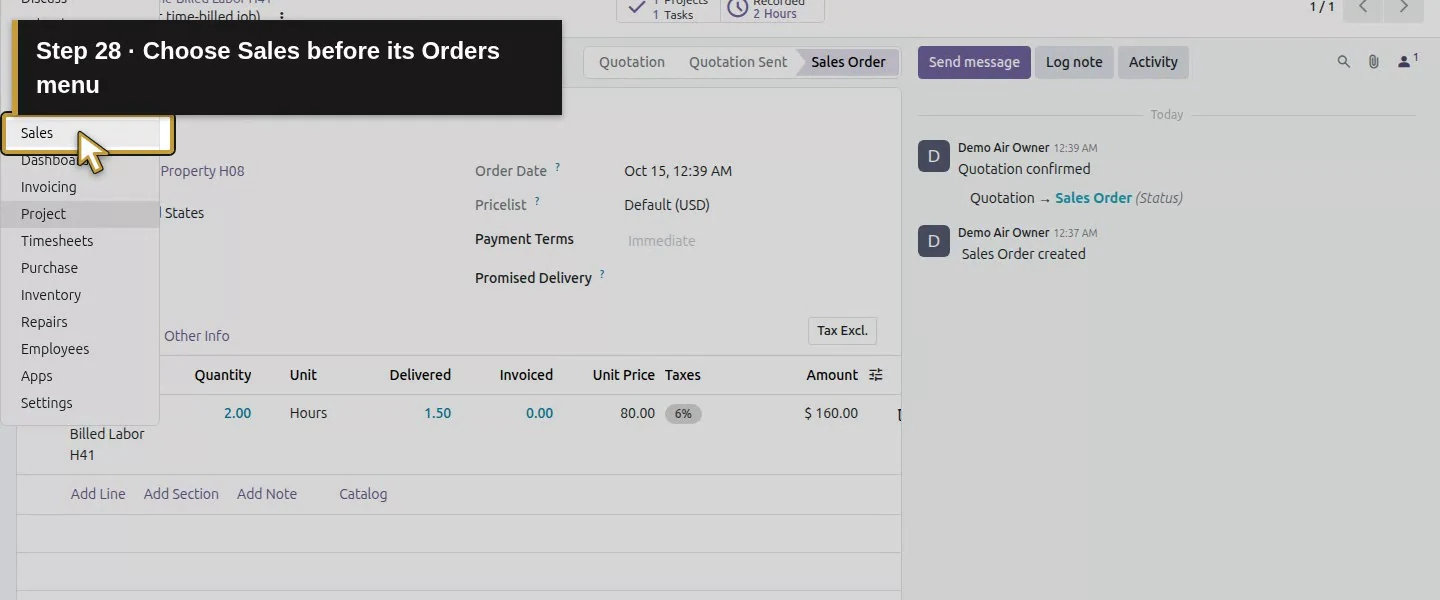
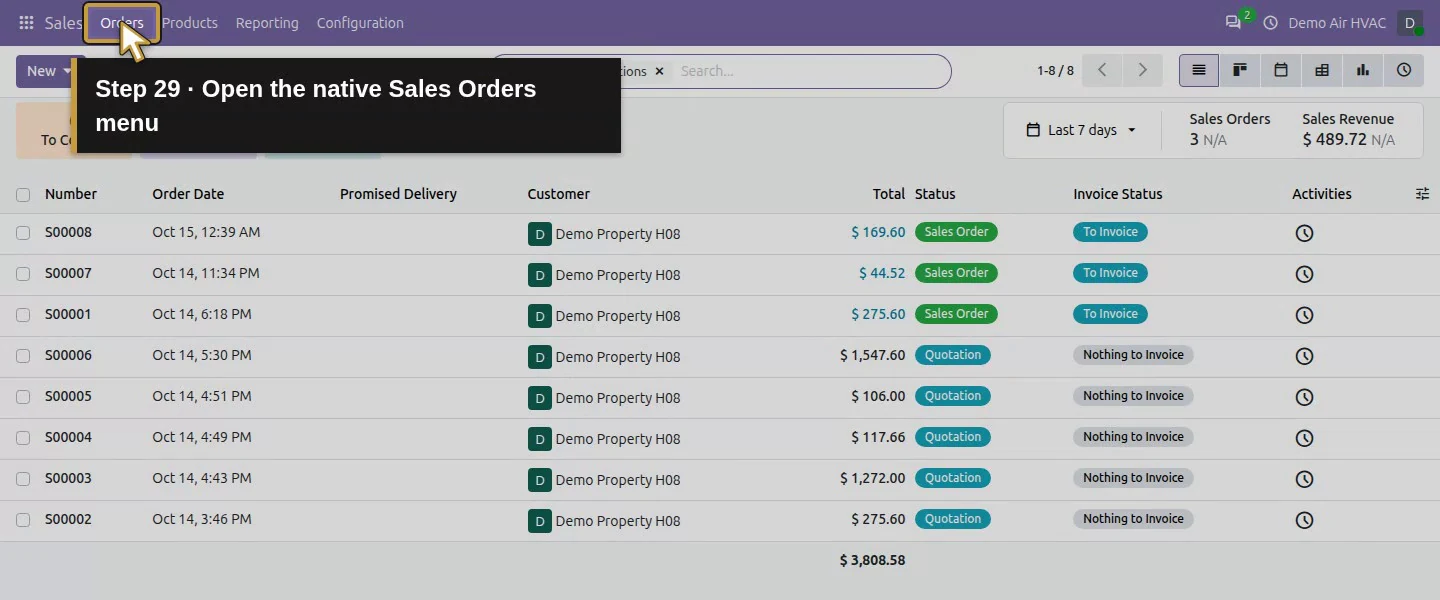
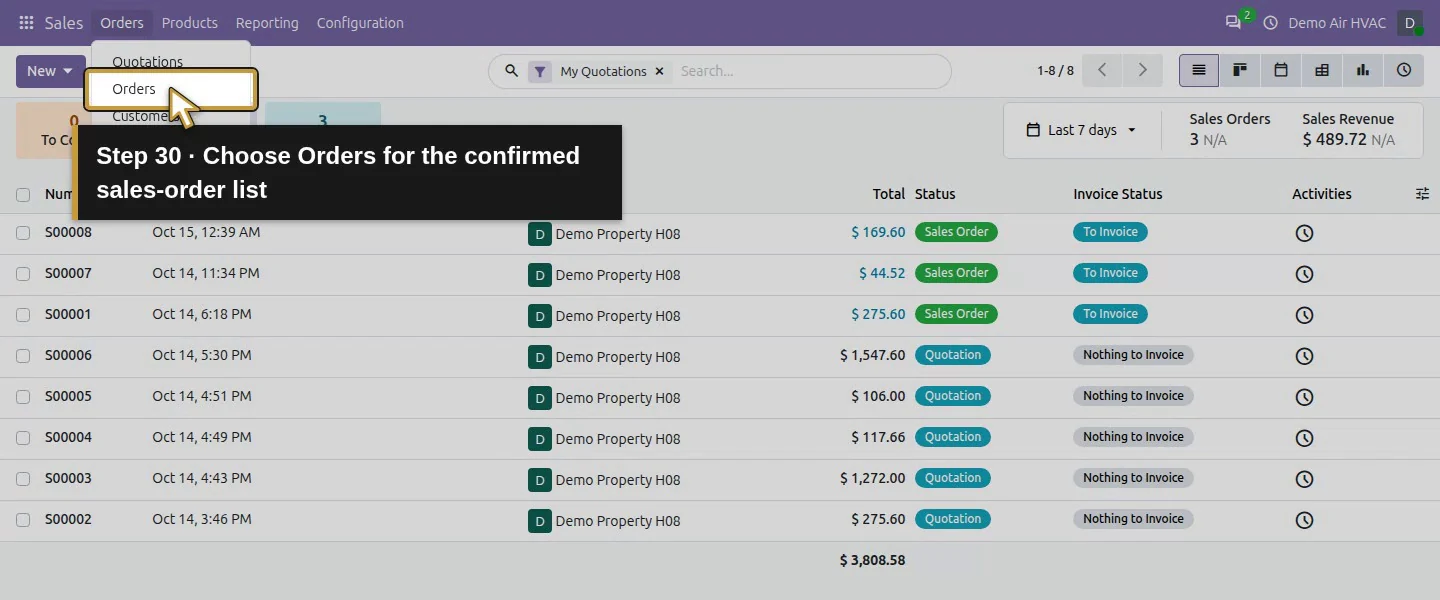
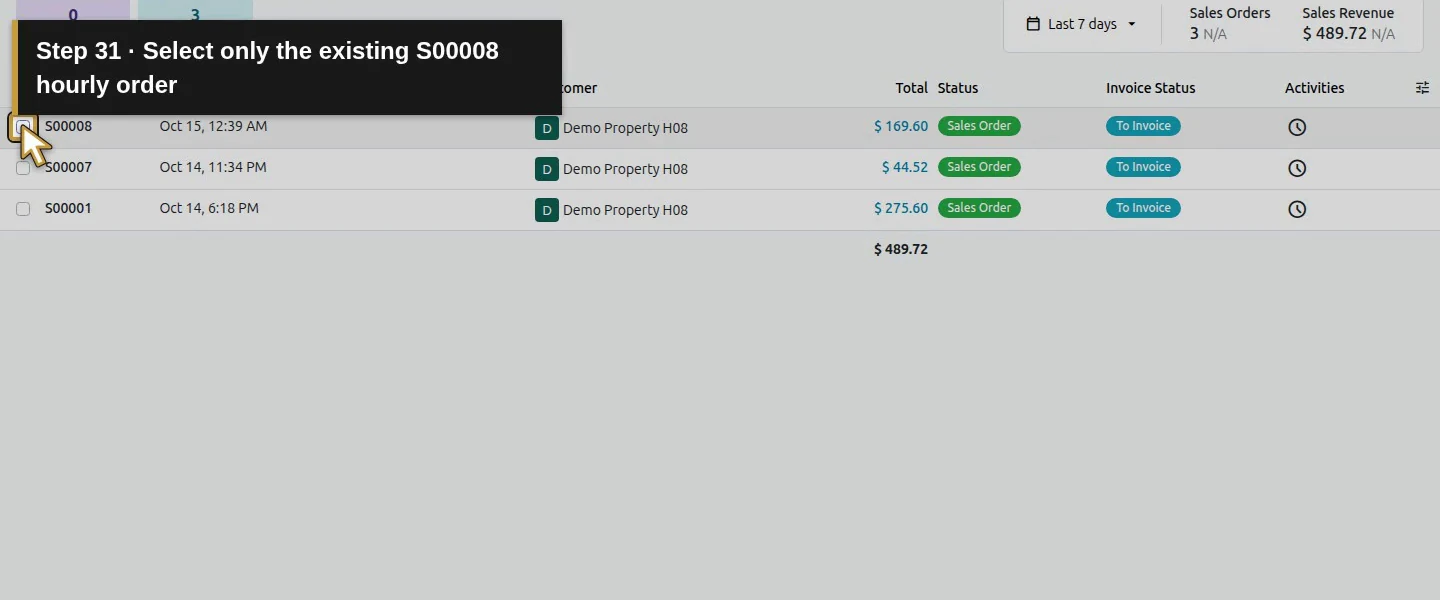
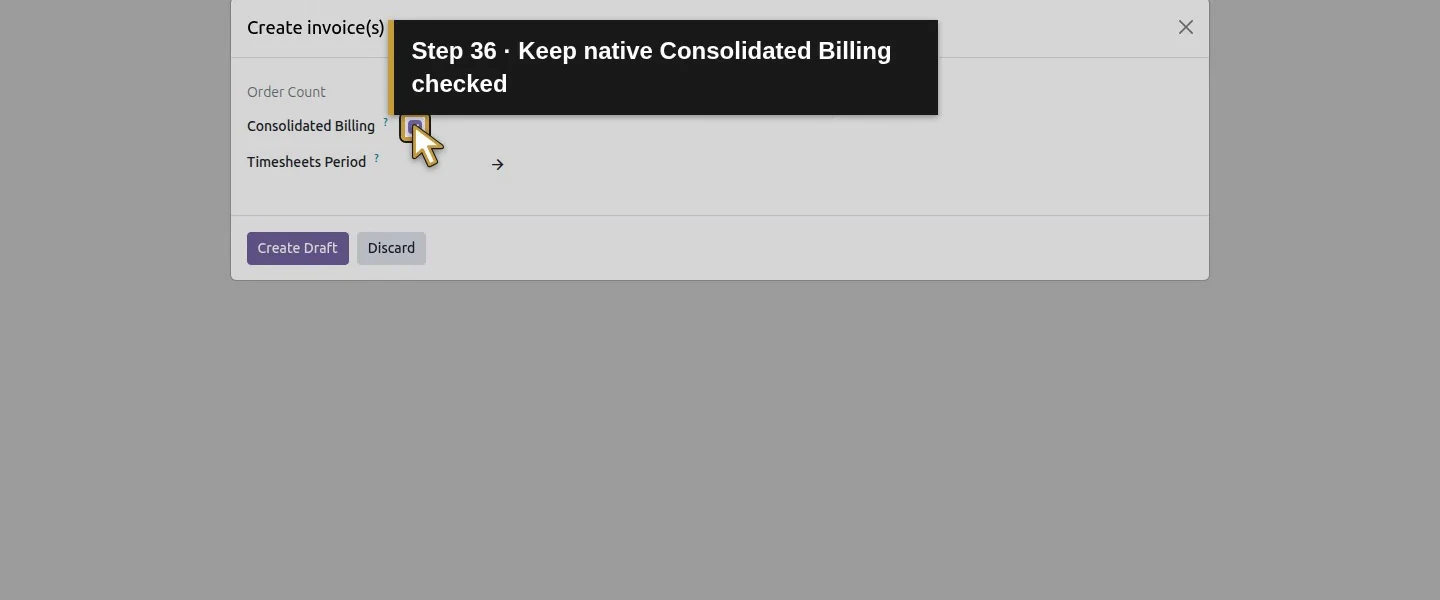
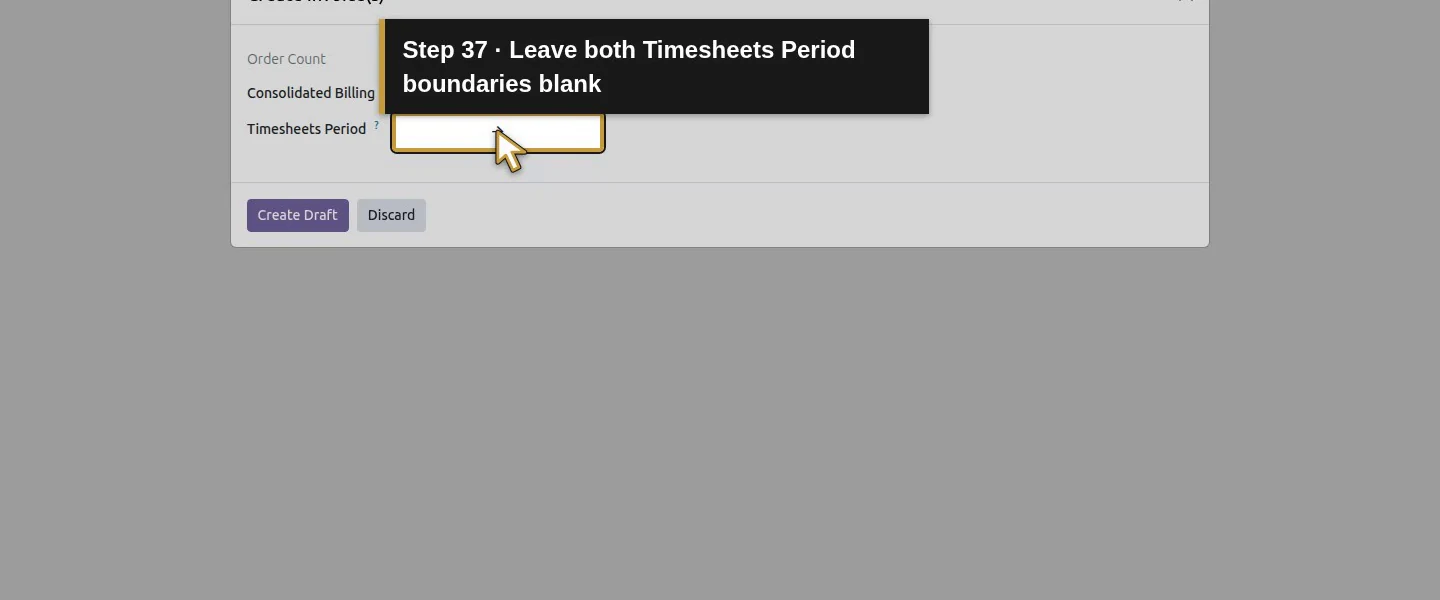
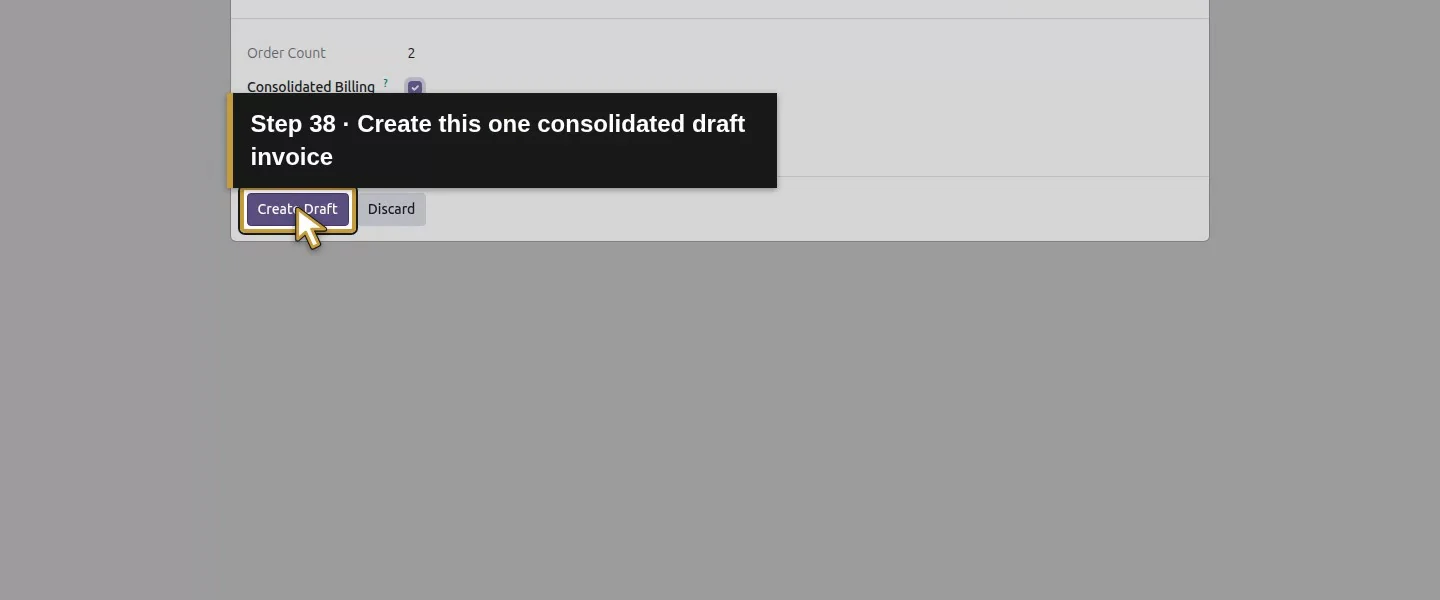
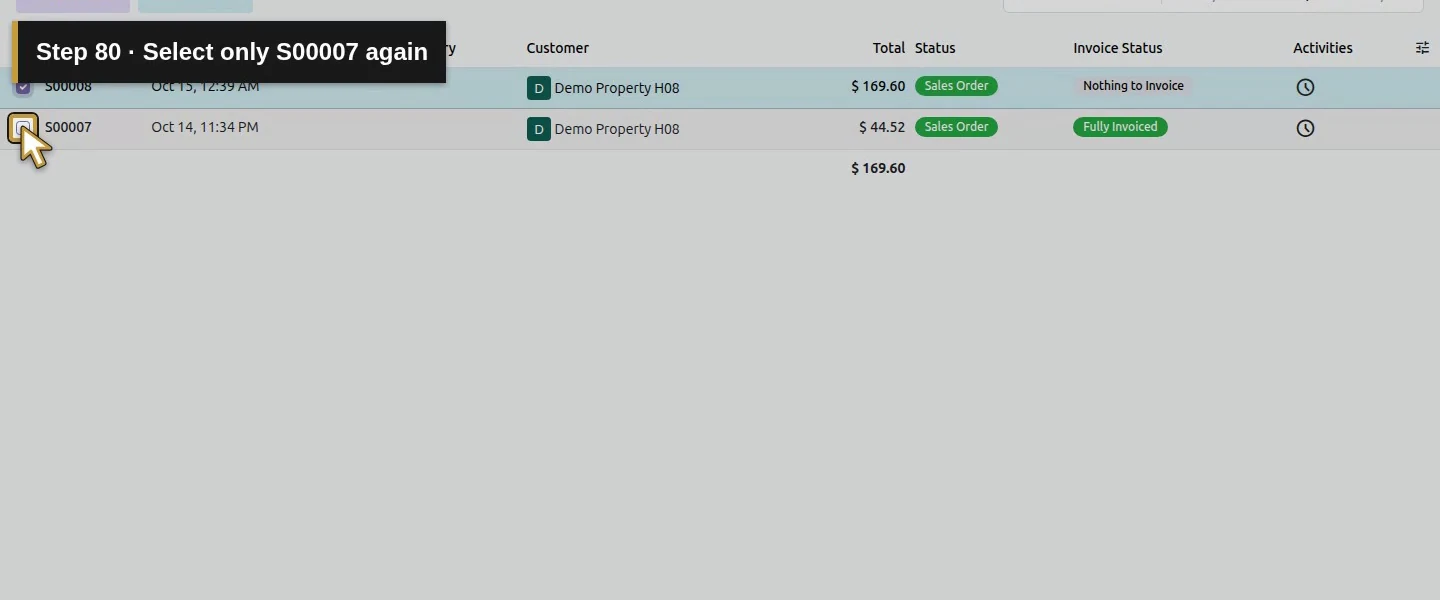
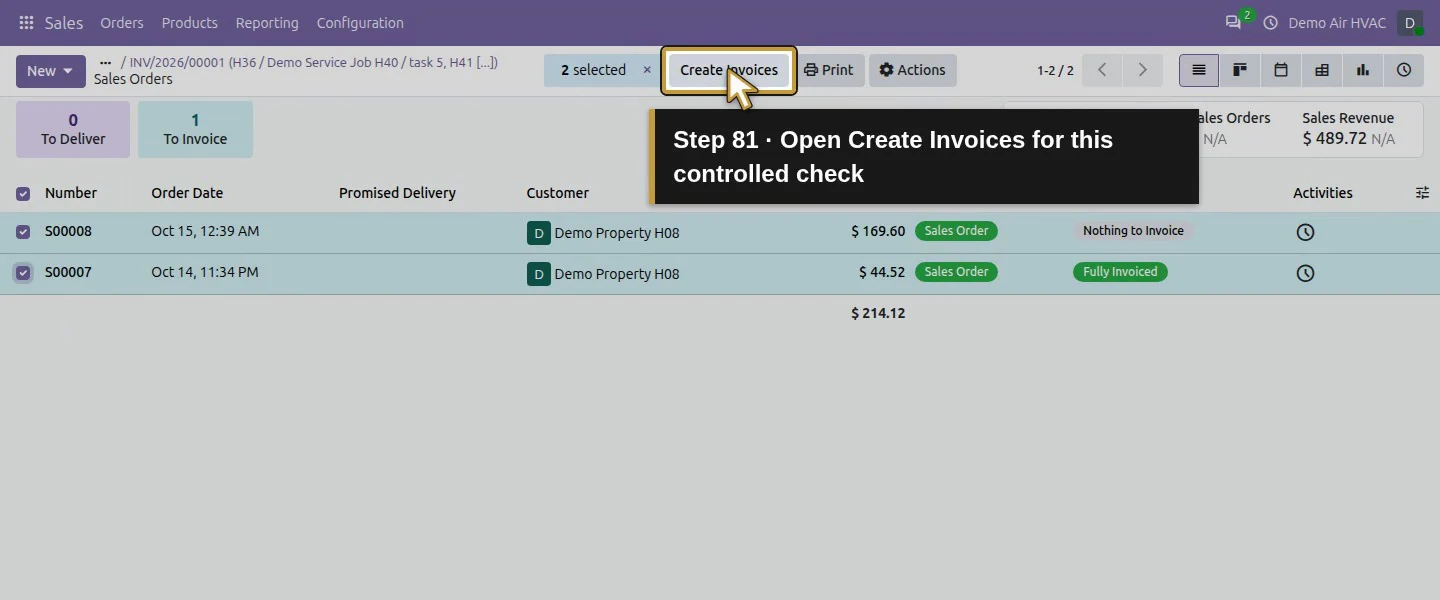
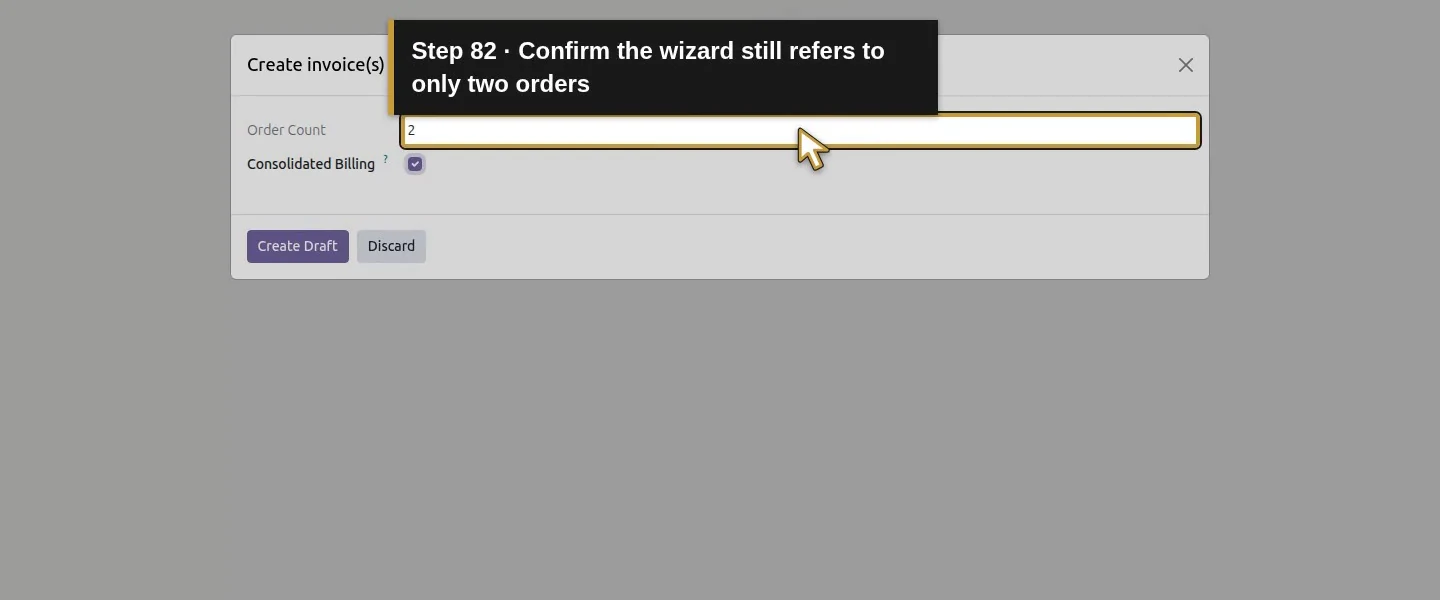
Open Sales and its order list. Tick the rows S00007 and S00008, confirming 2 selected and the right customer. Click Create Invoices. In Create invoice(s), check Order Count: 2 and the checked Consolidated Billing option. The initial dialog also exposes Timesheets Period; we left both date boundaries blank and included the sole eligible entry. A date-restricted period was not tested.
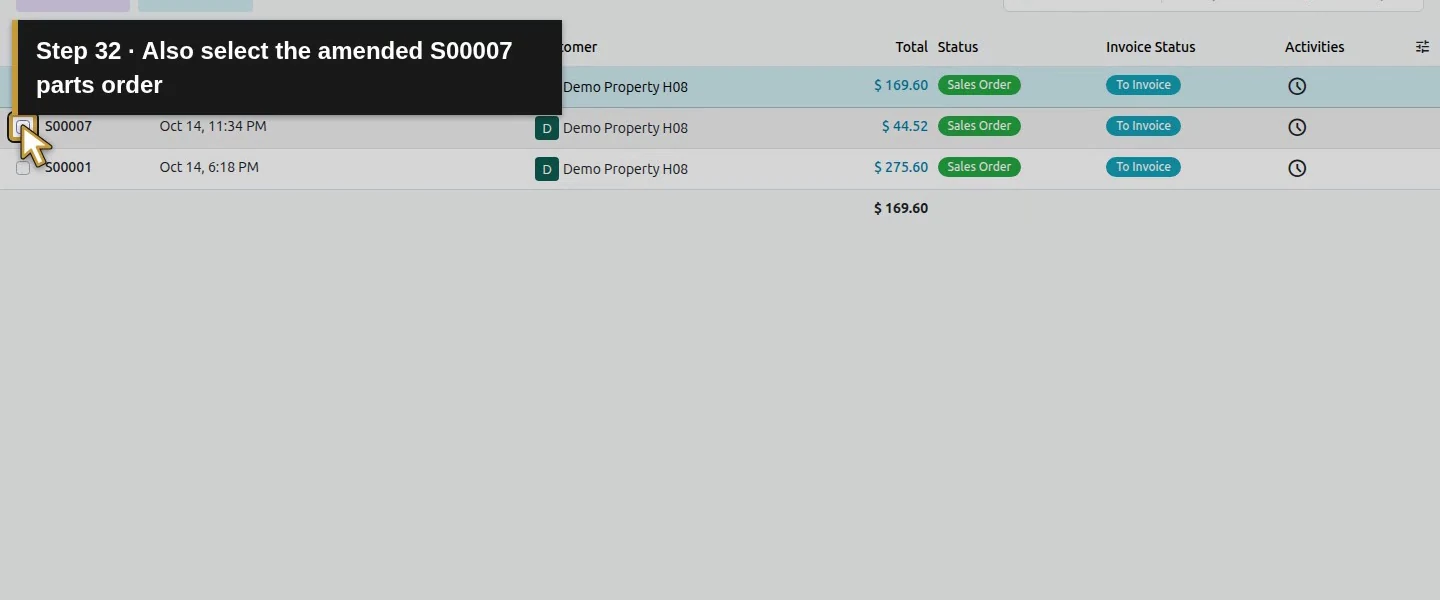
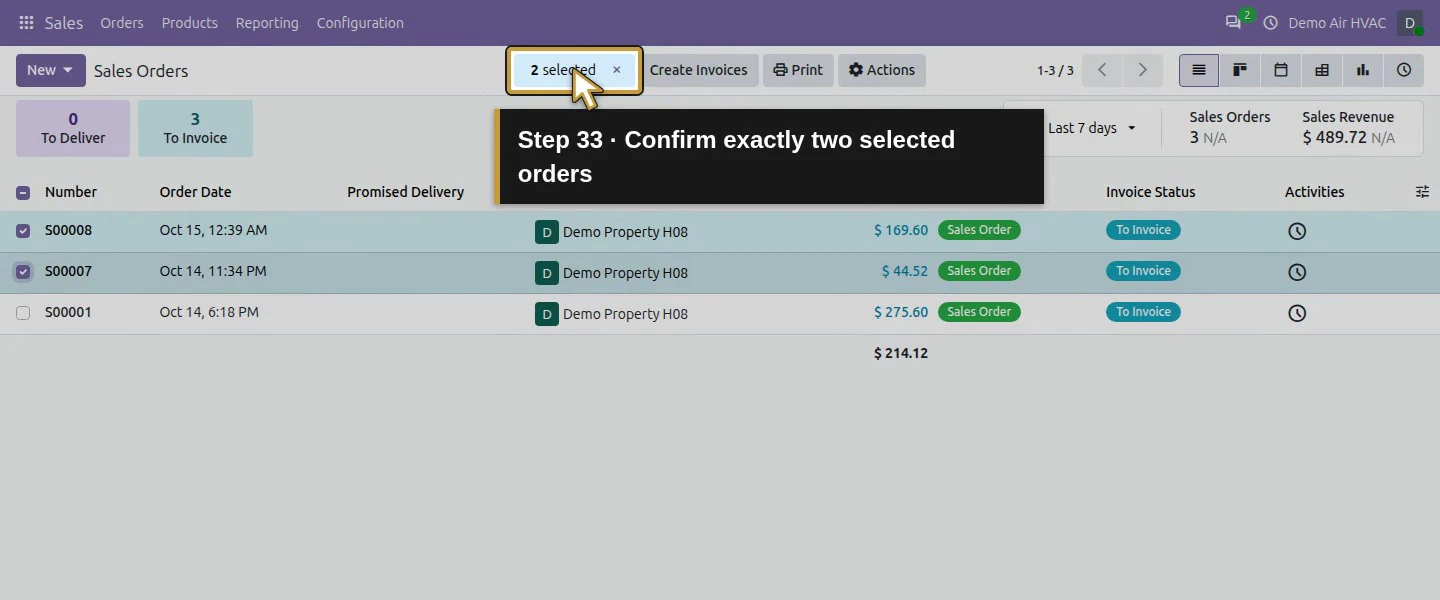
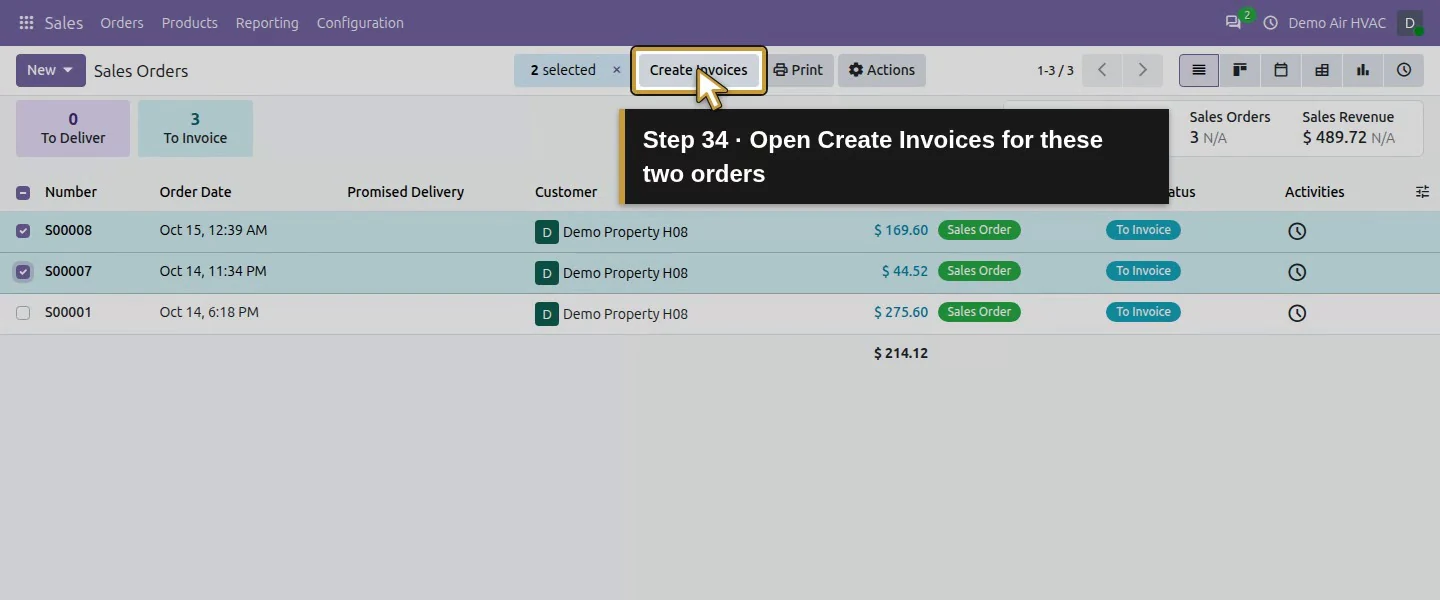
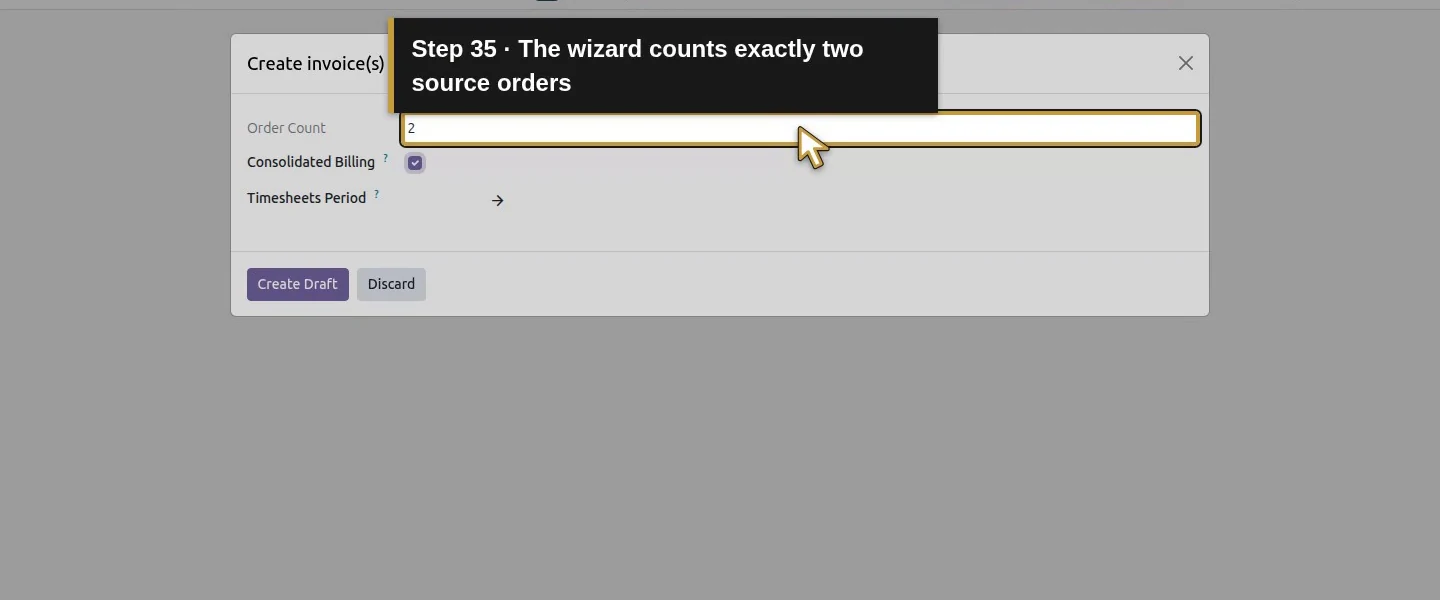
Step 4. Create one draft and match its exact lines
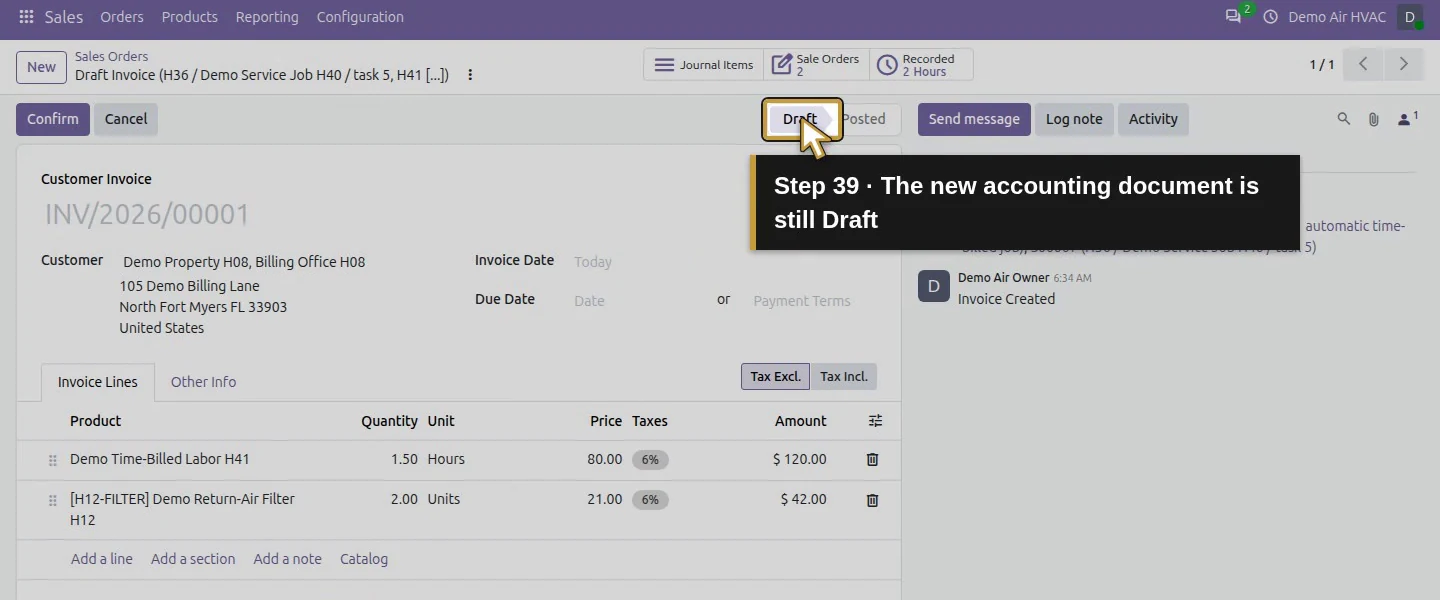
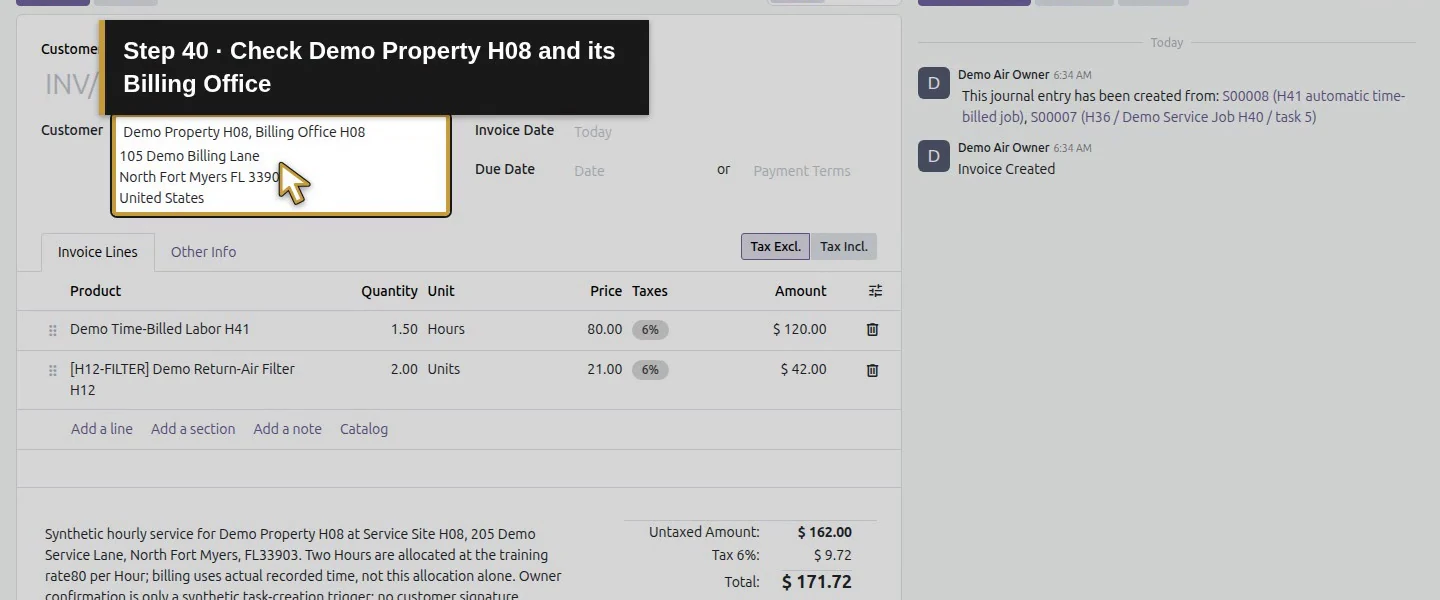
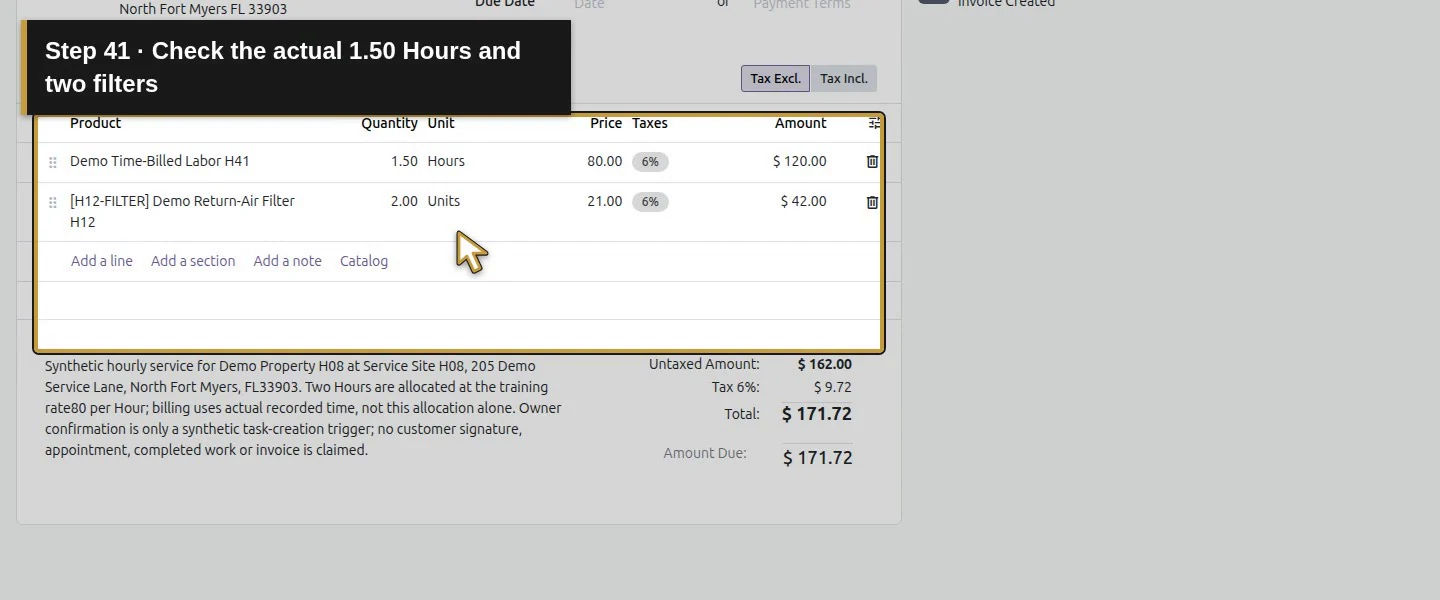
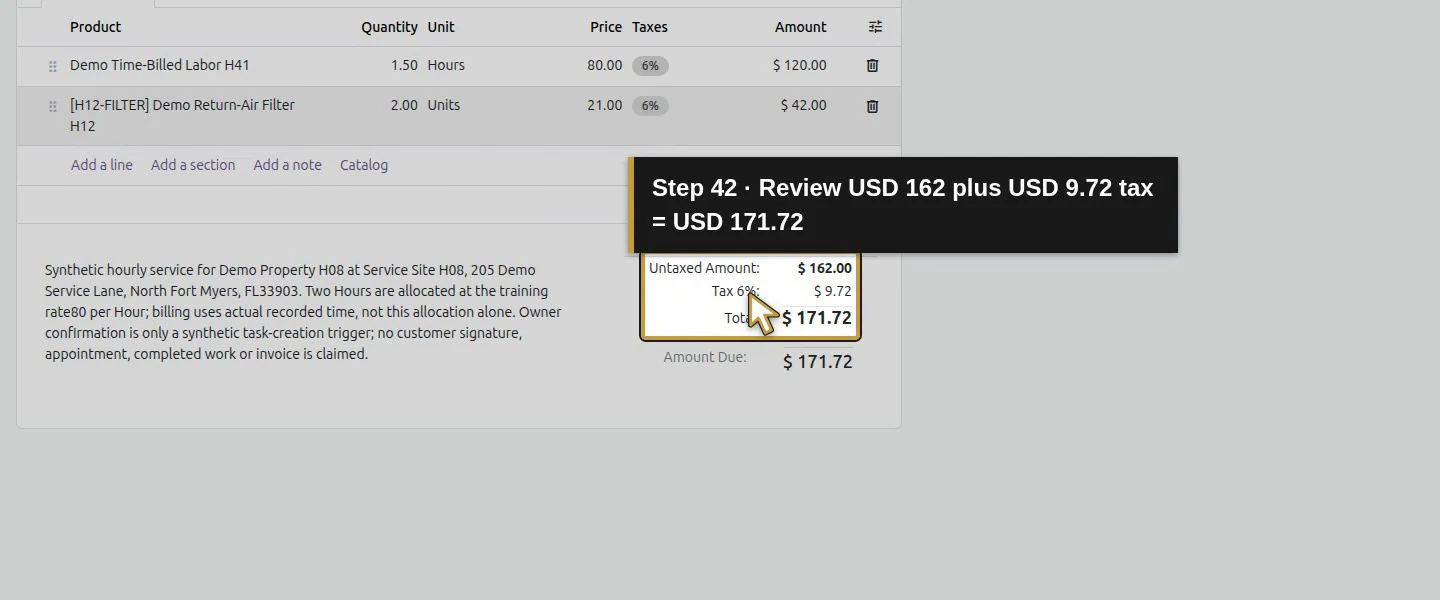
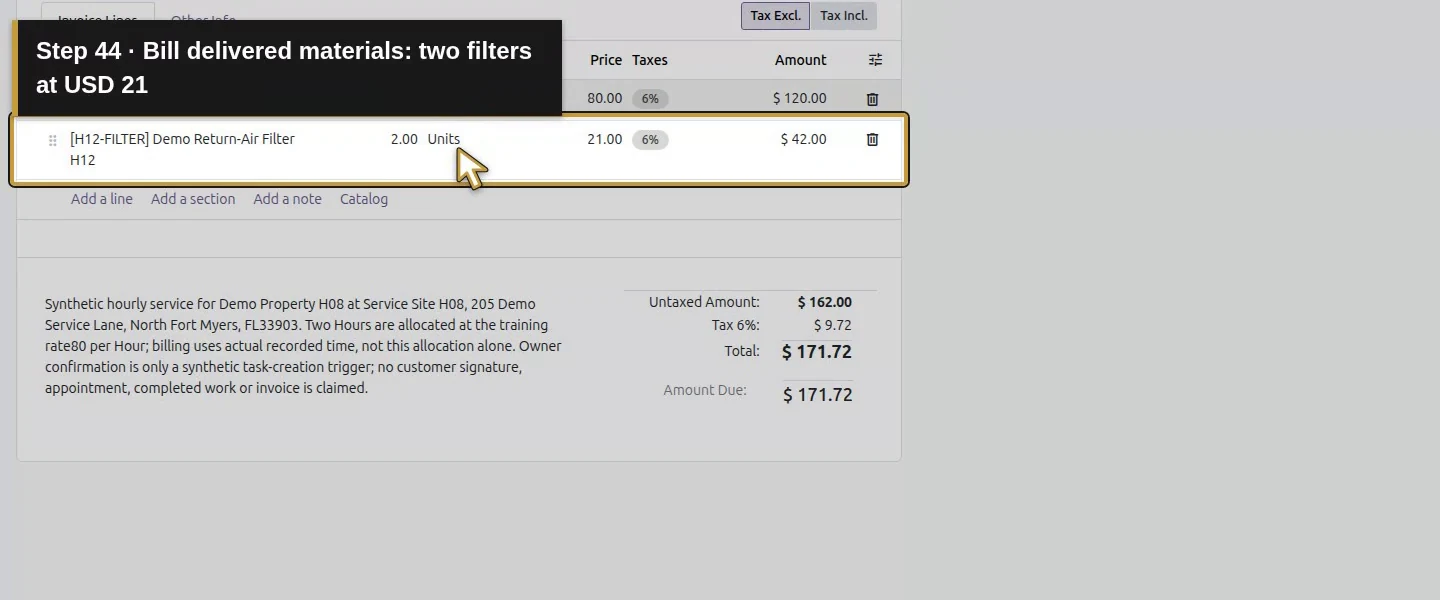
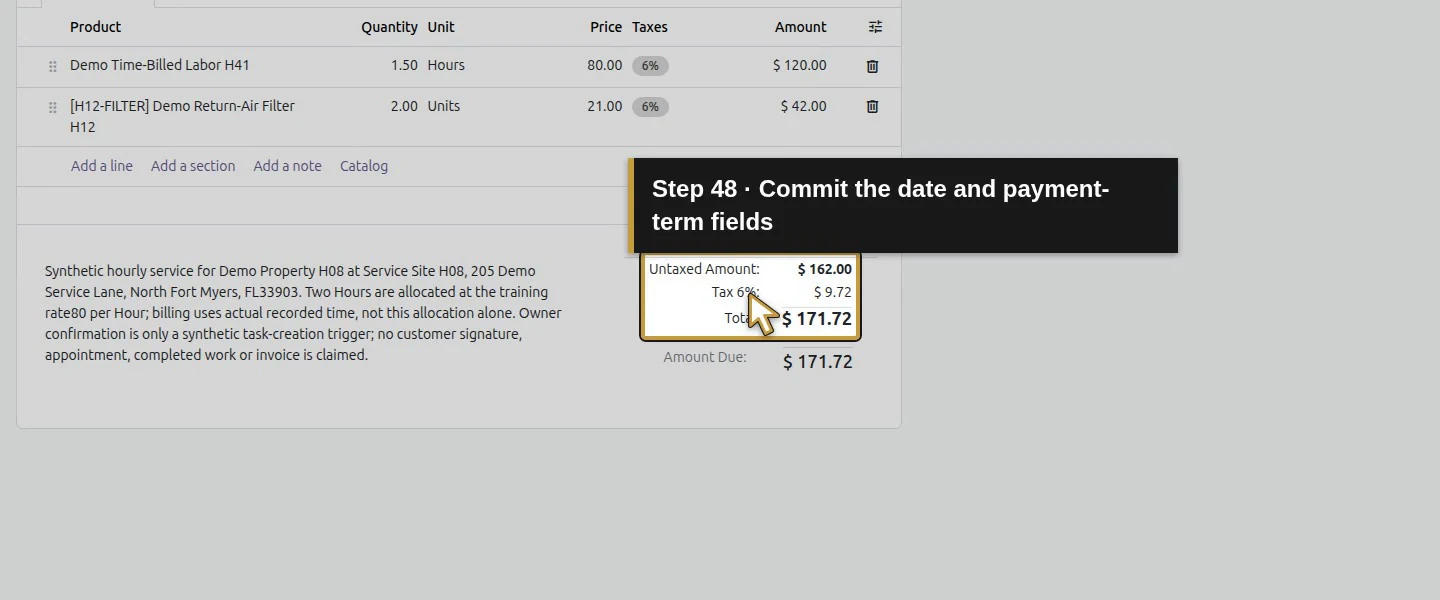
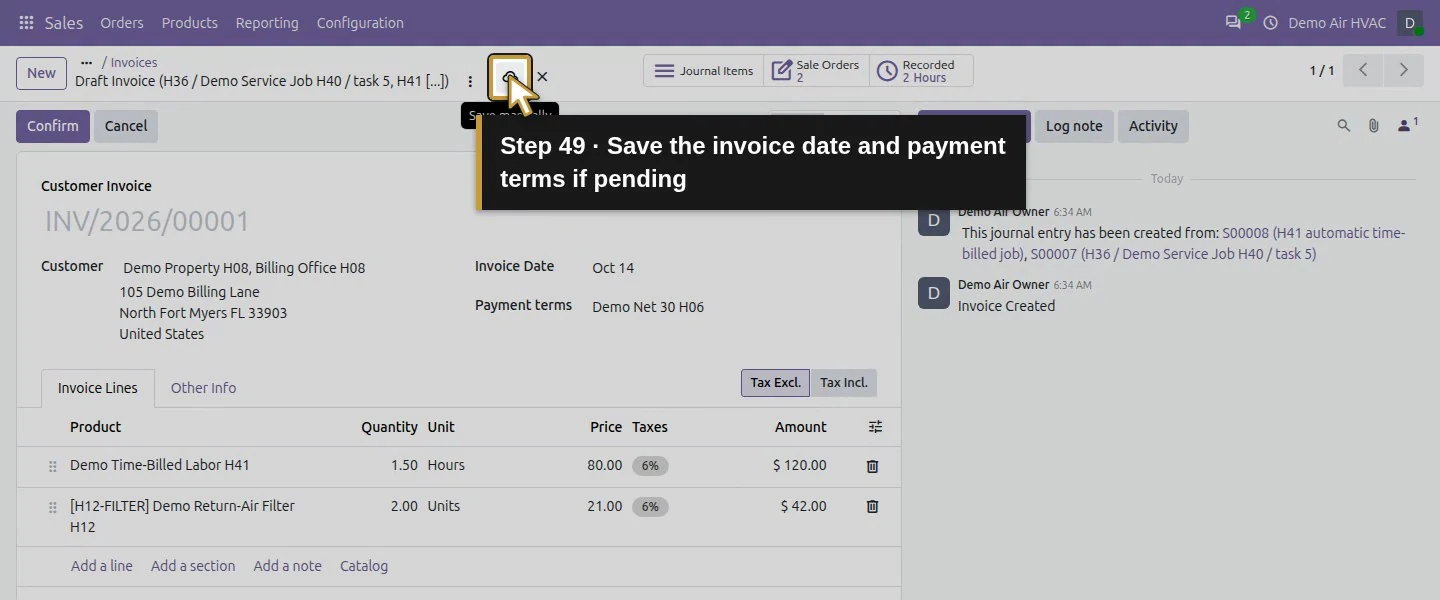
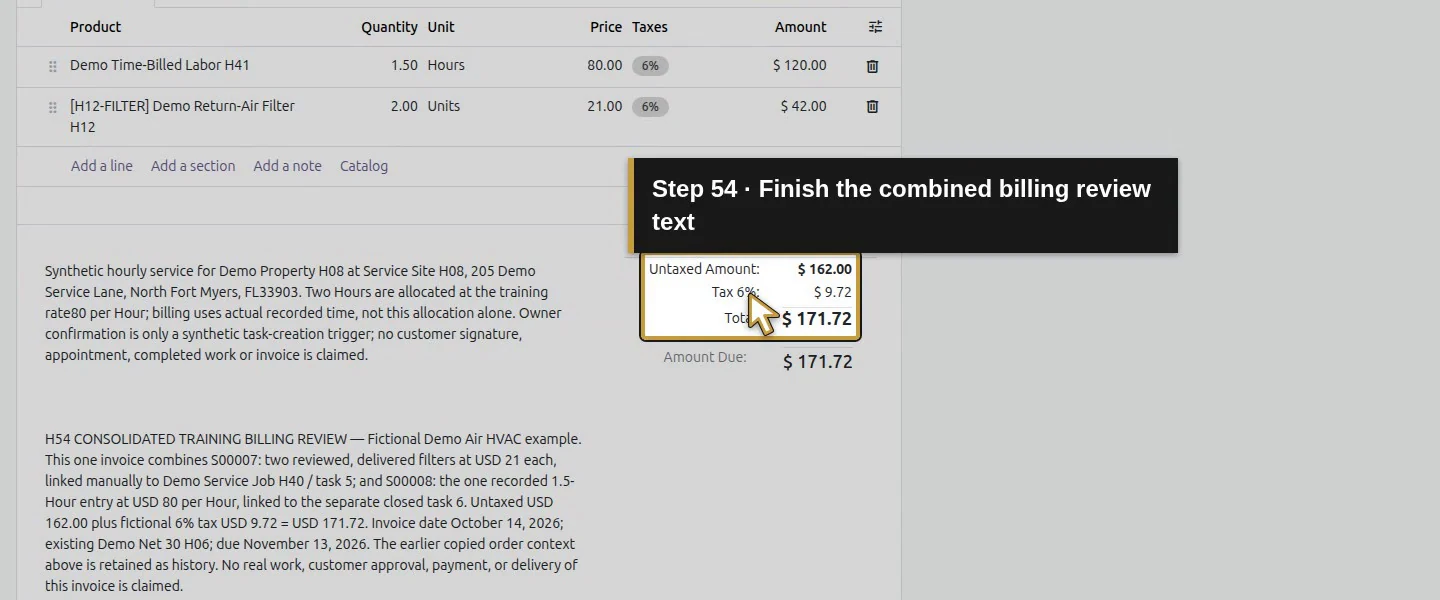
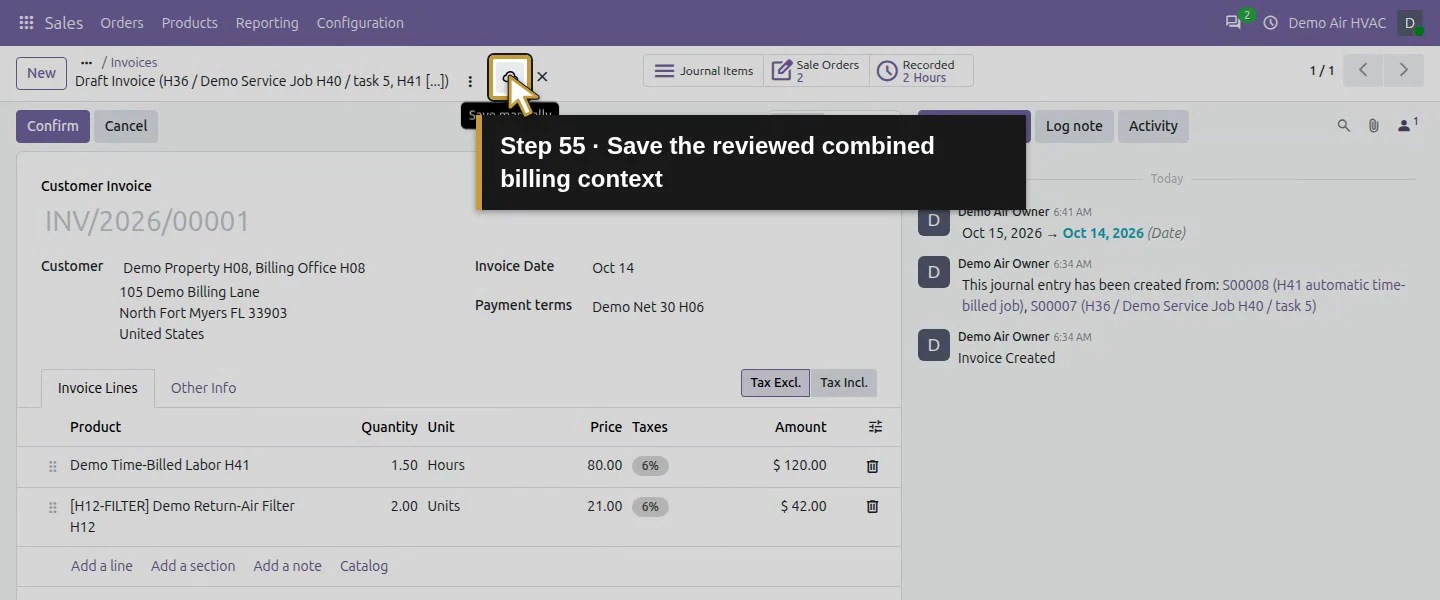
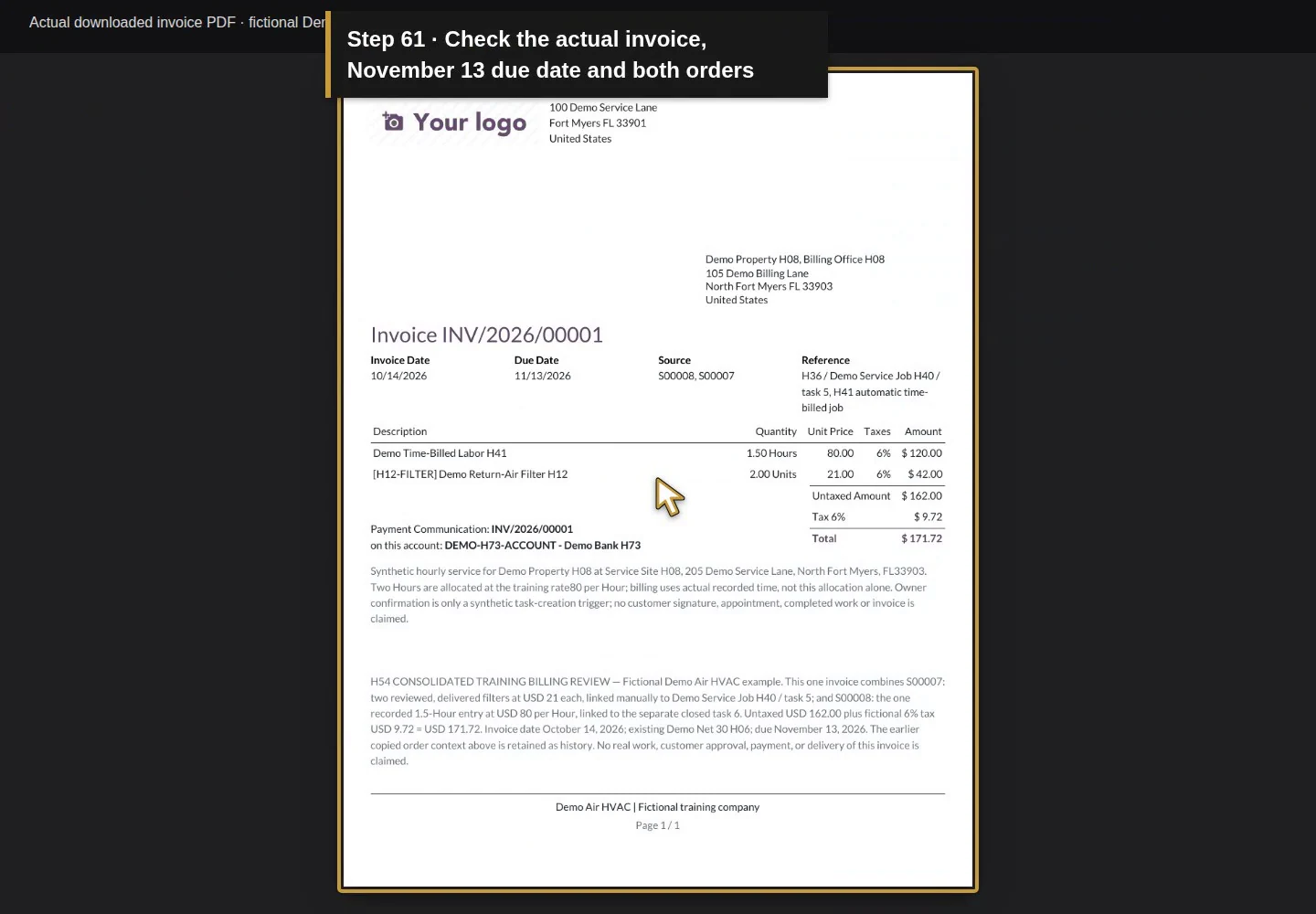
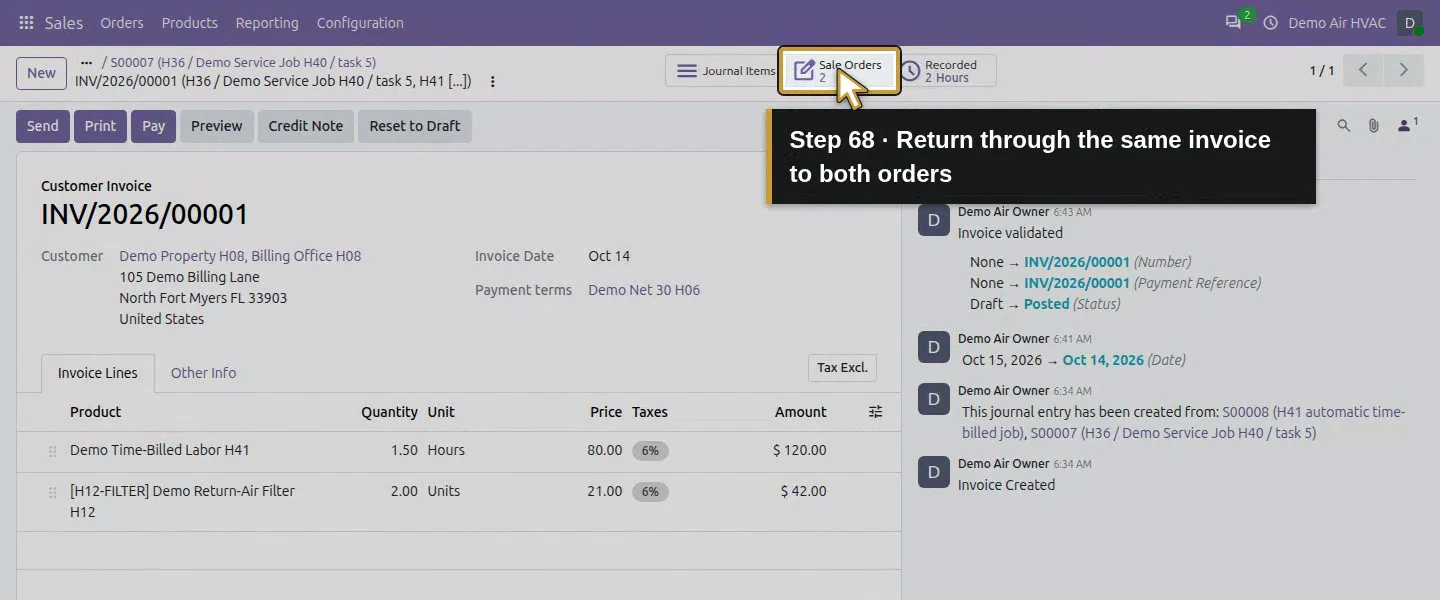
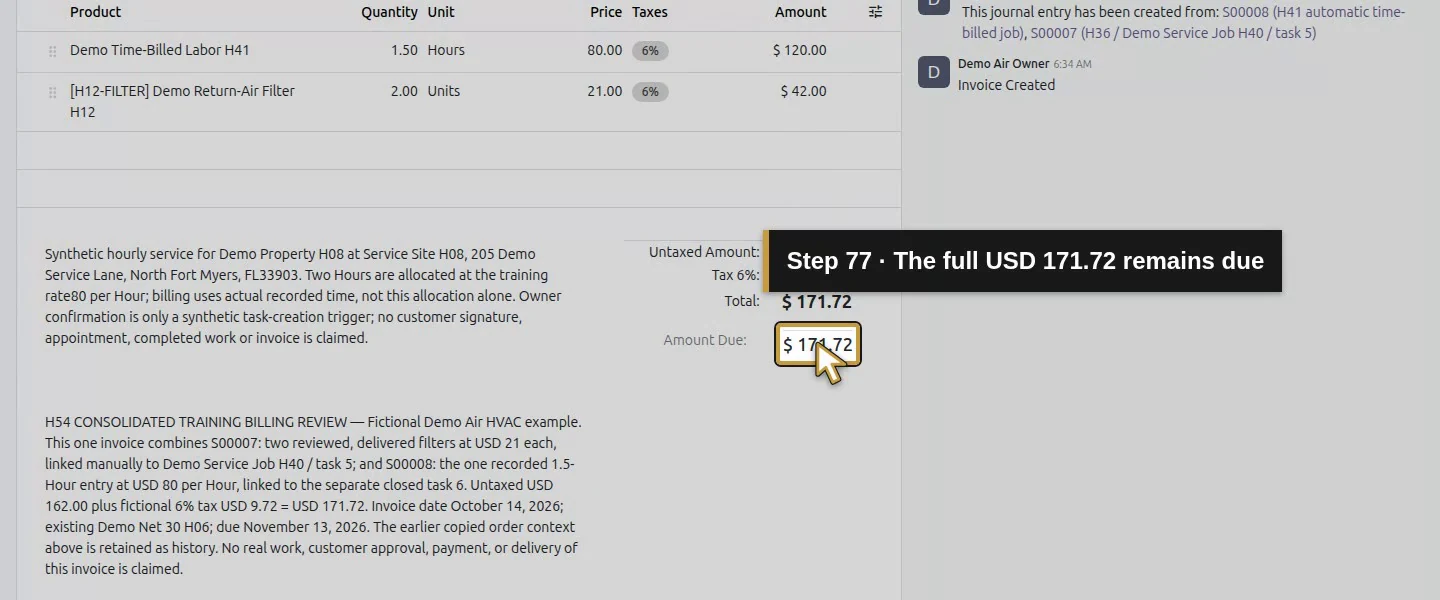
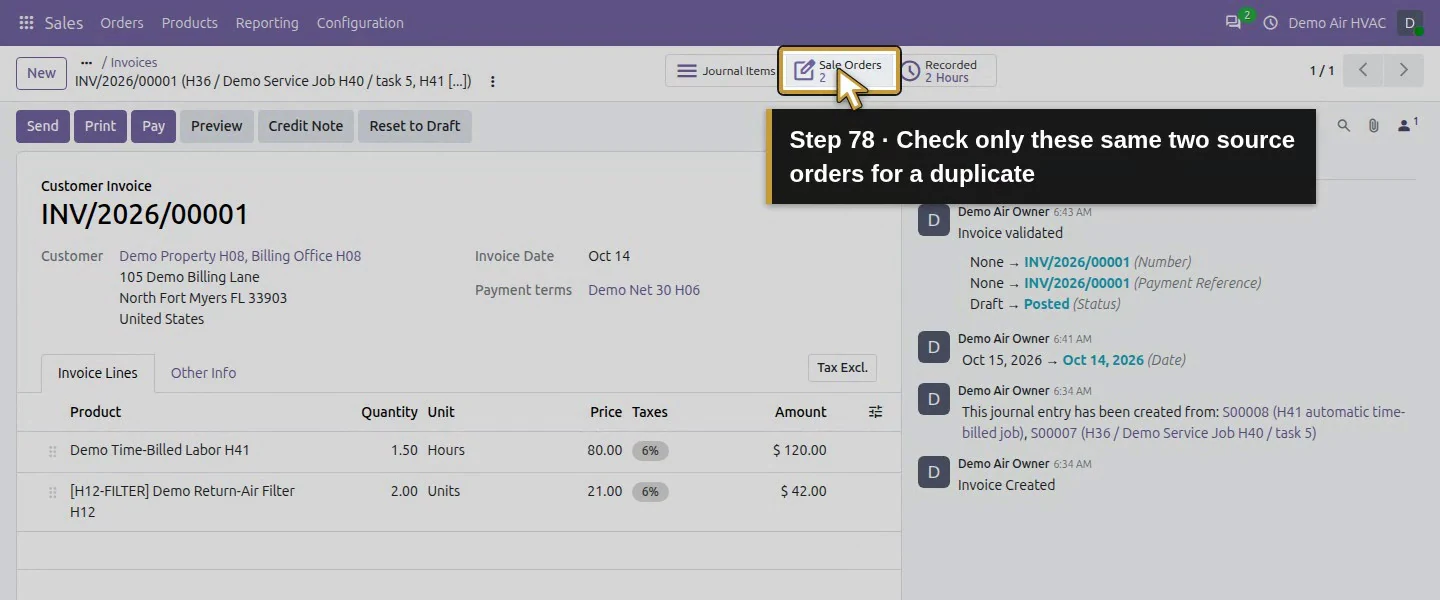
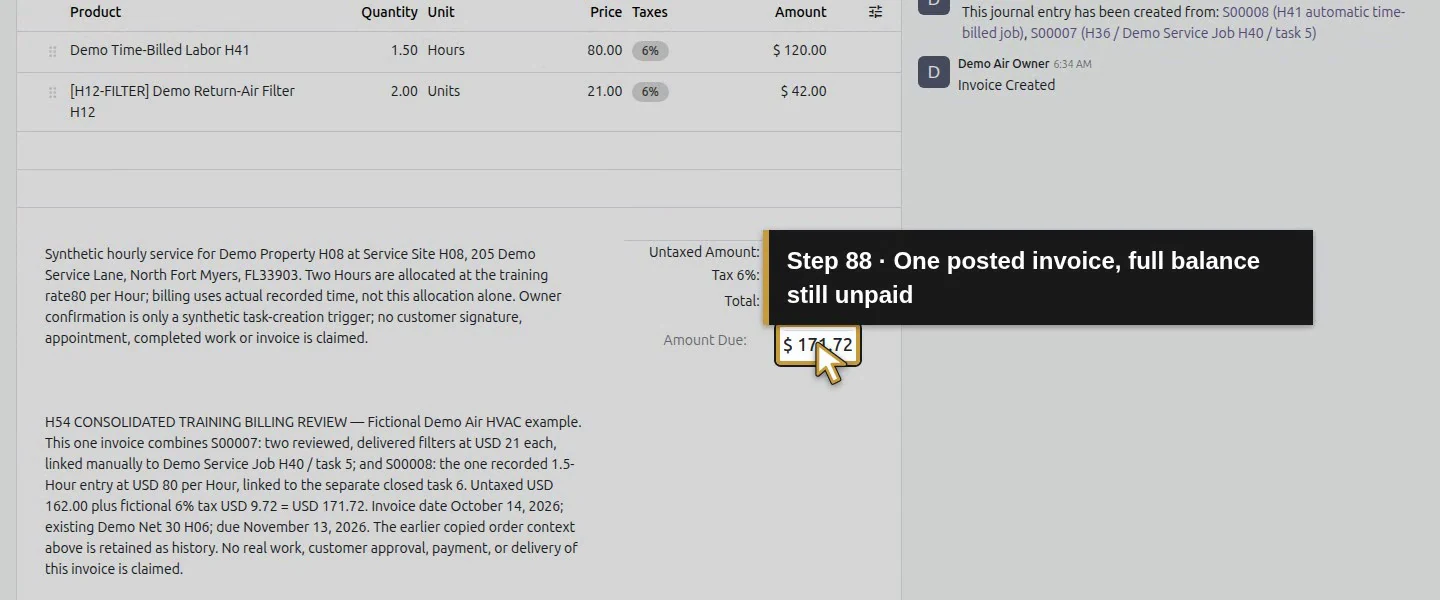
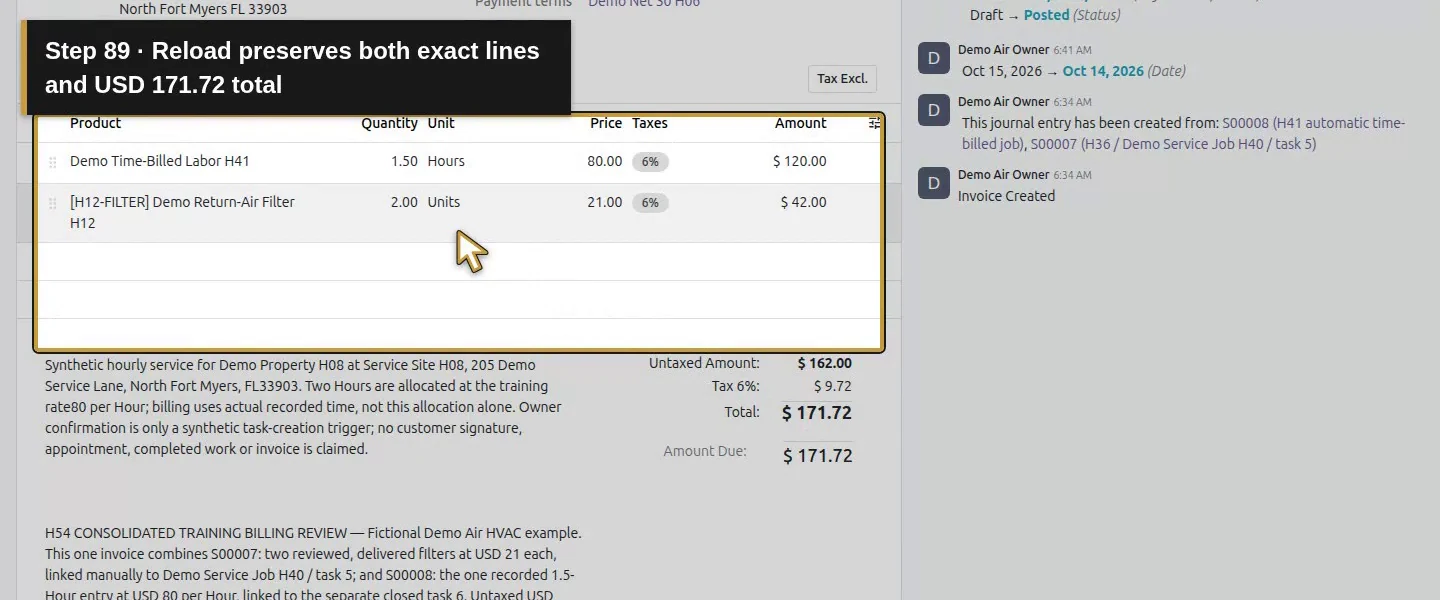
Click Create Draft once. The native result is one draft Customer Invoice addressed to Demo Property H08, Billing Office H08, with 2 Sale Orders linked. Check exactly two product lines: Demo Time-Billed Labor H41 — 1.50 Hours × $80 = $120 and Demo Return-Air Filter H12 — 2.00 Units × $21 = $42. The totals are $162 untaxed + $9.72 demo tax = $171.72. Both invoice lines retain their intended sales-line links. Do not replace the time quantity with the estimate.
Step 5. Set the actual invoice date and existing term
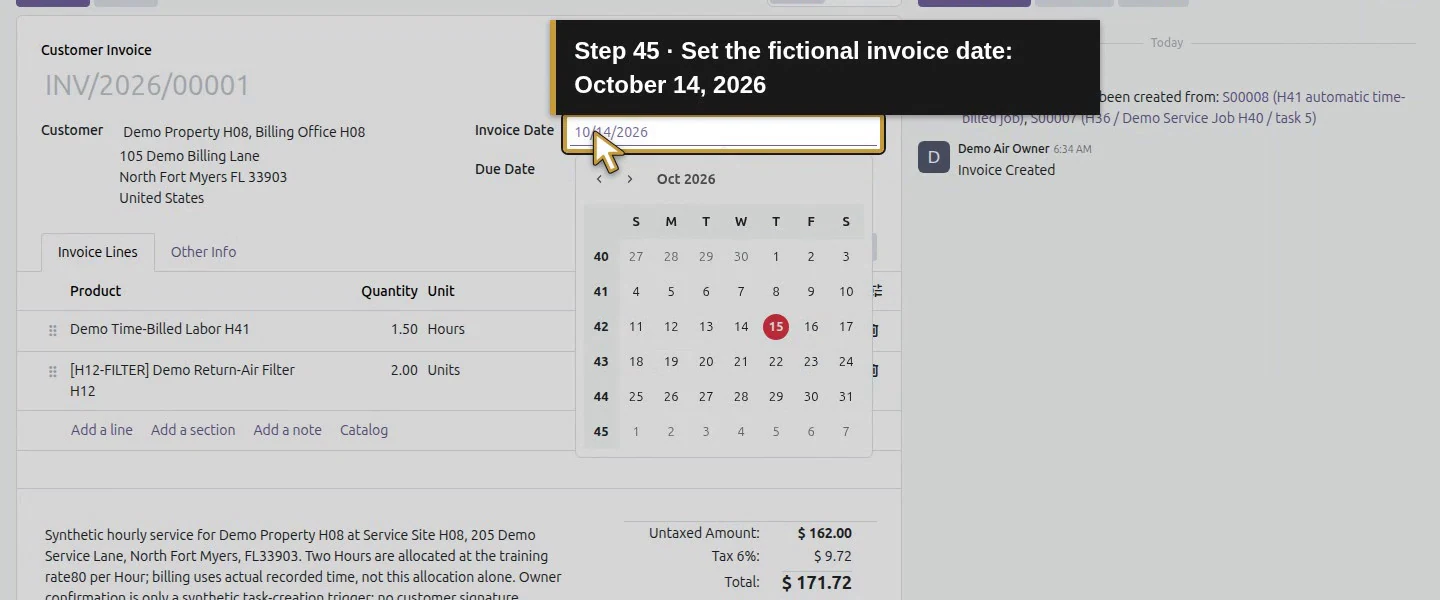
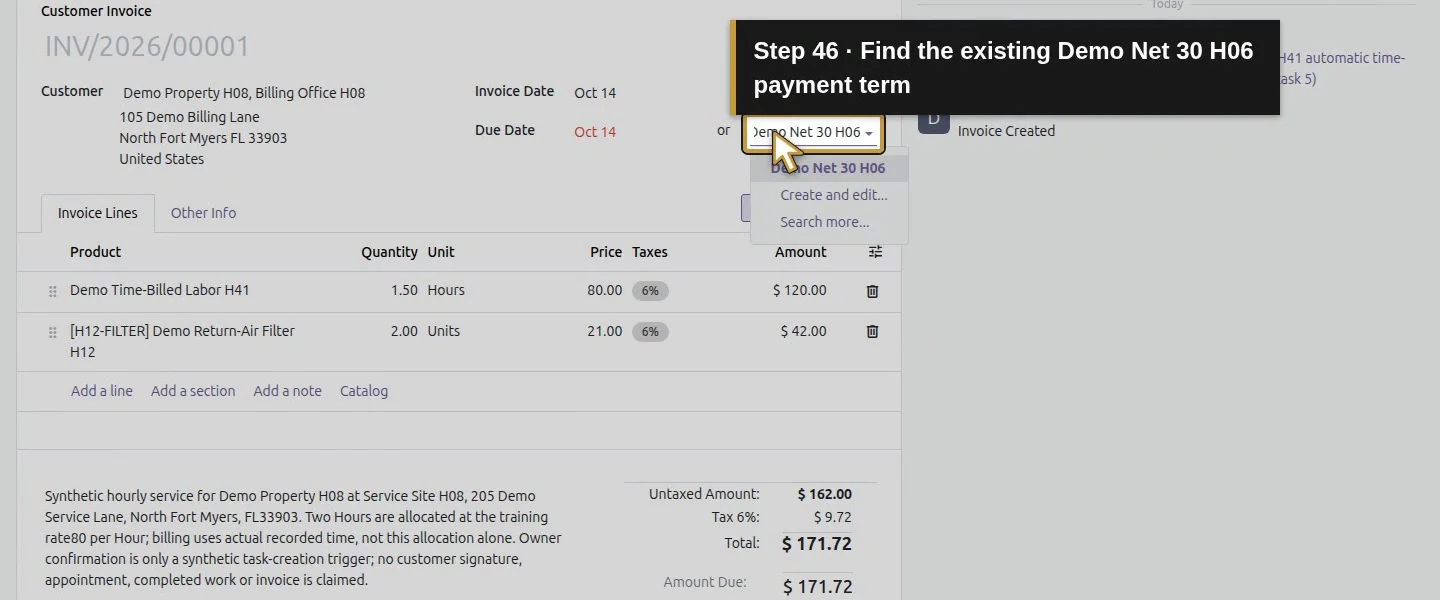
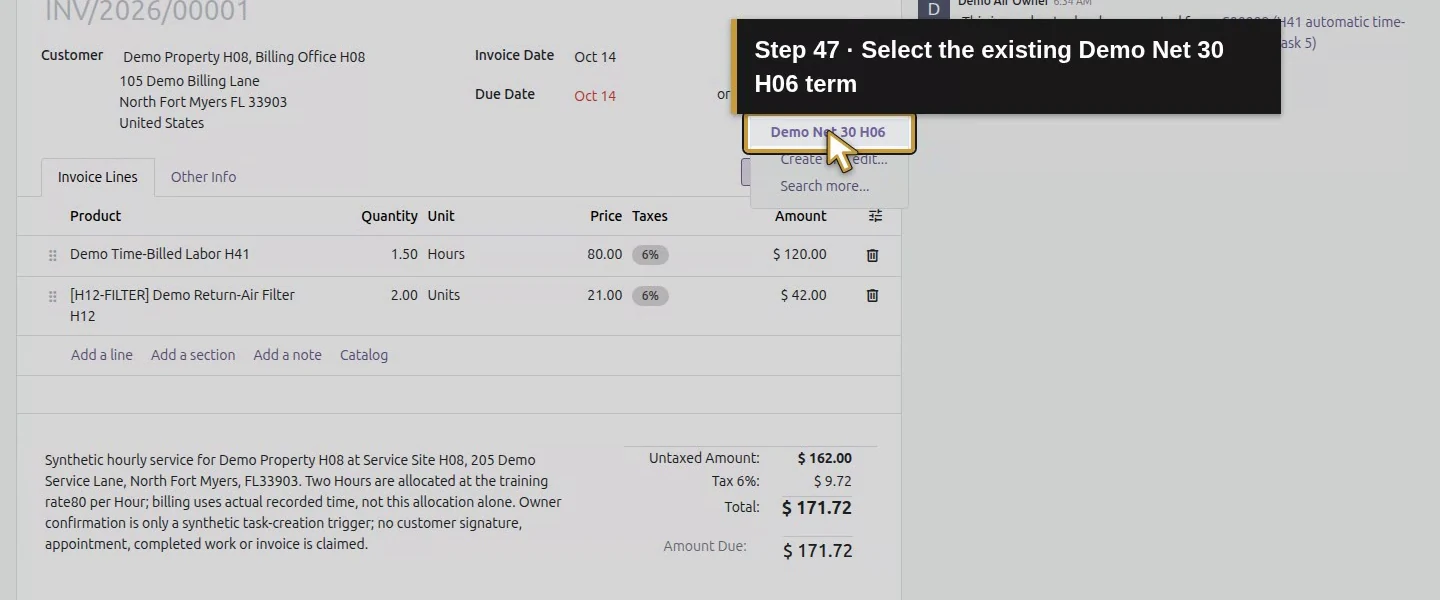
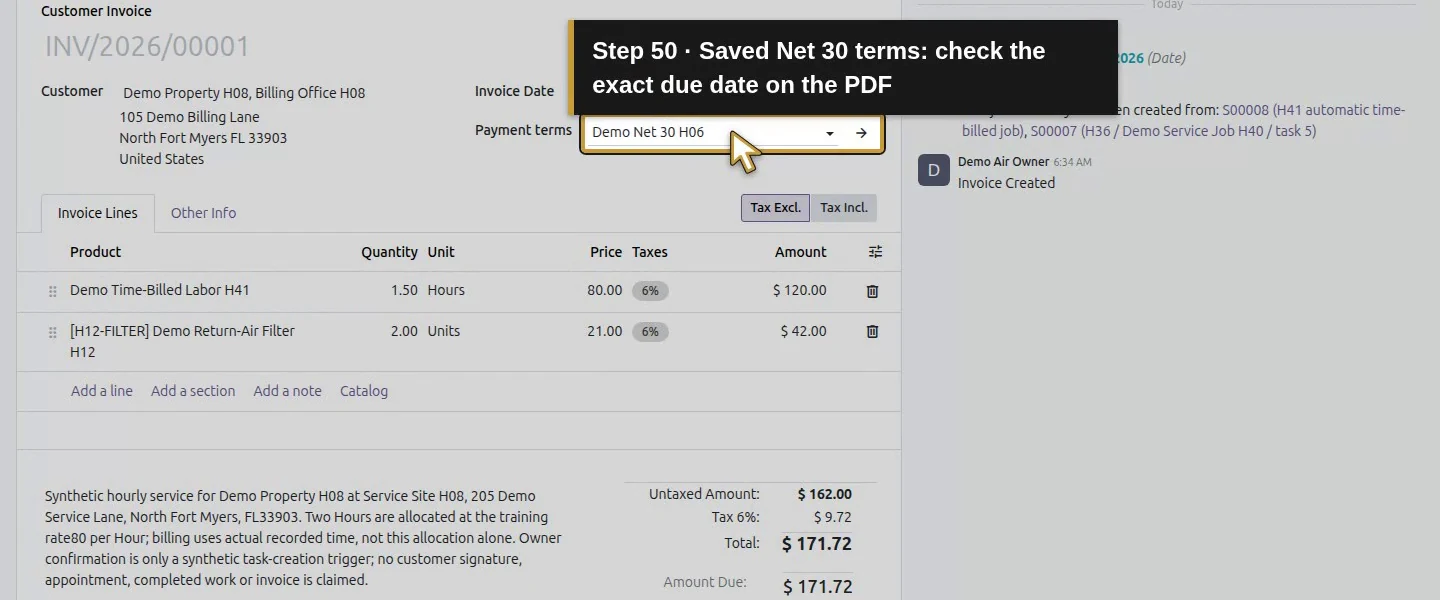
Enter 10/14/2026 in Invoice Date and finish the field. In Payment Terms, search and select the existing Demo Net 30 H06 option; do not merely leave typed search text or create another rule. Wait for pending changes to clear and use Save manually if that control remains visible. In this native invoice form the date/term had already persisted before a later manual-save attempt. Saved values are October 14, 2026, term Demo Net 30 H06 and calculated due date November 13, 2026. The source orders had no selected term, so the invoice choice was deliberate.
Step 6. Review address, terms and commercial context
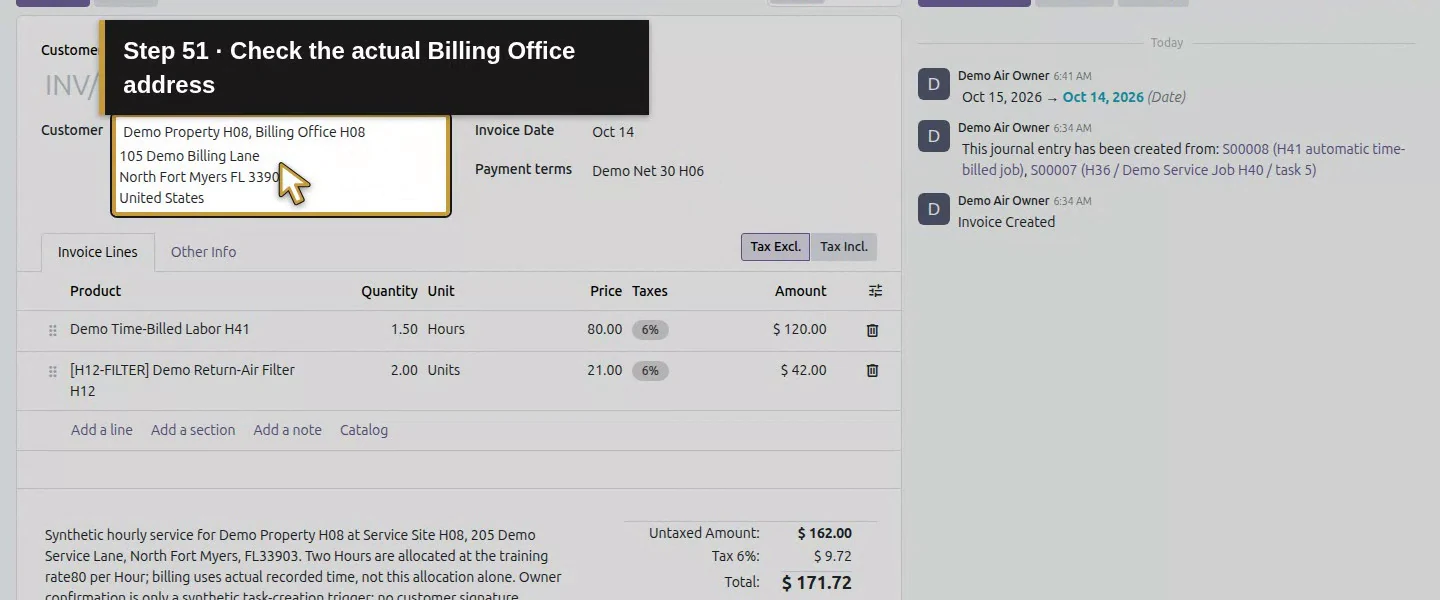
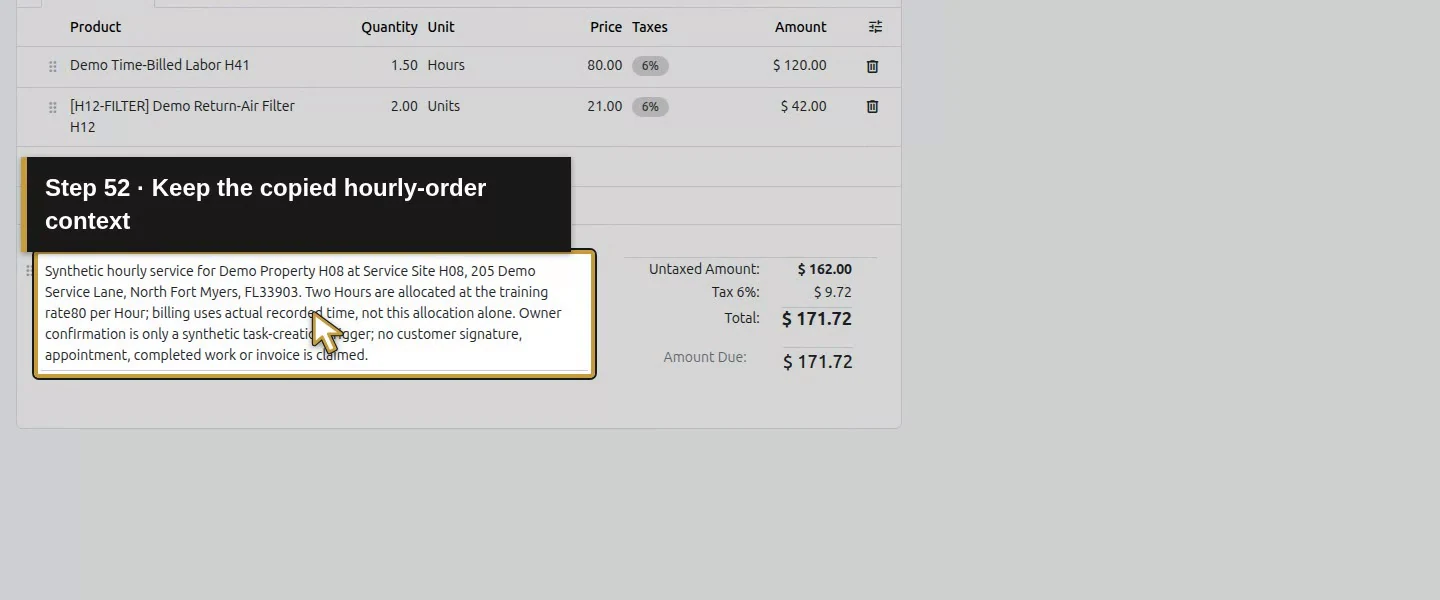
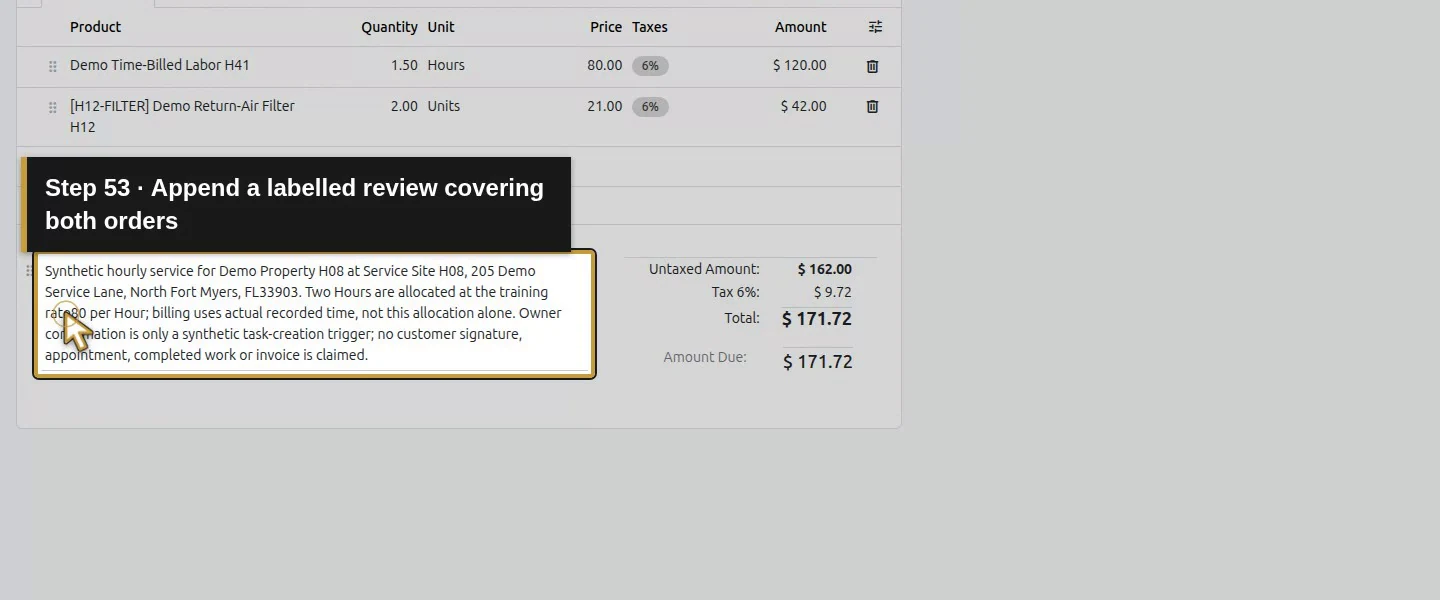
Check Billing Office H08, 105 Demo Billing Lane, currency, quantities, unit prices, demo tax and source-order links. Consolidation initially copied the hourly order’s narration; it did not automatically combine both orders’ written scopes. Preserve that context and append a clear training billing note identifying amended S00007’s two filters and S00008’s 1.5 hours, the selected term and the fictional nature of the example. Review the appropriate details before posting.
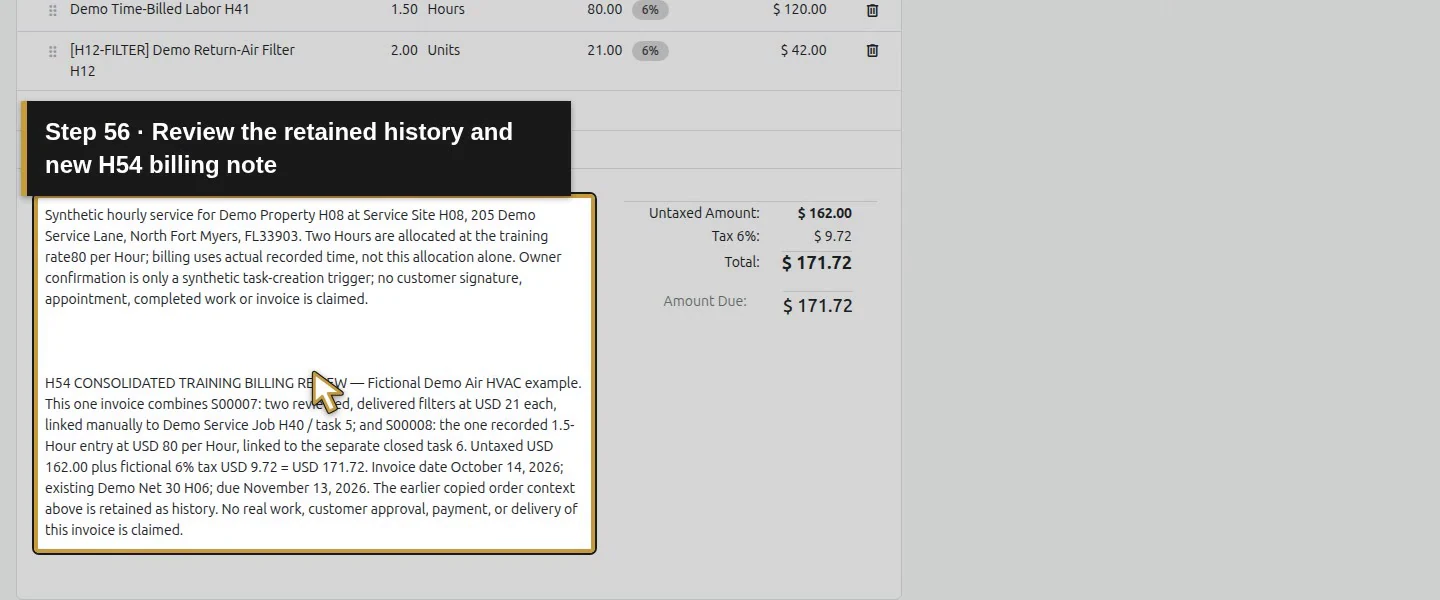
Step 7. Post the reviewed training invoice
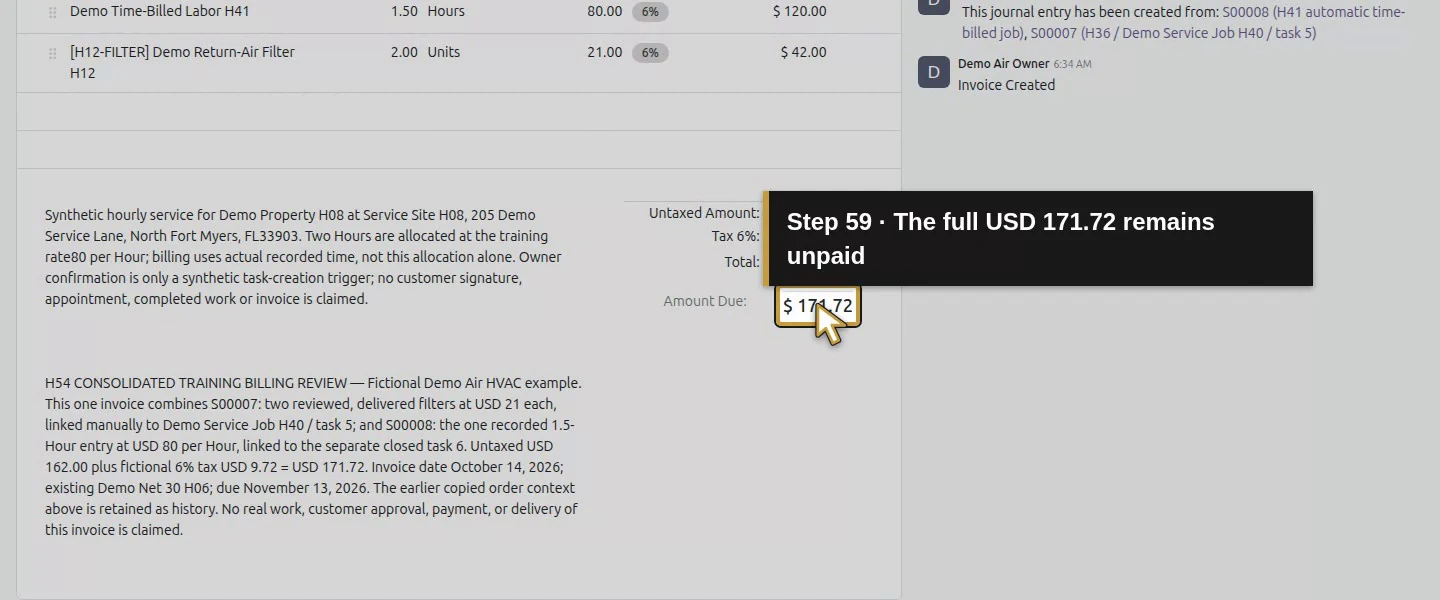
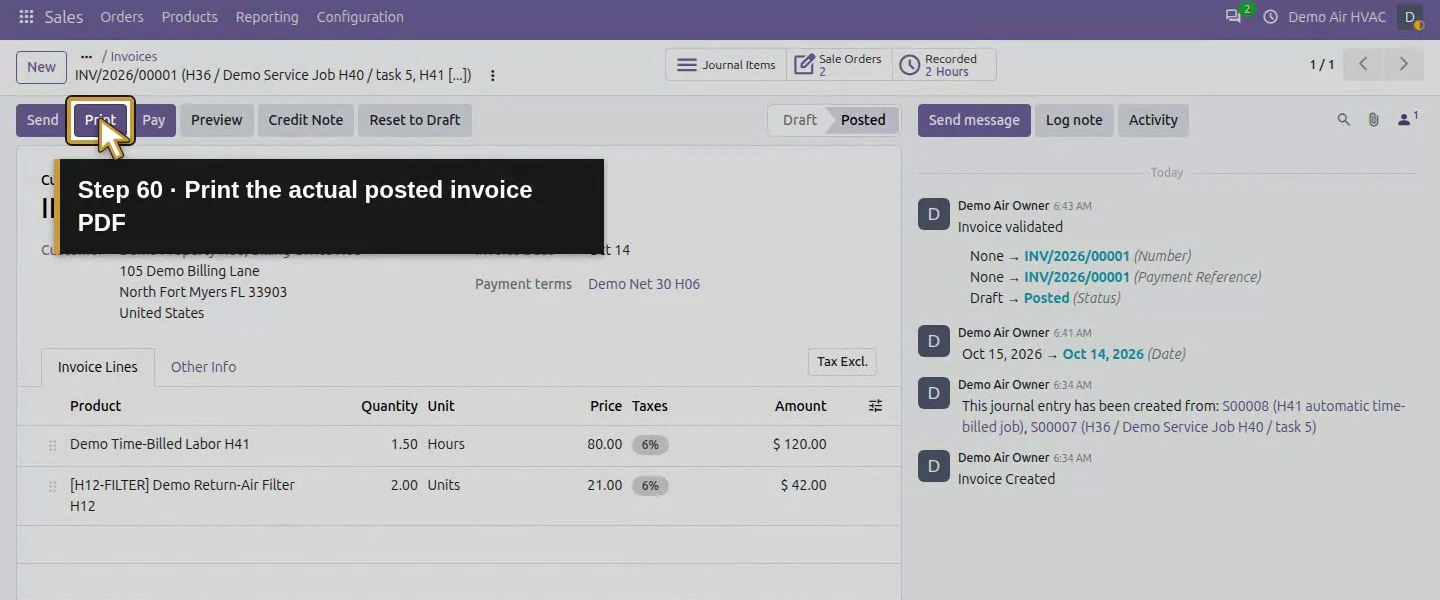
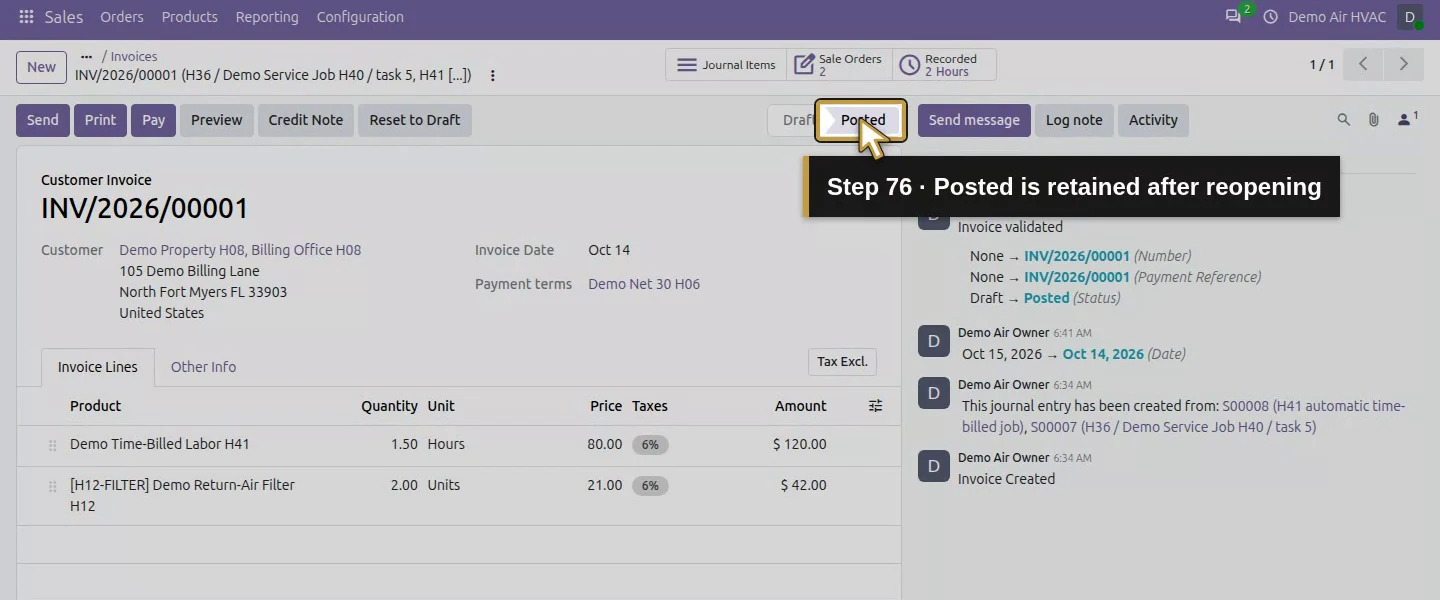
Click Confirm, the posting control on this draft. Wait for Posted and invoice number INV/2026/00001. The form shows Total: $171.72 and Amount Due: $171.72. Its saved payment state is unpaid; the journal entry balances with $171.72 debit and credit totals. Posting creates the accounting document. It did not collect a payment or send this invoice to the customer.
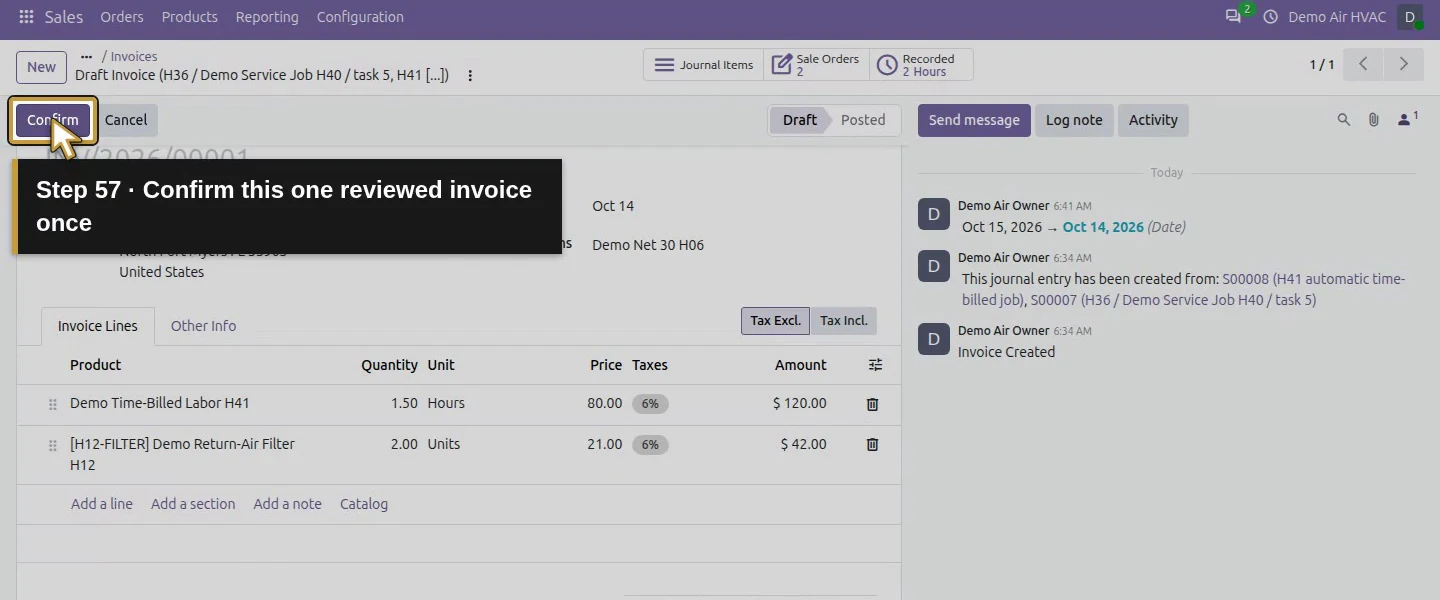
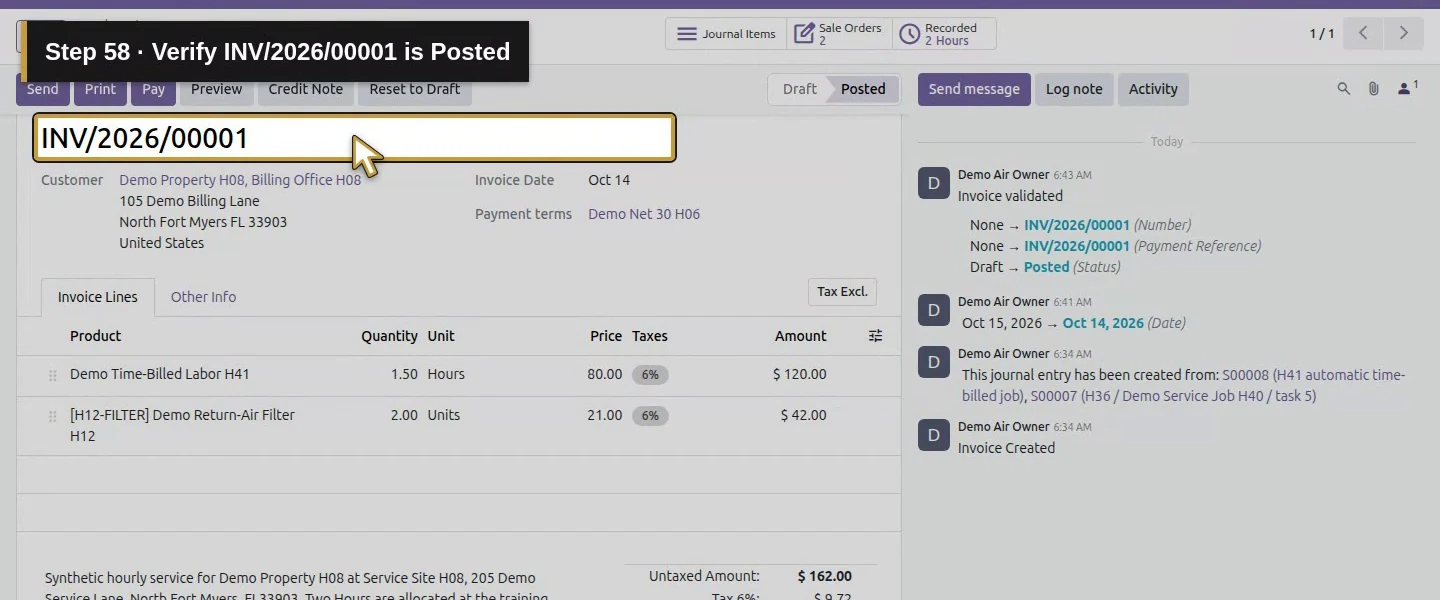
Step 8. Download and inspect the native invoice PDF
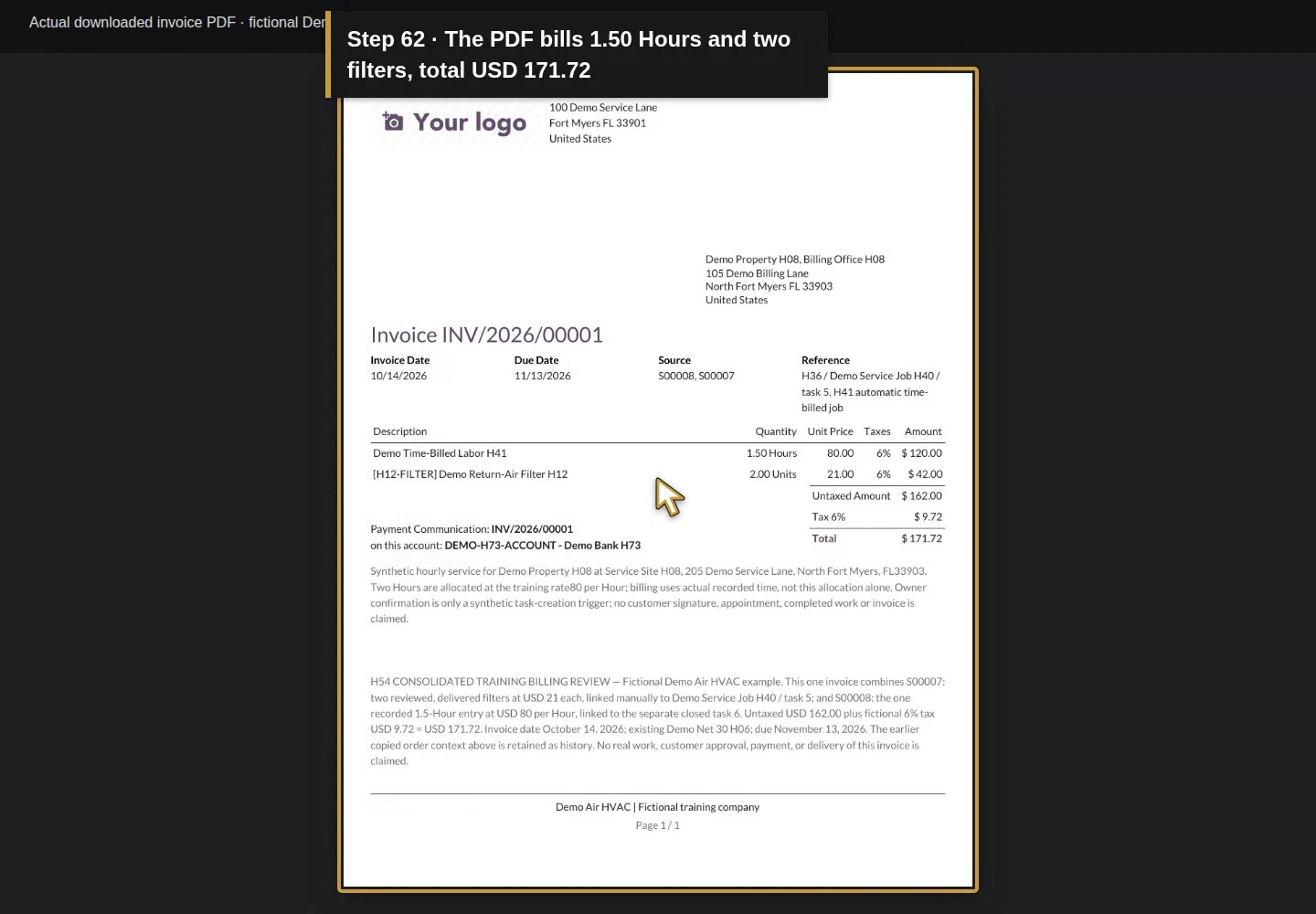
Click Print and open the actual PDF download. Check invoice number, both source orders, billing address, 10/14/2026, 11/13/2026, the exact two line quantities, totals and footer. The one-page file retains H05’s configured placeholder logo and Demo Air HVAC | Fictional training company footer; no layout change was needed. This also supplies the actual invoice-output check deferred by the document-layout guide. It is a training document, with an explicitly fictional payment account.
Step 9. Reconcile both order links and already billed time
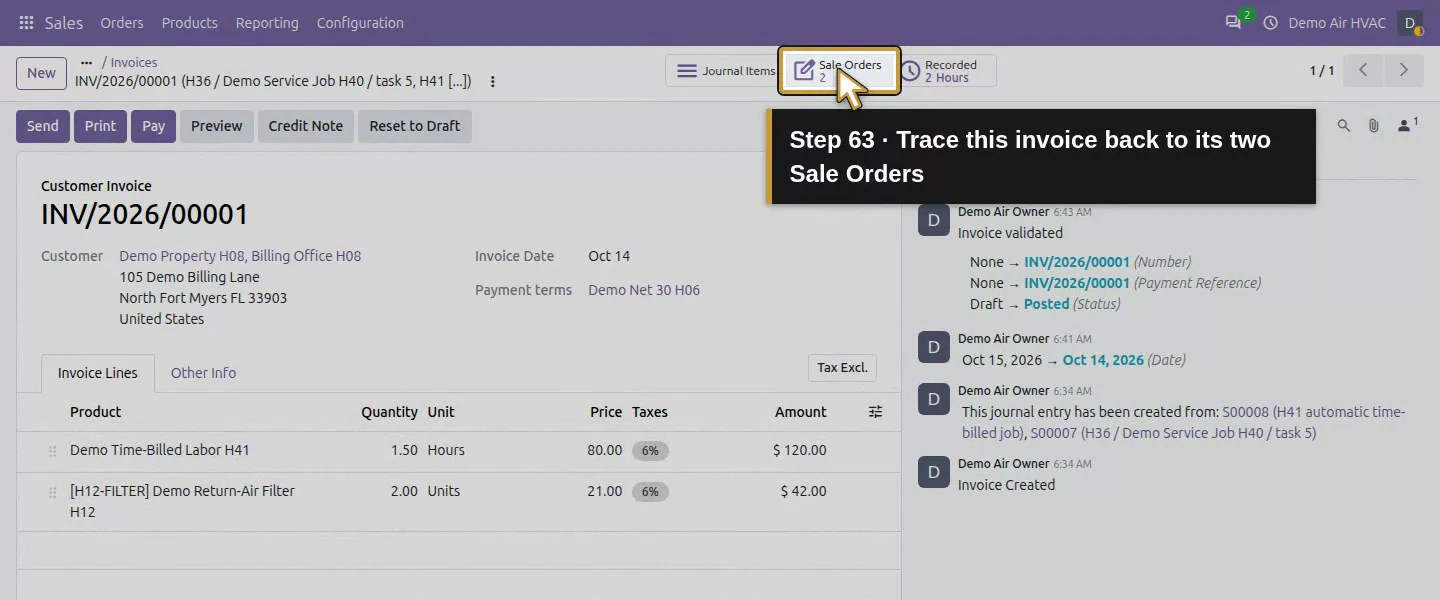
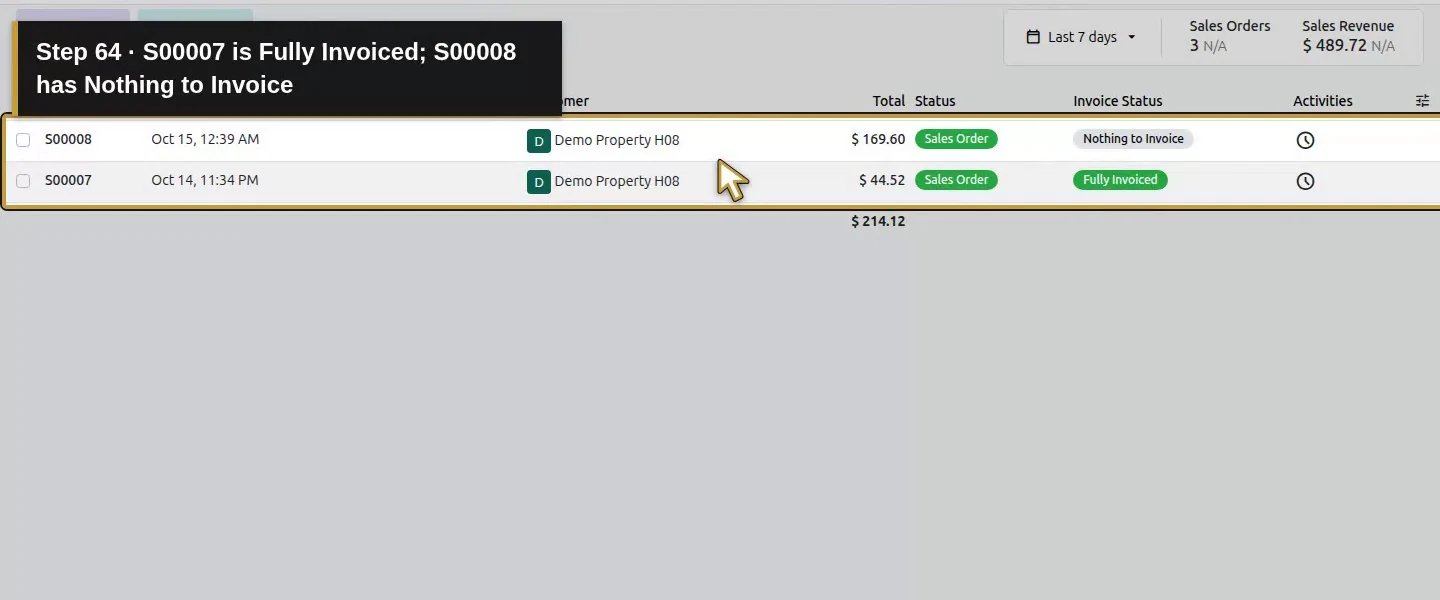
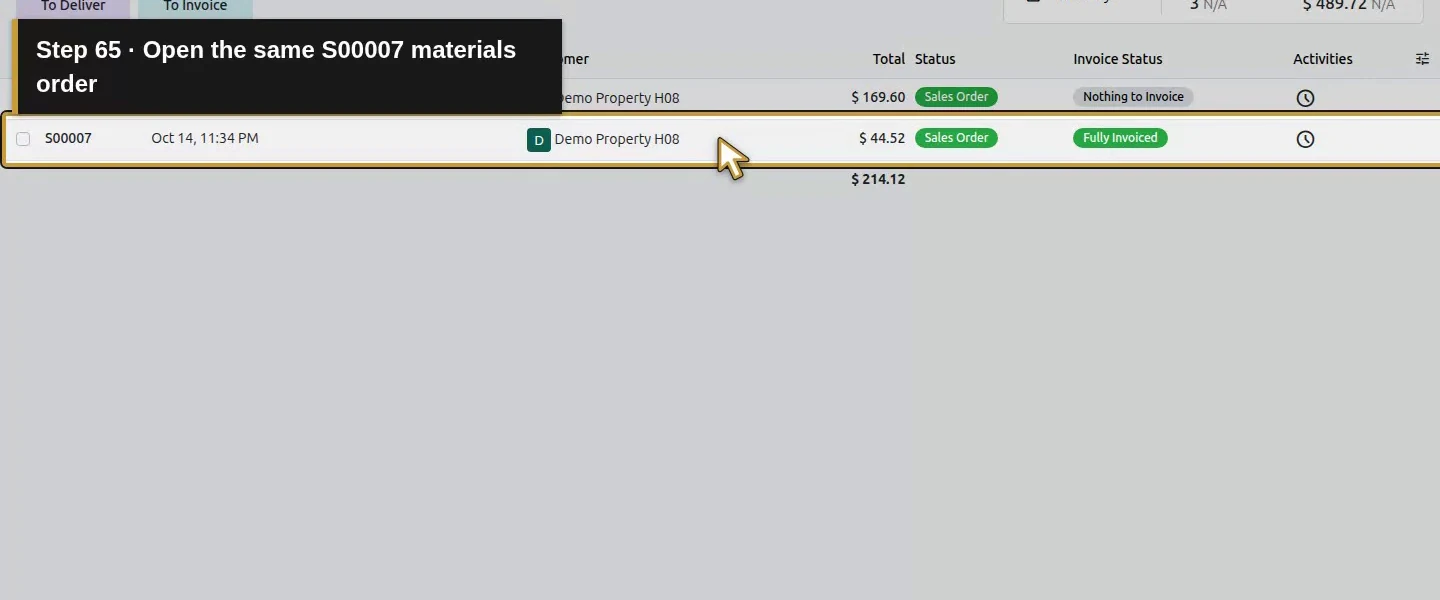
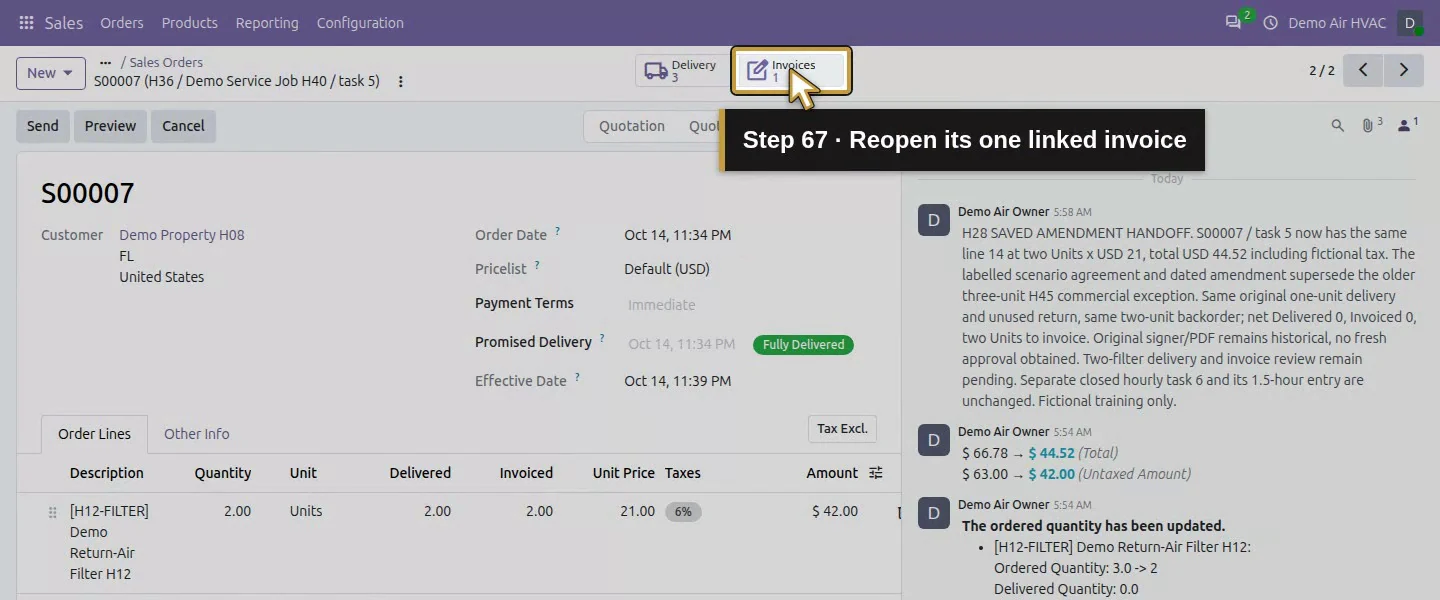
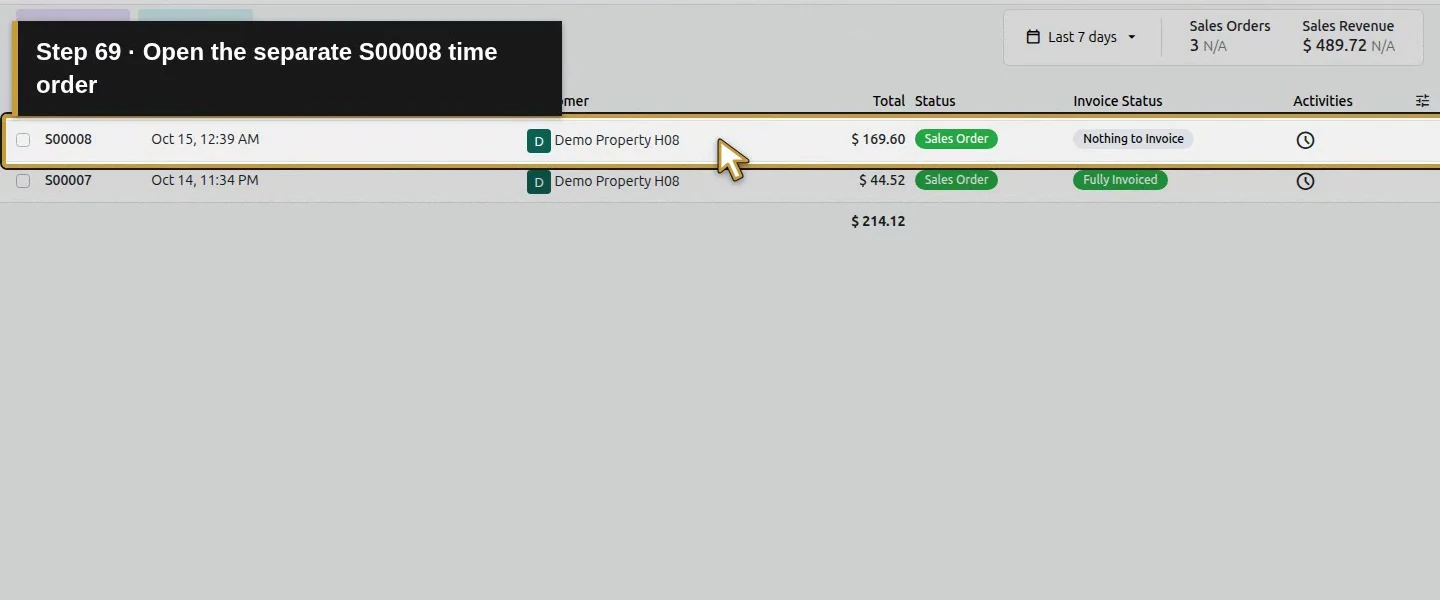
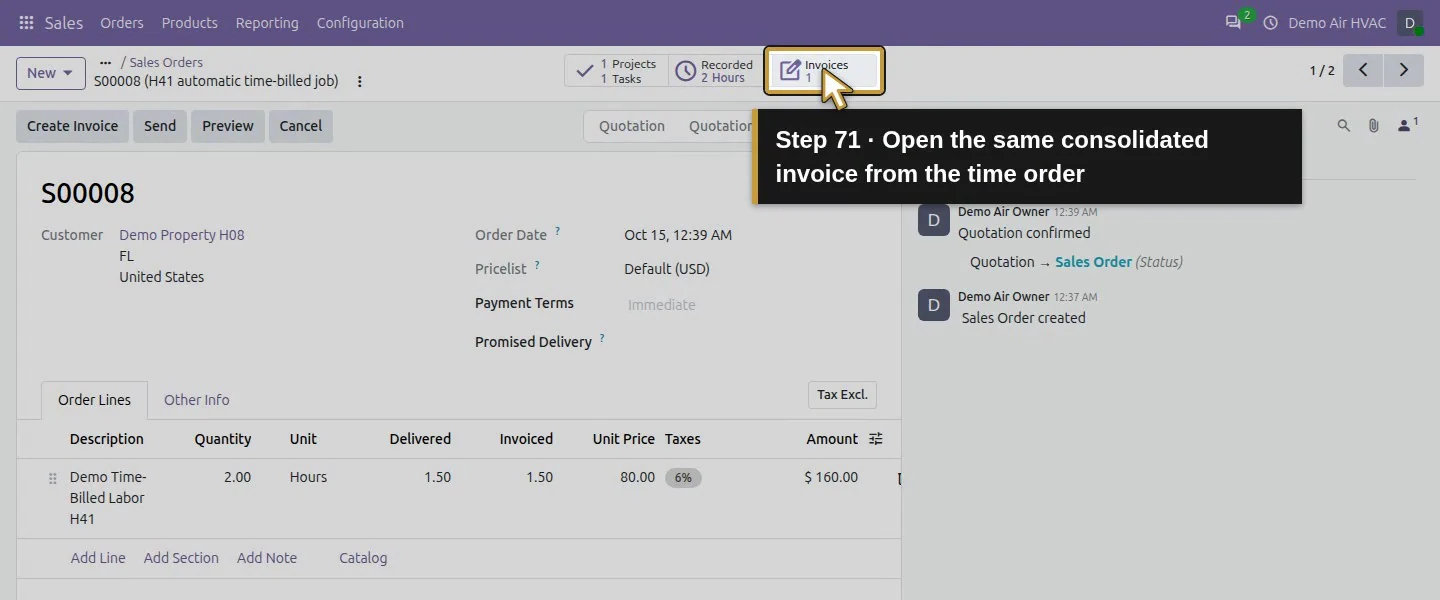
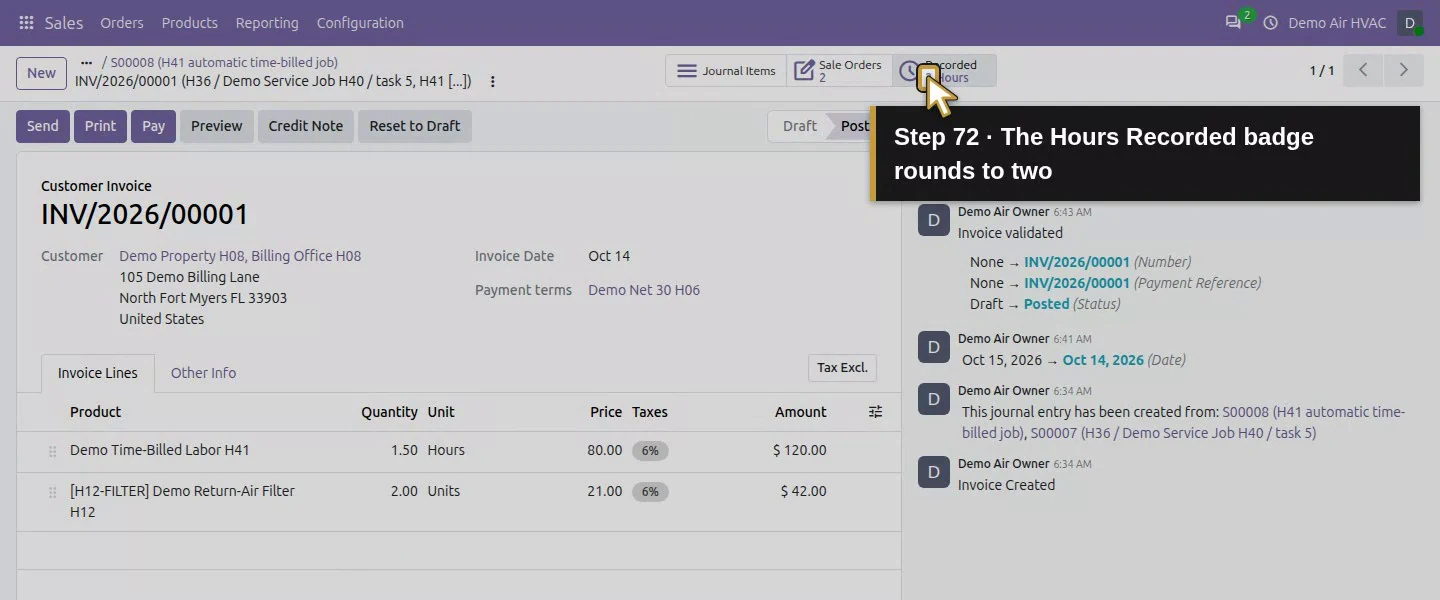
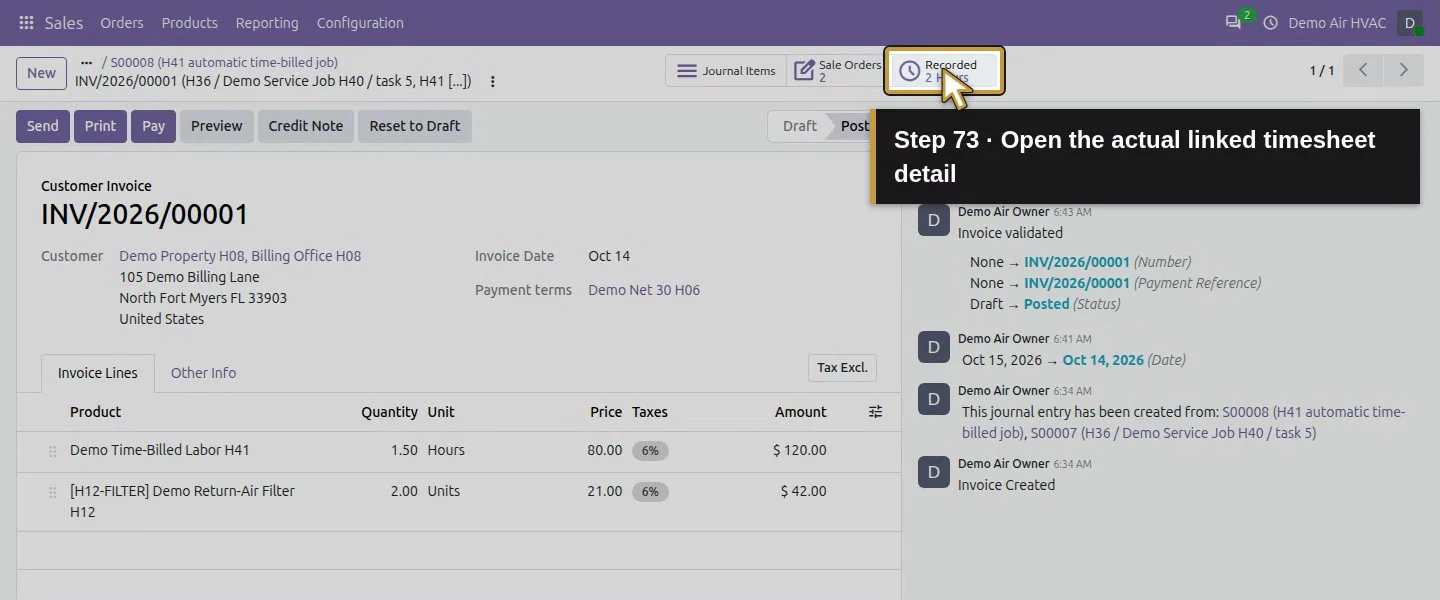
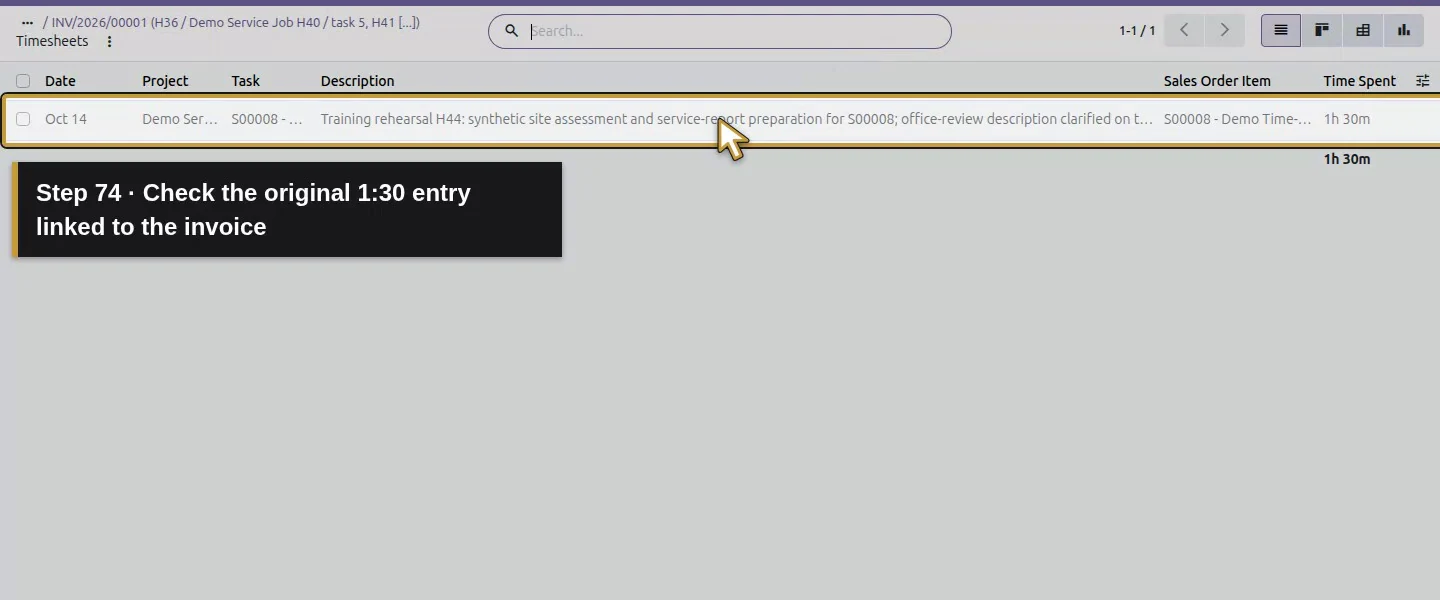
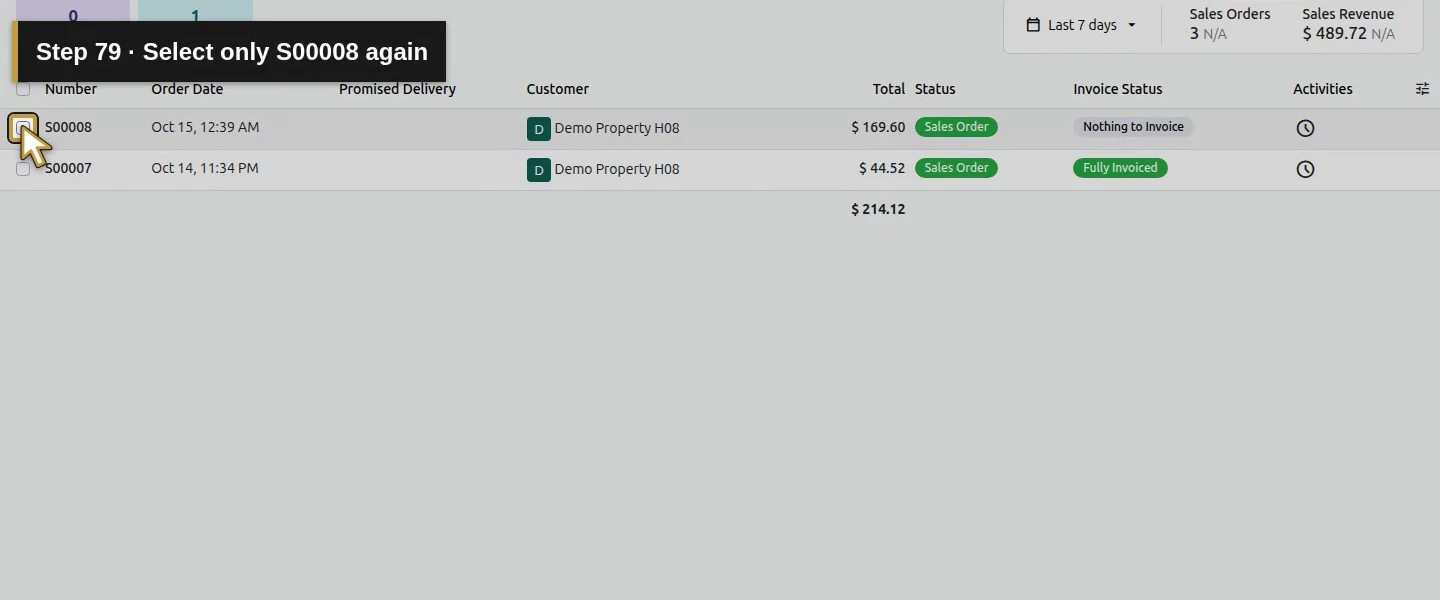
Use 2 Sale Orders to inspect the two source records. Both link to the same invoice. The goods line has Delivered/Invoiced 2.00/2.00, zero left to invoice and Fully Invoiced status. The time line has Delivered/Invoiced 1.50/1.50, zero left to invoice and Nothing to Invoice status in this runtime. The original two-hour estimate remains. The same time entry now links to the posted invoice; no duplicate timesheet was created.
Step 10. Reopen the invoice and preserve its unpaid boundary
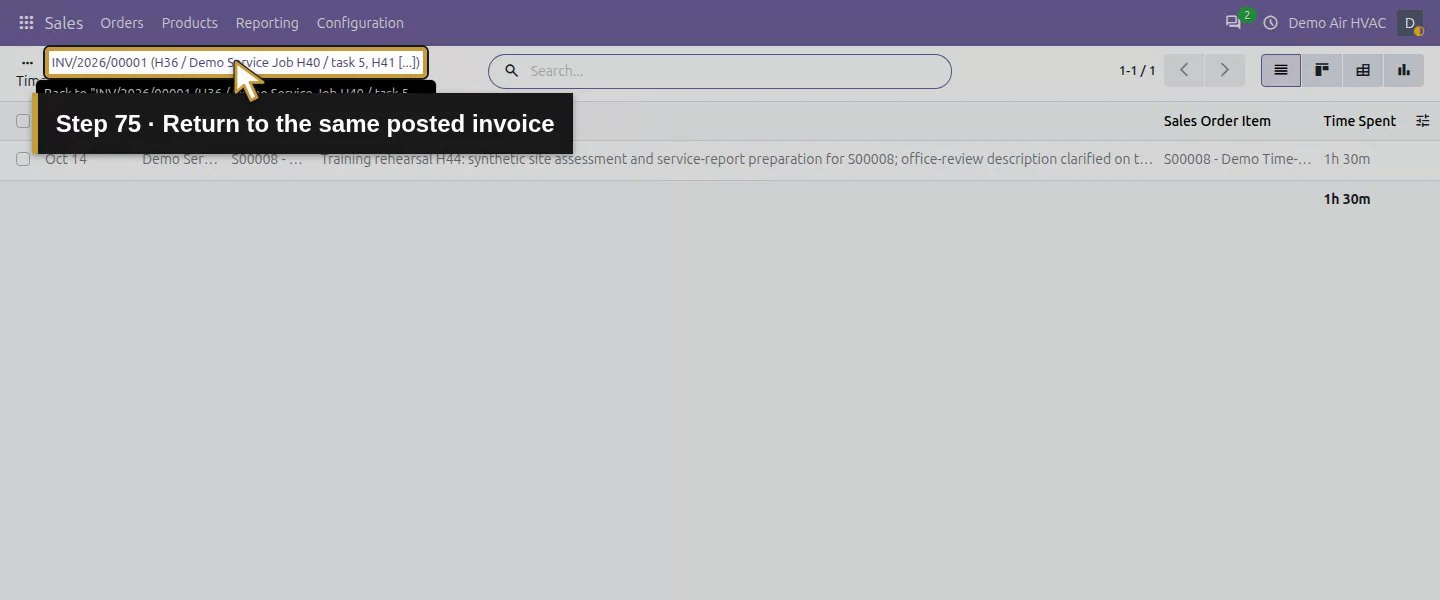
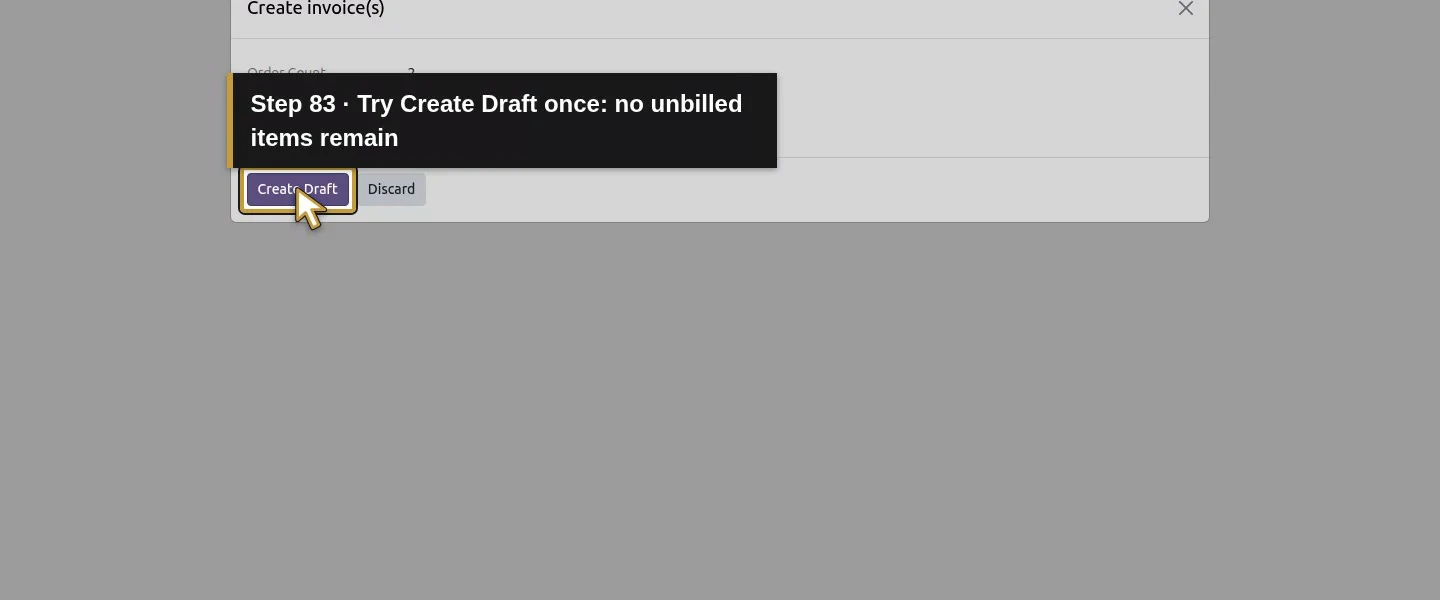
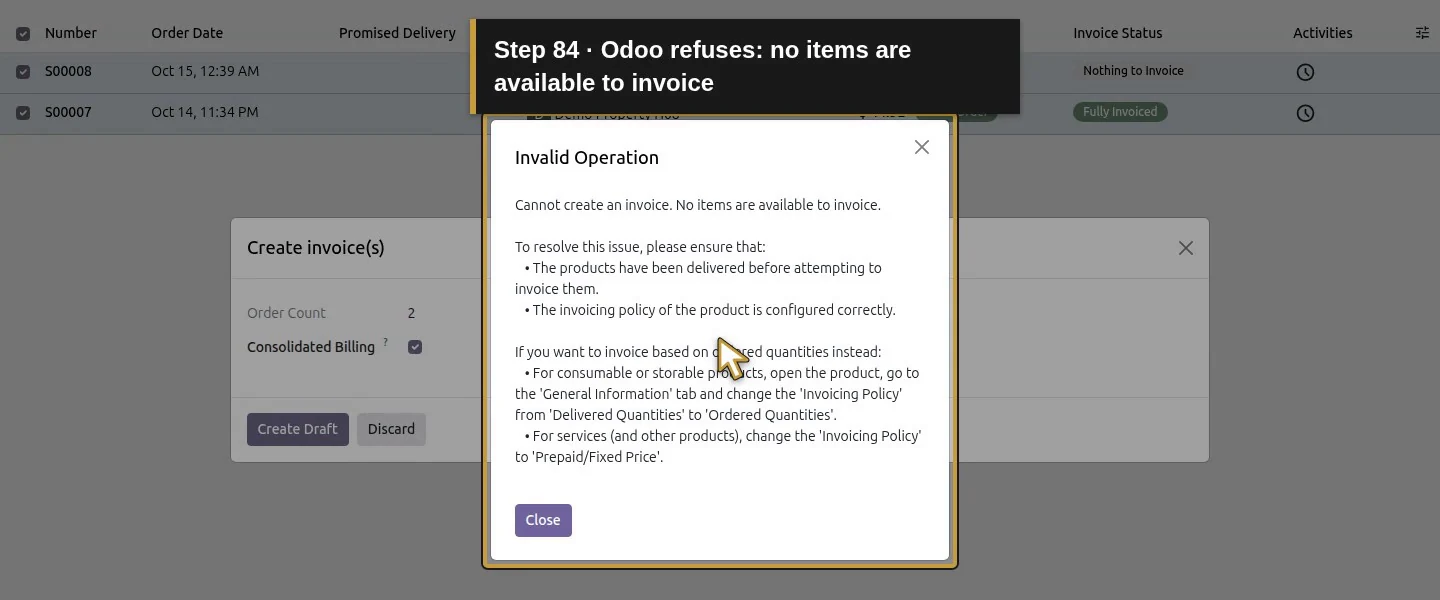
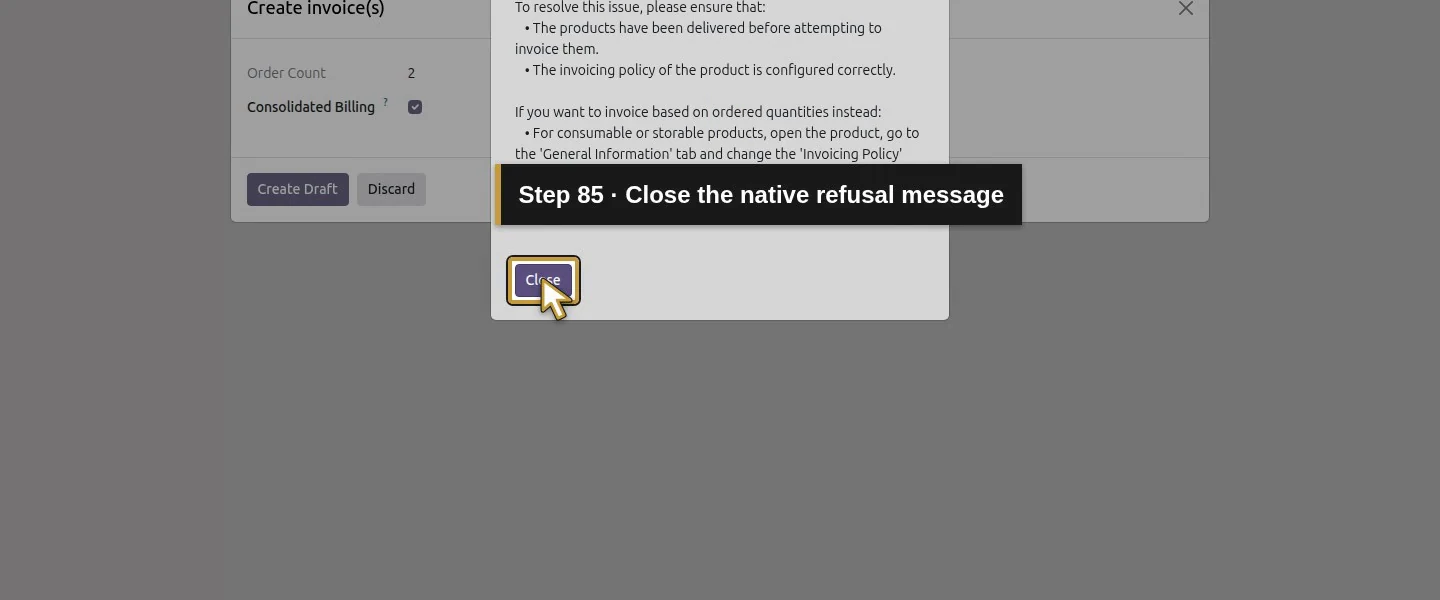
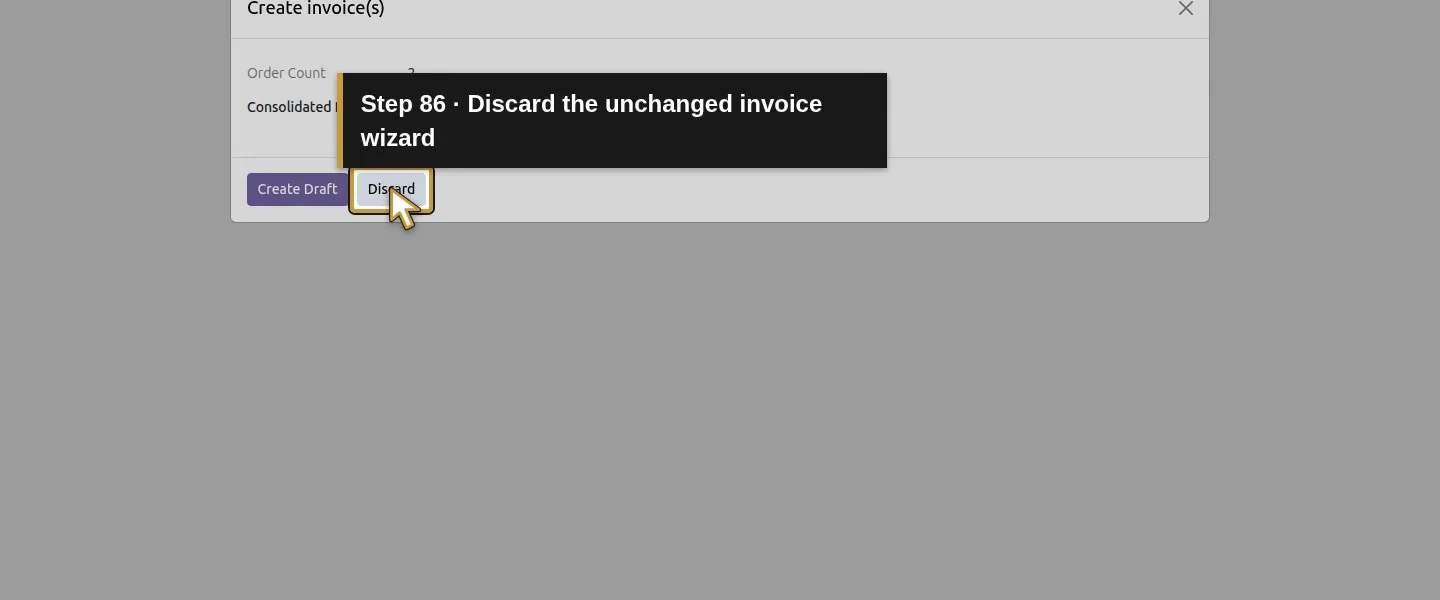
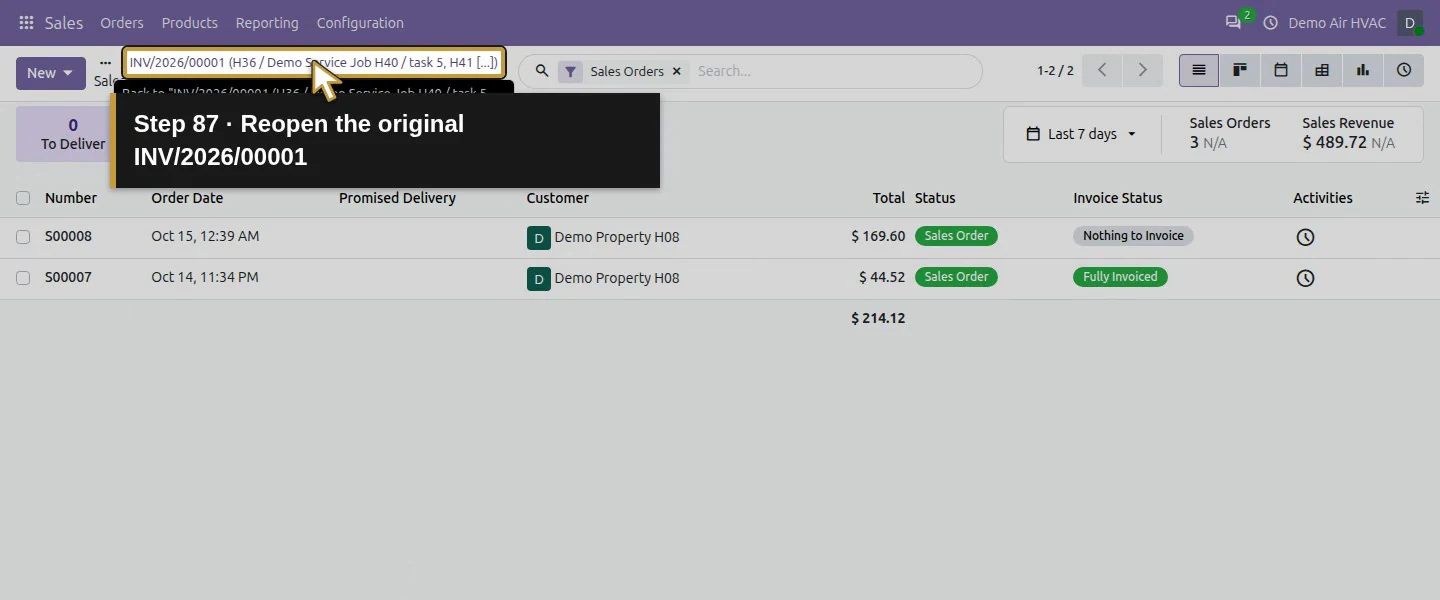
Return to INV/2026/00001 and reload. Check the same two lines, source links, due date and full unpaid balance. A controlled native repeat of Create Draft for those same billed orders was refused with No items are available to invoice; the invoice count stayed one and its original line IDs remained. Reopening also kept one invoice. Pay, Send and Credit Note are separate actions; this lesson used none of them.
Check the result
One posted Customer Invoice, INV/2026/00001, contains 1.5 Hours at $80 and two filters at $21, with $162 untaxed, $9.72 demo tax and $171.72 total/residual unpaid. It retains both order and exact sale-line links, Billing Office H08 and Service Site H08, invoice date October 14 and Net 30 due date November 13. Both source lines have zero quantity currently left to invoice. The original time record links to this invoice, and a duplicate attempt was refused without creating another invoice. The actual one-page PDF was downloaded and visually checked. The goods backorder is completed; the broader manual service task remains under review, the hourly task stays Done, and prior finance/order records are preserved.
If your screen differs
This consolidated result was tested for two eligible orders with the same company, customer/billing address and USD. Different customers, currencies or grouping cases were not tested. The material product uses Ordered quantities: it was already invoiceable before delivery, and we deliberately completed/reviewed the actual remaining delivery first. The hourly product uses Based on Timesheets; its two-hour estimate did not become two billed hours. The Hours Recorded badge rounds to 2, so check detailed time and the invoice’s 1.50 quantity. The time order showed Nothing to Invoice after billing its current hours; the goods order showed Fully Invoiced. If the no-items error occurs, check already billed quantities and source links before changing product policy. Date-period filtering, invoice email delivery, payment collection, bank settlement, credits and refunds remain separate workflows. The 6% rate, prices, agreement, account and work evidence are fictional examples.
Frequently asked questions
How do I invoice timesheets and materials in Odoo?
Review the correct time-based sales line, actual employee time, material order, delivery/returns and invoicing policies. Select only the eligible orders and compare the native draft with those records. This test posted one invoice with 1.5 actual-time Hours and two reviewed filters, exact source links and a $171.72 unpaid balance.Can I combine Odoo sales orders into one invoice?
This native test selected two reviewed orders for the same customer, billing contact, company and USD, then used Create Invoices → Consolidated Billing → Create Draft. Odoo created one invoice retaining both order references and the intended sale-line links. Other customer/currency/grouping combinations were not tested, and consolidation did not automatically merge all written scope notes.
Why are my Odoo timesheet hours missing from an invoice?
Check the service policy, confirmed order and correct task/sales-line link, actual eligible time, any Timesheets Period selection and quantities already invoiced. Here the Based on Timesheets line supplied 1.5 hours; the two-hour estimate and rounded hours badge were not the exact billable quantity. After posting, those hours had zero left to invoice and a repeated draft attempt was refused. A restricted period was not exercised.Continue building the business
Continue with How do I record full or partial customer payments in Odoo?. The posted $171.72 balance is still unpaid. Invoice-email delivery also needs its own test; printing this PDF did not establish that delivery.
Talk to an Odoo partner
Bring your current process and the result you need to Onward to plan your Odoo workflow. Talk to an Odoo partner.